Oljeversjon
 Alt om Evening







































 For kunstverk eller reproduksjoner som er større enn 105 cm (ca. 41 tommer) på noen side, vil rammen bli sendt som et sett som må monteres. Denne metoden sikrer trygg levering og forhindrer skader under transport.


Edvard Munch's "Evening": A Study in Melancholy and Solitude
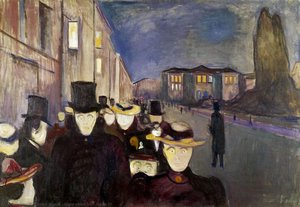
Edvard Munch’s “Evening,” painted in 1888, is an early work that foreshadows the artist’s later explorations of psychological depth and emotional intensity. This piece, housed within the Museo Nacional Thyssen-Bornemisza, offers a poignant glimpse into Munch's developing style as he transitioned from Impressionism towards Expressionism. The painting depicts a solitary figure, believed to be his sister Laura, seated in profile against a backdrop of a Norwegian fjord at dusk.
Style and Technique
“Evening” showcases a blend of Impressionistic techniques with emerging Symbolist tendencies. While the brushstrokes are looser than those found in purely academic works, they still retain a degree of naturalism in depicting the landscape. However, Munch’s use of color is far from objective; he employs dark, muted tones—primarily blues, greens, and browns—to evoke a sense of melancholy and introspection. The composition itself contributes to this mood: Laura's placement on the left side of the canvas, partially obscured and truncated, emphasizes her isolation. The original painting included two additional figures which Munch later removed, further amplifying the feeling of solitude.
Historical Context and Influences
Created during a period of significant artistic change in the late 19th century, “Evening” reflects a broader shift away from traditional representational art. Artists were increasingly interested in exploring subjective experiences and expressing inner emotions rather than simply depicting external reality. Munch was influenced by Symbolism and early Expressionist ideas, which sought to convey psychological states through symbolic imagery and distorted forms. The painting’s somber atmosphere aligns with the growing sense of alienation and anxiety that characterized modern life during this era.
Symbolism and Emotional Impact
The symbolism within “Evening” is subtle yet powerful. Laura's gaze directed towards the distant fjord suggests a longing or contemplation, while her detached posture conveys a profound sense of solitude. The darkening sky and tranquil waters contribute to an overall atmosphere of quiet melancholy. Munch’s choice to eliminate other figures from the scene underscores this feeling of isolation, drawing the viewer’s attention solely to Laura's introspective state. The painting resonates with viewers because it taps into universal human experiences of loneliness, reflection, and the passage of time.
A Precursor to Munch's Masterpieces
“Evening” serves as a crucial stepping stone in Munch’s artistic development, foreshadowing many of the themes and stylistic elements that would define his later masterpieces, including “The Scream.” It demonstrates his early mastery of conveying complex emotions through color, composition, and subtle symbolism. Owning a reproduction of this work allows one to appreciate not only its inherent beauty but also its significance within the broader context of modern art history.
Spørsmål og svar
Er Evening malt for hånd eller er det et trykk?
Håndmalt: en utdannet kunstner kopierer Evening i olje på linlerret.
Hvilken størrelse bør jeg velge for Evening?
Størrelsene varierer fra 27.2 x 36.7 cm (Nkr1859) til 181.4 x 244.4 cm (Nkr15248); tabellen på denne siden viser de viktigste alternativene og deres priser.
Hvor lang tid tar leveringen?
Levering tar 4 til 5 uker med gratis ekspressfrakt over hele verden; en mulighet for hurtigproduksjon tilbys på denne siden. Du kan returnere varen innen 100 dager for full refusjon, uten betingelser.
Hvor befinner originalen av Evening seg?
Originalen er i samlingen til Thyssen-Bornemisza-museet, Madrid.
Hvilket medium brukte Edvard Munch for Evening?
Oil On Canvas
 Forhåndsvisning

 Send
 Del
 Vis detaljer
 Faktablad


 Last ned bilde
 Liknende objekter
 Røntgenundersøkelse
 Lysbildefremvisning
 Spørsmål og svar

 Statistikk