
 Forhåndsvisning
 Send
Send Del
Del
 Vis detaljer
 Utskriftsvennlig guide

 Last ned bilde
 Liknende objekter
 Røntgenundersøkelse
 Lysbildefremvisning
 Q&A
Q&A Statistikk
Sketch for the play

- 30.0 x 30.0 cm


 Vis hele teksten
Giclée / Kunsttrykk
Giclée- eller lerretsprint av museumskvalitet med rask produksjon og fleksible valgmuligheter for etterbehandling. ( Kjøp håndmalt maleri Bytt til digitalt bilde)




P118B Nkr10

P118H Nkr10

P118W Nkr10

P438Z Nkr10

P508JH Nkr12

P508YH Nkr12

P805H Nkr10

P805Z Nkr10

P919BZ Nkr10

P919G Nkr10

P919XJ Nkr10

P959ZH Nkr10

P968JZ Nkr12

W106C Nkr8

W218G Nkr10

W218JH Nkr8

W218Y Nkr10

W307PJ Nkr10

W316G Nkr10

W316PJ Nkr8

W316Y Nkr10

W398PJ Nkr8

W4111J Nkr10

W500HY Nkr15

W500JH Nkr15

W692G Nkr12

W849H Nkr8

W940BG Nkr15

W953PJ Nkr8




Velg mellom våre forhåndsdefinerte størrelser som bevarer kunstverkets opprinnelige proporsjoner.

Skriv inn ønsket bredde og høyde for å tilpasse trykket til din ramme eller vegg. Et trykk kan kun beskjæres, aldri skaleres opp utover motivets opprinnelige størrelse, noe som betyr at et format med andre proporsjoner vil føre til tap av deler av bildet. Vi sender deg en digital mockup for godkjenning før vi starter trykkeprosessen. Bildet som vises på denne siden viser ikke den faktiske beskjæringen — det er kun mockuppen som viser dette.
Verdensomspennende levering () på 2 uker i stedet for standard 4/5 uker. (3 November)

Gratis ekspressfrakt over hele verden

Lerretsduk av lin av høy kvalitet

Full transportforsikring

Garanti for refusjon av toll og importavgifter

Garantert fargegjengivelse

100 dagers returrett ved fabrikasjonsfeil

100% pengene tilbake-garanti

Rabatt ved flere kjøp
 Glassalternativet er kun tilgjengelig i størrelser under 110 cm

Sketch for the play
Giclée / Kunsttrykk
Størrelse på reproduksjon
-


Totalpris for valgte alternativer
Nkr 769
David Kakabadze’s ‘Sketch for the Play’: A Window into Georgian Modernism
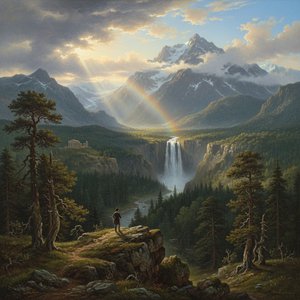
David Kakabadze's “Sketch for the Play,” painted in 1947, isn’t merely a depiction of a mountainous landscape; it’s a vibrant portal into the heart of Georgian modernism. Born in the remote village of Kukhi near Khoni, Kakabadze’s life was one of profound transformation, shifting from rural simplicity to the bustling intellectual circles of St. Petersburg University and the avant-garde fervor of Paris. This painting embodies that journey – a synthesis of his native Georgian traditions with the burgeoning influences of European artistic movements like Expressionism and Cubism. The work immediately commands attention not through photographic realism, but through an intensely emotional response; it’s a landscape imbued with a palpable sense of drama, urgency, and perhaps even melancholy.
The scene itself is dominated by a colossal wooden structure – a bridge or some other significant architectural element – that pierces the dramatic sky. Mountains loom in the background, rendered not as serene vistas but as imposing, almost threatening forms. The color palette is deliberately cool: deep blues and grays dominate, punctuated by flashes of ochre and burnt umber. This restrained use of color contributes to a feeling of atmospheric depth and creates an unsettling tension within the composition. Kakabadze masterfully employs impasto – thick, textured brushstrokes – particularly evident in the foreground elements, lending a tactile quality to the scene and drawing the viewer’s eye into its depths.
A Pioneer of Georgian Modernism: Context and Influences
Kakabadze's artistic trajectory is remarkable. Initially trained as a natural scientist, he was drawn to art through the patronage of local philanthropists who secured him an education in St. Petersburg. This exposure to Western European movements – particularly Cubism’s fragmentation of form and Fauvism’s bold use of color – profoundly shaped his approach. However, Kakabadze never abandoned his Georgian roots. He sought to fuse these foreign influences with the rich traditions of his homeland, creating a uniquely Georgian modern style. His work reflects a deep engagement with Georgian folklore, mythology, and landscape, often imbued with symbolic meaning.
The painting’s creation occurred during a pivotal moment in Georgian history – the interwar period following the Russian Revolution. Georgia was navigating a complex political landscape, grappling with Soviet influence while striving to maintain its cultural identity. Kakabadze's art became a powerful expression of this struggle, reflecting both the anxieties and aspirations of his time. His work served as a bridge between the old world of Georgian tradition and the uncertain promise of the new.
Symbolism and Emotional Resonance
Beyond its formal qualities, “Sketch for the Play” is rich in symbolic interpretation. The imposing wooden structure could represent both progress and constraint – a symbol of human ambition reaching towards the heavens while simultaneously grounding itself in the earth. The turbulent sky suggests conflict, uncertainty, and perhaps even impending doom. The solitary figure on the left side of the composition adds another layer of complexity, hinting at contemplation, observation, or perhaps a sense of isolation within this dramatic landscape.
Kakabadze’s use of light and shadow is particularly effective in creating an emotional atmosphere. The strong contrasts between illuminated areas and deep shadows heighten the drama and contribute to the painting's overall sense of unease. The viewer isn’t simply observing a scene; they are invited to experience it – to feel the weight of the mountains, the chill of the wind, and the uncertainty of the future.
Bringing Kakabadze’s Vision Home: Reproduction Options
A high-quality reproduction of “Sketch for the Play” offers a captivating addition to any interior space. OriginalUniqueArt.com provides exceptional reproductions that faithfully capture the artist's original vision, utilizing archival-quality materials and printing techniques to ensure lasting beauty and vibrancy. Whether you’re drawn to its evocative atmosphere, its symbolic depth, or simply its striking visual impact, this painting remains a testament to David Kakabadze’s genius and a window into the heart of Georgian modernism. Consider a standard size for immediate impact, or explore custom dimensions to perfectly complement your space.
Spørsmål og svar
Når ble "Sketch for the play" skapt, og hvilken kunstretning tilhører den?
"Sketch for the play" ble laget i 1947, innenfor Expressionist Modernism-retningen.
Kan jeg undersøke "Sketch for the play" mer detaljert?
Røntgenvisningen av "Sketch for the play" av David Kakabadze finnes på verkets Røntgenstråling-side: en interaktiv undersøkelse av bildet gjennom elleve optiske lag.
Hvilke proporsjoner har "Sketch for the play" av David Kakabadze, og hva er målene?
Formatet på "Sketch for the play" er Square, og originalen måler 30 x 30 cm. Begge deler er nyttige når man planlegger en reproduksjon.
Om kunstneren
A Pioneer of Georgian Modernism: The Life and Art of David Kakabadze
David Kakabadze, born in the village of Kukhi near Khoni, Georgia, in 1889, stands as a pivotal figure in the development of twentieth-century Georgian art. His career was one of remarkable innovation, seamlessly blending the burgeoning currents of European avant-garde movements with a deep reverence for his native Georgian traditions. Kakabadze wasn’t merely an artist; he was a polymath – a painter, graphic artist, scenic designer, art scholar, cinematic innovator, and even an amateur photographer. This multifaceted approach to creativity defined his artistic journey and cemented his legacy as one of Georgia's most important modernist masters. His early life, though rooted in the simplicity of a peasant family, was marked by intellectual curiosity fostered through sponsorship that allowed him to pursue studies at St. Petersburg University, graduating with a degree in natural sciences in 1916. Simultaneously, he honed his artistic skills under Dmitroyev-Kavkazsky and immersed himself in the study of Georgia’s rich artistic heritage. This dual education – scientific rigor combined with artistic sensitivity – would become a hallmark of his work.Parisian Encounters and Artistic Transformation
Following a brief period teaching and painting in Tbilisi, Kakabadze embarked on a transformative chapter of his life in Paris from 1919 to 1927. This sojourn placed him at the epicenter of the European avant-garde, exposing him to Cubism, Futurism, and other radical artistic experiments. He actively participated in exhibitions with the Société des Artistes Indépendants, forging connections with fellow Georgian artists Lado Gudiashvili and Shalva Kikodze. It was during this period that Kakabadze’s style underwent a dramatic evolution. Initially captivated by the landscapes of his native Imereti province – particularly the ethereal beauty of misty mountains and shimmering lakes – he began to explore “subjectless painting,” experimenting with unconventional materials like metal, mirror glass, and stained glass in place of traditional paints. This exploration wasn't merely about technical innovation; it was a quest to redefine the very essence of pictorial representation. He delved deeply into Cubism, absorbing its fragmented forms and analytical approach, yet always maintaining a distinct artistic voice that prevented his work from becoming mere imitation. His theoretical writings during this time, published in Parisian art journals, demonstrate a profound engagement with the intellectual underpinnings of modern art, establishing him as a thought leader within the modernist community. He meticulously dissected visual perception, questioning established conventions and advocating for new ways of perceiving and interpreting reality—a stance that foreshadowed many developments in subsequent artistic movements.Innovation Beyond the Canvas: Cinema and Stage Design
Kakabadze’s inventive spirit extended far beyond painting. Recognizing the potential of new technologies, he began experimenting with cinema in the early 1920s, driven by a desire to overcome what he perceived as film's inherent limitations. He envisioned a cinematic experience that transcended conventional viewing, aiming for an immersive illusion akin to theatrical spectacle. Driven by this ambition, he designed and patented a stereoscopic film projector that created the illusion of three-dimensionality without the need for glasses – a remarkable feat of engineering and artistic vision that positioned him as a pioneer of 3D cinema decades before it became mainstream. This inventive streak also manifested in his stage designs, particularly during his collaboration with the renowned Georgian theatre director Kote Marjanishvili after returning to Georgia in 1927. His sets were not merely backdrops but immersive environments incorporating innovative techniques like projections, light effects, and collage-like constructions—a bold departure from traditional theatrical aesthetics. He created impressive set designs for films by Noutsa Gogoberidze and Michail Kalatosov, transforming the theatrical experience into a dynamic interplay of space and illusion.Return to Georgia and Enduring Legacy
Kakabadze’s return to Georgia in 1927 coincided with the rise of Soviet power and the imposition of Socialist Realism as the dominant artistic style. This presented a significant challenge for an artist whose work was deeply rooted in abstraction and experimentation. While he continued to contribute to Georgian art through stage design, documentary filmmaking focused on preserving cultural heritage, and teaching at the Tbilisi State Academy of Arts—a testament to his unwavering dedication to artistic principles—his modernist inclinations increasingly clashed with the prevailing ideological demands. Despite facing pressure and eventual marginalization, Kakabadze remained committed to his artistic vision. His later landscapes retained a unique sensibility informed by his earlier explorations, reflecting both the grandeur of Georgian nature and the subtle nuances of personal observation. David Kakabadze passed away in 1952, leaving behind a body of work that was largely overlooked for decades. However, in recent years, there has been a growing recognition of his importance as a key figure in Georgian modernism and a significant contributor to the broader European avant-garde movement. His innovative spirit, intellectual depth, and unwavering commitment to artistic exploration continue to inspire artists today, ensuring his enduring legacy as a true visionary.Key Works and Collections
Some of Kakabadze’s most notable works include Sailboats, Bretagne, and Sketch for Getting Various Grades of Light in a Single Electric Bulb. These pieces exemplify his ability to synthesize European artistic trends with Georgian cultural identity. His work can be found in prominent collections around the world, including the Art Palace of Georgia – Museum of Cultural History in Tbilisi, the Berardo Collection Museum in Lisbon, and the Thyssen-Bornemisza Museum in Madrid. Furthermore, a significant collection of his early works resides at Yale University, testament to his international recognition during his lifetime.
David Kakabadze
1889 - 1952 , Georgia
Kort om kunstneren
- Artistic Movement Or Style: Avant-garde, Cubism
- Artists Or Movements Influenced By This Artist: ['Numerous artists']
- Date Of Birth: August 20, 1889
- Date Of Death: 1952
- Full Name: David Kakabadze
- Nationality: Georgian
- Notable Artworks:
- Sailboats
- Bretagne
- Sketch for getting…
- Place Of Birth: Kutaisi, Georgia
Relaterte artikler

Evocations of Place: A Historical Journey Through Landscape Art
Explore the rich history of landscape art with OriginalUniqueArt. Discover renowned artists, movements like Impressionism & Romanticism, and expert guidance for collecting timeless pieces. Find your perfect serene escape today!

John Constable: Topp 25 Maler – Engelsk Landskapskunst i Ditt Hjem
Opplev John Constables 25 mest ikoniske malerier! Fordyp deg i engelsk romantikk, landskapskunst og atmosfæriske scener. Finn museumskvalitets reproduksjoner & interiørinspirasjon på OriginalUniqueArt.com. Utforsk samlingen online!

Romantiske landskap: Topp 10 mesterverk for hjemmet – Kunst fra OriginalUniqueArt.com
Oppdag de 10 mest ikoniske romantiske landskapsmaleriene! Fra Caspar David Friedrich til Turner – utforsk kunsthistorien, stemningen og fargepalettene. Finn museumskvalitets reproduksjoner på OriginalUniqueArt.com.
Evoking Nature's Sublime: A Comprehensive Exploration of 19th-Century Landscape Painting
Explore the captivating world of 19th-century landscape painting! Discover renowned artists like Friedrich & Monet, key movements, and find the perfect artwork to bring nature's serenity into your home. Expert insights at OriginalUniqueArt.

David Cox the Elder: Landscape, Light & the Romantic Vision of Rural England
Explore the captivating landscapes of David Cox the Elder, a pivotal figure in British Romanticism. Discover his masterful watercolour techniques, enduring legacy & find timeless art for your home at OriginalUniqueArt.
