
 Forhåndsvisning
 Send
Send Del
Del
 Vis detaljer
 Utskriftsvennlig guide

 Last ned bilde
 Liknende objekter
 Røntgenundersøkelse
 Lysbildefremvisning
 Spørsmål og svar
 Statistikk
Metropolis

- 239.0 x 548.0 cm


 Vis hele teksten
Kunstverket som vises på denne siden er beskyttet av opphavsretten, noe som betyr at vi ikke har juridisk tillatelse til å lage eller selge identiske reproduksjoner. Denne beskyttelsen håndheves i henhold til internasjonale avtaler som for eksempel Bernerkonvensjonen og av nasjonale lover, inkludert de som er fastsatt i Amerikansk lov om opphavsrett – Tittel 17.
Denne metoden er i fullt samsvar med opphavsrettslige regler, da den ikke innebærer kopiering eller duplisering av det beskyttede kunstverket. I stedet er det snakk om en kreativ nytolkning – et nytt maleri som er inspirert av originalen, men ikke identisk med den.
Giclée / Kunsttrykk
Giclée- eller lerretsprint av museumskvalitet med rask produksjon og fleksible valgmuligheter for etterbehandling. ( Kjøp håndmalt maleri Bytt til digitalt bilde)




P118B Nkr10

P118H Nkr10

P118W Nkr10

P438Z Nkr10

P508JH Nkr12

P508YH Nkr12

P805H Nkr10

P805Z Nkr10

P919BZ Nkr10

P919G Nkr10

P919XJ Nkr10

P959ZH Nkr10

P968JZ Nkr12

W106C Nkr8

W218G Nkr10

W218JH Nkr8

W218Y Nkr10

W307PJ Nkr10

W316G Nkr10

W316PJ Nkr8

W316Y Nkr10

W398PJ Nkr8

W4111J Nkr10

W500HY Nkr15

W500JH Nkr15

W692G Nkr12

W849H Nkr8

W940BG Nkr15

W953PJ Nkr8




Velg mellom våre forhåndsdefinerte størrelser som bevarer kunstverkets opprinnelige proporsjoner.

Skriv inn ønsket bredde og høyde for å tilpasse trykket til din ramme eller vegg. Et trykk kan kun beskjæres, aldri skaleres opp utover motivets opprinnelige størrelse, noe som betyr at et format med andre proporsjoner vil føre til tap av deler av bildet. Vi sender deg en digital mockup for godkjenning før vi starter trykkeprosessen. Bildet som vises på denne siden viser ikke den faktiske beskjæringen — det er kun mockuppen som viser dette.
Verdensomspennende levering () på 2 uker i stedet for standard 4/5 uker. (4 November)

Gratis ekspressfrakt over hele verden

Lerretsduk av lin av høy kvalitet

Full transportforsikring

Garanti for refusjon av toll og importavgifter

Garantert fargegjengivelse

100 dagers returrett ved fabrikasjonsfeil

100% pengene tilbake-garanti

Rabatt ved flere kjøp
 Glassalternativet er kun tilgjengelig i størrelser under 110 cm

Metropolis
Giclée / Kunsttrykk
Størrelse på reproduksjon
-


Totalpris for valgte alternativer
Nkr 774
A City’s Fever Dream: Zaha Hadid's ‘Metropolis’
Zaha Hadid’s “Metropolis,” painted in 1988, isn’t merely a cityscape; it’s a visceral representation of urban anxiety and the relentless expansion of modern life. Created during a pivotal period of her architectural career – a time when she was forging a radical new aesthetic that defied conventional spatial thinking – the painting captures a frenetic energy rarely found in traditional cityscapes. It's a work brimming with dynamism, a fever dream rendered in acrylic on canvas, and a surprisingly intimate reflection on the complexities of urban existence.
Hadid’s early artistic explorations were deeply rooted in mathematics and geometry, disciplines she approached with an almost obsessive precision. This intellectual rigor is immediately apparent in “Metropolis.” The city isn't presented as a harmonious whole but rather as a fractured mosaic of interconnected villages, each pulsating with its own distinct rhythm. These individual units – rendered in varying shades of red, ochre, and yellow – seem to be vying for dominance, creating a sense of chaotic competition. The River Thames, a vital artery of London, is depicted as a vibrant orange streak, acting as both a divider and a connector between these disparate zones.
Deconstructing the Metropolis: Style and Technique
The painting’s style is undeniably deconstructivist, anticipating many of the principles that would later define Hadid's architectural designs. The sharp angles, fragmented forms, and deliberate distortions challenge traditional notions of perspective and spatial coherence. Unlike a realistic depiction, “Metropolis” prioritizes emotional impact over photographic accuracy. Hadid employs bold brushstrokes and layered colors to build up texture and create a sense of movement—as if the city itself is constantly shifting and evolving.
Technically, the painting showcases Hadid’s early experimentation with acrylic on canvas. The medium lends itself beautifully to her fluid, dynamic style, allowing for both precise detailing and broad washes of color. Notice how she uses layering – building up colors in thin glazes—to create a luminous quality and suggest depth within the fragmented composition. The deliberate use of red isn’t simply decorative; it's symbolic, representing the intensity, urgency, and even the potential danger inherent in urban life.
Symbolism and Emotional Resonance
“Metropolis” is rich with symbolism, offering a commentary on the social and psychological pressures of modern city living. The prevalence of red—often associated with fire, passion, and conflict—suggests a simmering tension beneath the surface of the urban landscape. The individual villages represent not just physical spaces but also distinct communities, each grappling with its own challenges and aspirations. The painting subtly critiques the homogenization of urban experience, highlighting the fragmentation and isolation that can arise within densely populated areas.
Despite its somewhat unsettling depiction, “Metropolis” is ultimately a powerful and evocative work. It’s not simply a portrayal of London; it's an exploration of the human condition—our desire for connection, our struggles with identity, and our constant negotiation with the overwhelming forces of urban life. The painting invites viewers to contemplate their own relationship to the city, prompting questions about its beauty, its chaos, and its enduring allure.
A Legacy in Reproduction
Today, “Metropolis” stands as a testament to Zaha Hadid’s visionary talent and her profound impact on contemporary art and architecture. High-quality reproductions capture much of the original's dynamism and emotional intensity, offering a compelling addition to any collection or interior space. When selecting a reproduction, consider the materials used – archival quality prints on canvas or fine art paper will ensure that the colors remain vibrant for years to come, preserving the essence of this remarkable work.
Spørsmål og svar
Kan man se en lysbildefremvisning av "Metropolis" av Zaha Hadid?
Du kan se diaporamabildet av "Metropolis" på verkets Bildekarusell-side.
Hva forestiller "Metropolis" av Zaha Hadid, og hvilken stemning formidler det?
"Metropolis" av Zaha Hadid skildrer cityscape, birds, red background, hadid, architecture, urban, metropolis i en Dramatic stemning. Motiv og atmosfære beskriver verket sammen.
Hva er teknikk og dimensjoner på "Metropolis" av Zaha Hadid?
Det originale verket "Metropolis" av Zaha Hadid er et Acrylic On Canvas med målene 239 x 548 cm. Teknikk og størrelse beskriver det originale objektet.
Om kunstneren
En revolusjonerende visjon: Zaha Hadids liv og ettermæle
Født i Bagdad, Irak, i 1950, trådte Dame Zaha Mohammad Hadid frem som en av vår tids mest betydningsfult arkitektoniske krefter. Hennes reise begynte ikke innenfor de tradisjonelle rammene av en kunstnerisk oppvekst, men midt i et stimulerende intellektuelt miljø; hennes far, Muhammad al-Hajj Husayn Hadid, var en vellykket industrimann og politiker, mens hennes mor, Wajiha al-Sabunji, pleiet en lidenskap for kunst. Denne unike blandingen av pragmatisme og kreativitet skulle prege den unge Zahas verdensbilde dypt. Etter å først ha studert matematikk ved American University of Beirut, oppdaget hun snart at hennes sanne kall lå innen romlig design, noe som førte henne til London i 1972 og innskriving ved Architectural Association School of Architecture. Det var her, under veiledning av innflytelsesrike skikkelser som Rem Koolhaas, Elia Zenghelis og Bernard Tschumi, at Hadids radikale arkitektoniske tenkning begynte å ta form. Disse mentorene oppmuntret til å stille spørsmål ved etablerte normer og fostret et miljø der eksperimentering og innovasjon blomstret – et fundament hun skulle bygge sin ekstraordinære karriere på.Dekonstruksjon av konvensjoner: Stil og påvirkning
Zaha Hadid designet ikke bare bygninger; hun skulpturerte opplevelser. Vidt anerkjent som en pioner innen dekonstruktivismen, forkastet hennes arbeid dristig de rigide geometriene og de konvensjonelle formene som lenge hadde definert arkitektonisk praksis. I stedet omfavnet hun fragmentering, dynamiske kurver og en følelse av flytende bevegelse, noe som skapte strukturer som virket å trosse selve tyngdekraften. Hennes design var ikke bare funksjonelle rom; de var kunstneriske ytringer – kraftfulle uttrykk for form og energi. Påvirkningen fra det tidlige 20-århundrets avantgarde-bevegelser, særlig suprematismen og arbeidet til Kazimir Malevich, er tydelig i hennes tidlige utforskninger. Faktisk fungerte hennes avgangsprosjekt, «Malevich’s Tektonik», som en kraftfull demonstrasjon av hennes forpliktelse til abstrakte prinsipper og ikke-rektilineære former. Men Hadid var ikke bare en etterligner; hun syntetiserte disse påvirkningene med sin egen unike visjon, og frigjorde arkitektonisk geometri ved å gi den en ny ekspressiv identitet. Avgjørende var det at maleri og tegning ikke bare var forberedende verktøy for Hadid – de var integrerte deler av selve designprosessen, noe som lot henne utforske romlige konsepter og visualisere komplekse former før de materialiserte seg i betong og stål.Landemerker: En global innvirkning
Hadid etablerte sitt eget kontor i London i 1980, men anerkjennelsen kom ikke lett. Hennes tidlige design ble ofte ansett som for radikale, for utfordrende for det rådende arkitektoniske klimaet. Likevel holdt hun ut, og gradvis begynte hennes innovative tilnærming å vinne terreng. Hong Kong Peak Club (1983) var en tidlig fremvisning av hennes fremvoksende stil, som antydet de pustløse strukturene som skulle følge. Gjennom de påfølgende tiårene fullførte Hadids firma en serie landemerke-prosjekter som redefinerte urbane landskap over hele verden. Disse inkluderte det flytende og dynamiske London Aquatics Centre for OL i 2012, et vitnesbyrd om hennes evne til å skape rom som inspirerer til bevegelse og atletisme; Broad Art Museum i Michigan, USA, med sin slående plisserte fasade i rustfritt stål; MAXXI – Nasjonalmuseet for 21. århundres kunst i Roma, Italia, et komplekst samspill mellom volum og tomrom; Guangzhou Opera House i Kina, som ligner to glatte småstein på Perleelven; og Heydar Aliyev Center i Baku, Aserbajdsjan, en pustløs bølgeaktig struktur som legemliggjelse av hennes signaturpregede kurvelinjære estetikk. Disse prosjektene var ikke bare bygninger – de var kulturelle ikoner som flyttet grensene for arkitektoniske muligheter.Anerkjennelse og varig innflytelse
Utmerkelsene som ble tildelt Zaha Hadid gjennom hennes karriere er et bevis på hennes ekstraordinære talent og varige innvirkning. Hun mottok en rekke priser, som kulminerte i Pritzker-prisen i 2004 – den høyeste utmerkelsen innen arkitektur – noe som gjorde henne til den første kvinnen som mottok denne prestisjetunge anerkjennelsen individuelt. Ytterligere æresbevisninger inkluderte Stirling Prize (tildelt to ganger, i 2010 og 2011), og posthumt, Royal Gold Medal fra Royal Institute of British Architects i 2016, igjen en historisk først for en kvinne. Utover sine arkitektoniske prestasjoner brøt Hadid barrierer som kvinnelig arkitekt i et historisk mannsdominert felt, og ble en inspirasjon for utallige aspirerende designere. Hennes arv strekker seg utover de fysiske strukturene hun skapte; den ligger i hennes transformative innflytelse på arkitektonisk tenkning og praksis. Selv etter hennes tidlige død i 2016, fortsetter Zaha Hadid Architects å operere, og fører videre hennes visjon og prinsipper med urokkelig dedikasjon. Hennes utforskning av kunstneriske medier utover arkitektur – som verk som «Tatlin Tower and Tectonic» – demonstrerer en unik synergi mellom designekspertise og kunstnerisk uttrykk. Zaha Hadids bygninger står som varige monumenter over hennes innovative ånd, og former det bygde miljøet for generasjoner som kommer.Utover bygninger: En varig kunstnerisk arv
Selv om hun primært feires for sine arkitektoniske bragder, strakte Zaha Hadids kreative visjon seg langt utover byggets design. Hun utforsket konsekvent kunstneriske medier som maleri og produktdesign, og så ikke på dem som separate disipliner, men som sammenhengende uttrykk for hennes unike estetiske sans. Hennes malerier, ofte karakterisert av dynamiske komposisjoner og abstrakte former, fungerte som konseptuelle utforskninger som direkte informerte hennes arkitektoniske prosjekter. Disse verkene var ikke bare skisser eller representasjoner; de var integrerte i utviklingen av hennes ideer, noe som lot henne eksperimentere med romlige relasjoner og visuelle teksturer før de ble oversatt til tredimensjonale strukturer.- Tidlige malerier: Hennes tidlige malerier, som «Orange Explosion on White», viser en fascinasjon for fragmenterte former og vibrerende farger, noe som varslet de dekonstruktivistiske prinsippene som skulle definere hennes arkitektoniske stil.
- Designobjekter: Hadid beveget seg også inn i produktdesign og skapte møbler, belysningsarmaturer og andre objekter som ekkoet de flytende linjene og de skulpturelle kvalitetene i hennes bygninger. Chanel Mobile Art Pavilion i Tokyo er et fremragende eksempel på denne tverrfaglige tilnærmingen, og viser hennes evne til å oversette arkitektoniske konsepter til et bærbart, oppslukende miljø.
- Konseptuelle utforskninger: Verk som «Interpretation of Tatlin» avslører hennes engasjement for historiske avantgarde-bevegelser og hennes ønske om å refortolke modernistiske prinsipper i en samtidskontekst.
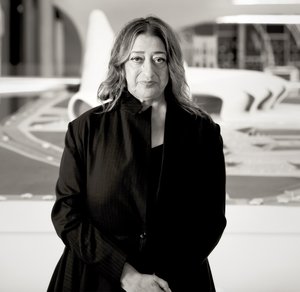
Zaha Hadid
1950 - 2016 , Irak
Kort om kunstneren
- Artistic Movement Or Style: Dekonstruktivisme
- Artists Or Movements Influenced By This Artist: ['Suprematisme']
- Artists Who Influenced This Artist:
- Kazimir Malevich
- Rem Koolhaas
- Date Of Birth: 31 oktober 1950
- Date Of Death: 31 mars 2016
- Full Name: Zaha Mohammad Hadid
- Nationality: Irak og Storbritannia
- Notable Artworks:
- The Peak Club
- Broad Art Museum
- MAXXI
- Vitra Fire Station
- Place Of Birth: Baghdad, Irak
Relaterte artikler

Crimson Threads of Narrative: Exploring Symbolism & Representation in Artworks Featuring the Red Dress
Explore the rich symbolism of the red dress in art history! From ancient power displays to iconic portraits like Cézanne’s 'Madame Cezanne', discover the cultural and artistic significance behind this captivating color. Expert analysis & insights.
Urban Visions: A Historical & Artistic Exploration of the Cityscape in Painting
Explore the evolution of cityscape painting from historical maps to Impressionist masterpieces. Discover artists like Caillebotte, Utrillo & Matsumoto Shunsuke. Find museum-quality reproductions at OriginalUniqueArt.
Feathered Visions: A Historical & Artistic Exploration of Birds in Painting
Explore the rich history of birds in painting! Discover symbolism, artistic movements & master artists like Audubon. High-quality reproductions available at OriginalUniqueArt.

Mark Rothkos 25 Mesterverk: Følelser i Farge – Kunst for Ditt Hjem | OriginalUniqueArt.no
Oppdag Mark Rothkos 25 mest ikoniske malerier! Fordyp deg i abstrakt ekspresjonisme, fargefeltmaling og emosjonell kunsthistorie. Finn inspirasjon til ditt hjem med museumskvalitets reproduksjoner på OriginalUniqueArt.com.

National Gallery Londons 25 Mesterverk: Kunsthistorie for Ditt Hjem | OriginalUniqueArt.no
Oppdag National Gallery Londons 25 mest ikoniske kunstverk! Lær historien bak mesterverk fra Van Gogh, Monet & Rembrandt. Finn inspirasjon til interiøret og kjøp museumskvalitets reproduksjoner på OriginalUniqueArt.com – din kilde for klassisk kunst.