

 Forhåndsvisning
 Send
Send Del med andre
 Vis detaljer

 Last ned bildet
 Liknende objekter
 Røntgenundersøkelse
 Lysbildefremvisning
The Lost Trail
 1856
1856 50.0 x 78.0 cm
 Thyssen-Bornemisza Nasjonalmuseet
 Vis hele teksten
Håndlaget oljereproduksjon
Håndmalt olje på lerret i din valgte størrelse og ramme, laget på bestilling av våre kunstnere. ( Kjøp trykk Kjøp bilde)




































Velg mellom våre forhåndsdefinerte størrelser som bevarer kunstverkets opprinnelige proporsjoner.

Du kan angi egne mål for å tilpasse en spesifikk ramme eller plass. Dersom den valgte størrelsen ikke samsvarer med originalbildets proporsjoner, vil vi enten beskjære kunstverket eller utvide maleriet med ytterligere håndmalte elementer. En digital mockup vil bli sendt til din godkjenning før produksjonen starter.
Vennligst merk at forhåndsvisningen på skjermen ikke gjenspeiler den faktiske beskjæringen eller utvidelsen. Kun mockuppen vil vise den endelige komposisjonen nøyaktig.
Selv om tilpassede størrelser er tilgjengelige, anbefaler vi å velge et mål fra den forhåndsdefinerte listen for å bevare de originale proporsjonene.
Etter bestilling vil OriginalUniqueArt.com-teamet sende e-post til kunden for instruksjoner og sende et utkast (mockup) som forhåndsvisning.
Verdensomspennende levering () på 3–4 uker i stedet for standard 5 uker. (29 August). Ingen kompromisser med kvaliteten.

Gratis ekspressfrakt over hele verden

Lerretsduk av høykvalitets lin

Full forsikring under transport

Garanti for refusjon av toll og importavgifter

Garantert korrekt fargegjengivelse

60 dagers returrett (kun ved feil)

100% pengene tilbake-garanti

Rabatt ved flere kjøp
 Glassalternativet er kun tilgjengelig i størrelser under 110 cm

The Lost Trail
Teknikk for reproduksjon
Størrelse på reproduksjon
-


Endelig pris
$ 300
Om kunstneren
The Chronicler of the American Frontier: The Life and Vision of Carl Wimar
Karl Ferdinand Wimar, known to many as Charles Wimar, occupied a unique and vital space in the mid-19th-century art world, acting as a visual bridge between the disciplined traditions of European academies and the raw, untamed spirit of the American West. Born in 1828 in Siegburg, Prussia, Wimar’s journey was one of profound geographical and artistic transformation. After emigrating to St. Louis at the tender age of fifteen, he found himself immersed in the burgeoning frontier culture of Missouri. This early exposure to the vastness of the American landscape would later become the heartbeat of his creative output. His formal education, however, remained deeply rooted in the prestigious traditions of the Old World. By enrolling at the Düsseldorf Academy in 1852, Wimar placed himself under the tutelage of Emanuel Leutze, a master of Romanticism. This mentorship was transformative, instilling in him a rigorous dedication to realism and a penchant for dramatic, narrative-driven compositions that would define his later masterpieces.Expeditions into the Heart of the Great Plains
The true essence of Wimar’s artistry was forged not in the quiet studios of Germany, but along the winding currents of the Missouri and Mississippi Rivers. During the pivotal expeditions of 1858 and 1859, Wimar transitioned from a student of technique to an intrepid observer of life. Driven by an insatiable curiosity, he ventured deep into the Great Plains, documenting the rhythmic, nomadic existence of Native American tribes with an eye for both ethnographic detail and emotional resonance. He did not merely paint landscapes; he captured the pulse of a disappearing era. His canvases became windows into the daily rituals of indigenous peoples, the thunderous movement of massive buffalo herds, and the precarious encounters between migrating pioneer wagon trains and the original inhabitants of the land. Through his meticulous observation, Wimar imbued his subjects with a dignity and vitality that transcended simple documentation, elevating frontier life to the realm of high art.Legacy and Artistic Significance
Wimar’s body of work is characterized by a remarkable synthesis of Realism and Symbolism. While his technical execution relied on the precision learned at Düsseldorf, his thematic focus often touched upon the profound tensions of the colonial era. One of his most celebrated early achievements, The Abduction of Boone's Daughter by the Indians, serves as a hauntingly beautiful example of his ability to weave historical incident with dramatic tension. Beyond his individual canvases, Wimar’s contribution to American visual identity was cemented through large-scale projects, such as the magnificent murals he painted in 1861 for the Rotunda of the St. Louis Court House. Though his life was tragically short, ending in 1862, the impact of his vision remains indelible. He remains a foundational figure for anyone seeking to understand the complex, often turbulent, beauty of the American frontier through the lens of a master painter who saw both the majesty and the tragedy of a changing world.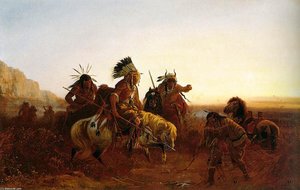
carl wimar
1828 - 1862 , Germany
Kort om kunstneren
- Artistic Movement Or Style: Romanticism
- Artists Or Movements Influenced By This Artist: ['Düsseldorf School']
- Artists Who Influenced This Artist: ['Emanuel Leutze']
- Date Of Birth: February 20, 1828
- Full Name: Karl Ferdinand Wimar
- Nationality: German-American
- Notable Artworks:
- The Abduction of Boone's Daughter by the Indians
- The Lost Trail
- Place Of Birth: Siegburg, Germany

