

 Forhåndsvisning
 Send
Send Del med andre
 Vis detaljer

 Last ned bildet
 Liknende objekter
 Røntgenundersøkelse
 Lysbildefremvisning
Translokation II

 Vis hele teksten
Giclée / Kunsttrykk
Giclée- eller lerretsprint av museumskvalitet med rask produksjon og fleksible valgmuligheter for etterbehandling. ( Kjøp håndlaget maleri Kjøp bilde)




P118B $10

P118H $10

P118W $10

P438Z $10

P508JH $12

P508YH $12

P805H $10

P805Z $10

P919BZ $10

P919G $10

P919XJ $10

P959ZH $10

P968JZ $12

W106C $8

W218G $10

W218JH $8

W218Y $10

W307PJ $10

W316G $10

W316PJ $8

W316Y $10

W398PJ $8

W4111J $10

W500HY $15

W500JH $15

W692G $12

W849H $8

W940BG $15

W953PJ $8




Velg mellom våre forhåndsdefinerte størrelser som bevarer kunstverkets opprinnelige proporsjoner.

Du kan oppgi egne mål for å tilpasse en spesifikk ramme eller et bestemt område. Dersom den valgte størrelsen ikke samsvarer med det originale bildets proporsjoner, vil vi enten beskjære kunstverket eller utvide bildet med en speilet eller ensfarget kant. En digital mockup vil bli sendt til din godkjenning før produksjonen starter.
Vennligst merk at forhåndsvisningen på skjermen ikke gjenspeiler den faktiske beskjæringen eller utvidelsen. Kun mockuppen vil vise den endelige komposisjonen nøyaktig.
Selv om tilpassede størrelser er tilgjengelige, anbefaler vi å velge et mål fra den forhåndsdefinerte listen for å bevare de originale proporsjonene.
Verdensomspennende levering () på 2 uker i stedet for standard 4/5 uker. (30 August)

Gratis ekspressfrakt over hele verden

Lerretsduk av høykvalitets lin

Full forsikring under transport

Garanti for refusjon av toll og importavgifter

Garantert korrekt fargegjengivelse

60 dagers returrett (kun ved feil)

100% pengene tilbake-garanti

Rabatt ved flere kjøp
 Glassalternativet er kun tilgjengelig i størrelser under 110 cm

Translokation II
Giclée / Kunsttrykk
Størrelse på reproduksjon
-


Endelig pris
$ 80
Om kunstneren
The Architect of Abstraction: The Life and Legacy of Camille Graeser
To encounter the work of Camille Graeser is to step into a world where geometry meets emotion, and where the rigid lines of structure dissolve into the profound textures of memory. Born on February 27, 1892, in Carouge, Switzerland, Graeser’s journey was one of constant movement—not just across borders, but through the very evolution of modern visual language. His early years were shaped by the artistic fervor of Stuttgart, Germany, where he first honed his sensibilities as a furniture designer. This foundational period in design instilled in him a lifelong respect for materiality and the structural integrity of form, a discipline that would later become the backbone of his most celebrated abstract compositions.
Graeser’s career was profoundly shaped by the turbulent winds of the twentieth century. As a member of the Deutsche Werkbund, he stood at the intersection of art and industry, participating in major exhibitions that championed the marriage of craftsmanship and modern utility. His talent caught the eye of the legendary architect Mies van der Rohe, who commissioned Graeser to design furniture for his groundbreaking architectural projects. However, the ascent of Nazism in 1933 forced a pivotal shift in his life; fleeing Germany, he sought refuge in Switzerland. This period of exile was not merely a geographical relocation but an artistic rebirth. In the quietude of Switzerland, Graeser turned his full attention toward the exploration of Concrete Art, finding a new voice within the Zurich avant-garde.
A Symphony of Form and Texture
As Graeser integrated into the Swiss art scene, becoming a prominent member of the Allianz group, his work underwent a remarkable transformation. He moved away from the functional constraints of design toward a more systematic, yet deeply expressive, form of geometric abstraction. His canvases became playgrounds for Concrete Art, where he utilized carefully manipulated geometric elements and strikingly bright colors to create a sense of rhythmic balance. Alongside luminaries such as Max Bill and Richard Paul Lohse, Graeser emerged as a leading figure in the Swiss movement, known for his ability to distill visual language into its purest, most essential essence.
What distinguishes Graeser’s oeuvre from the purely mathematical approach of some of his contemporaries is his profound engagement with texture and depth. His technique often involved layered textures—sometimes achieved through the use of encaustic—which imbued his works with a palpable physicality. These layers served as more than mere surface decoration; they acted as conduits for emotional resonance, capturing fleeting impressions of experience and the weight of history. In his hands, a simple geometric shape could carry the gravity of a landscape or the ephemeral quality of a memory, bridging the gap between the cerebral precision of constructivism and the visceral impact of abstract expressionism.
Historical Significance and Enduring Influence
The legacy of Camille Graeser is preserved not only in the museums that house his masterpieces but also through the dedicated stewardship of the Camille Graeser Foundation, established in 1981. His contribution to the trajectory of Swiss art remains immeasurable, particularly in how he bridged the gap between the decorative arts and high abstraction. His ability to navigate the transition from a designer of physical objects to a creator of purely visual experiences offers a profound lesson in artistic resilience and evolution.
Today, Graeser’s work continues to resonate with modern audiences who find beauty in the intersection of order and chaos. His achievements can be summarized through several key pillars of his career:
- Versatility of Medium: From furniture design for Mies van der Rohe to complex abstract paintings and reliefs.
- Pioneering Abstraction: A central figure in the development of Concrete Art in Switzerland.
- Material Mastery: The use of layered textures and encaustic to provide emotional depth to geometric forms.
- Cultural Resilience: Maintaining artistic integrity and contributing to the Swiss avant-garde despite the upheaval of political exile.
Ultimately, Graeser’s art remains a testament to the power of distillation—the ability to strip away the superfluous until only the most potent symbols of color, shape, and texture remain, speaking directly to the human spirit.

Kort om kunstneren
- Artistic Movement Or Style: Zurich Concrete artists
- Date Of Birth: February 27, 1892
- Full Name: Camille Graeser
- Nationality: Swiss
- Notable Artworks:
- Translokation II
- AUS DER REIHE GELÖSTES GELB YELLOW DETACHED FROM THE ROW
- Komplementär Relation I
- Place Of Birth: Carouge, Switzerland
Relaterte artikler

Geometrisk Abstraksjon: Topp 10 Mesterverk for Kunstelskere – OriginalUniqueArt.com
Utforsk de 10 mest innflytelsesrike verkene innen geometrisk abstraksjon! Oppdag historiene bak Mondrian, Kandinsky og Malevich. Finn inspirasjon til interiøret med OriginalUniqueArt.coms eksklusive reproduksjoner – museumskvalitet for ditt hjem. Utforsk samlingen online!

Kandinskys 25 Mesterverk: En Reise i Abstrakt Kunst og Fargeharmoni | OriginalUniqueArt.no
Utforsk Wassily Kandinskys 25 mest ikoniske malerier! Oppdag historien bak abstrakt kunst, ekspresjonisme og fargeharmoni. Finn inspirasjon til interiøret – museumskvalitet reproduksjoner på OriginalUniqueArt.com.

De 10 mest ikoniske malerier dominert av slåttegrå – Kunsthistorie og interiørinspirasjon
Oppdag de 10 mest ikoniske malerier dominert av slåttegrå – fra Monet til Van Gogh. Lær om kunsthistorien, fargetoner og teknikker bak disse mesterverkene. Finn din perfekte veggkunst og interiørinspirasjon på OriginalUniqueArt.com! Utforsk samlingen online.

Topp 10 mesterverk fra abstrakt ekspresjonisme – Kunst for ditt hjem | OriginalUniqueArt.no
Oppdag de 10 mest ikoniske verkene fra abstrakt ekspresjonisme! Lær historien bak Jackson Pollock, Mark Rothko og andre mestere. Finn kunsttrykk av høy kvalitet for ditt hjem på OriginalUniqueArt.com – museumskvalitet & inspirasjon.
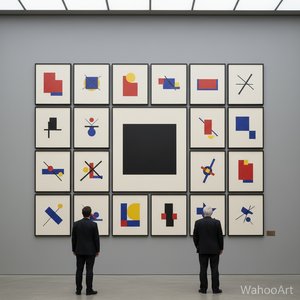
Kazimir Malevich' Top 25 Kunstverk: En Suprematistisk Reise for Din Vegg
Oppdag Kazimir Malevich' 25 mest ikoniske kunstverk! Fordyp deg i Suprematismens verden, fra det banebrytende 'Svart Kvadrat' til subtile fargepaletter. Finn din perfekte maleri reproduksjon og interiørinspirasjon på OriginalUniqueArt.com.

