
 Se i rommet
 Del som digitalt kort
 Del
Del
 Detaljer
 Studentguide

 Last ned
 Liknende objekter
 Røntgen
 Lysbildefremvisning
 Besøksstatistikk
Fair In Brittany

 Les mer
Giclée / Kunsttrykk
Giclée- eller lerretsprint av museumskvalitet med rask produksjon og fleksible valgmuligheter for etterbehandling. ( Bestill håndmalt reproduksjon Gå til digitalt bilde)




P118B $10

P118H $10

P118W $10

P438Z $10

P508JH $12

P508YH $12

P805H $10

P805Z $10

P919BZ $10

P919G $10

P919XJ $10

P959ZH $10

P968JZ $12

W106C $8

W218G $10

W218JH $8

W218Y $10

W307PJ $10

W316G $10

W316PJ $8

W316Y $10

W398PJ $8

W4111J $10

W500HY $15

W500JH $15

W692G $12

W849H $8

W940BG $15

W953PJ $8




Velg mellom våre forhåndsdefinerte størrelser som bevarer kunstverkets opprinnelige proporsjoner.

Du kan oppgi egne mål for å tilpasse en spesifikk ramme eller et bestemt område. Dersom den valgte størrelsen ikke samsvarer med det originale bildets proporsjoner, vil vi enten beskjære kunstverket eller utvide bildet med en speilet eller ensfarget kant. En digital mockup vil bli sendt til din godkjenning før produksjonen starter.
Vennligst merk at forhåndsvisningen på skjermen ikke gjenspeiler den faktiske beskjæringen eller utvidelsen. Kun mockuppen vil vise den endelige komposisjonen nøyaktig.
Selv om tilpassede størrelser er tilgjengelige, anbefaler vi å velge et mål fra den forhåndsdefinerte listen for å bevare de originale proporsjonene.
Verdensomspennende levering () på 2 uker i stedet for standard 4/5 uker. (25 September)

Gratis ekspressfrakt over hele verden

Lerretsduk av høykvalitets lin

Full transportforsikring

Garanti for refusjon av toll og importavgifter

Garantert fargeekthet

100 dagers returrett ved fabrikasjonsfeil

100% pengene tilbake-garanti

Mengderabatt
 Glassalternativet er kun tilgjengelig i størrelser under 110 cm

Fair In Brittany
Giclée / Kunsttrykk
Format på reproduksjon
-


Totalpris
$ 80
A Vision of Brittany: Decoding Boris Grigoriev’s Enigmatic Composition
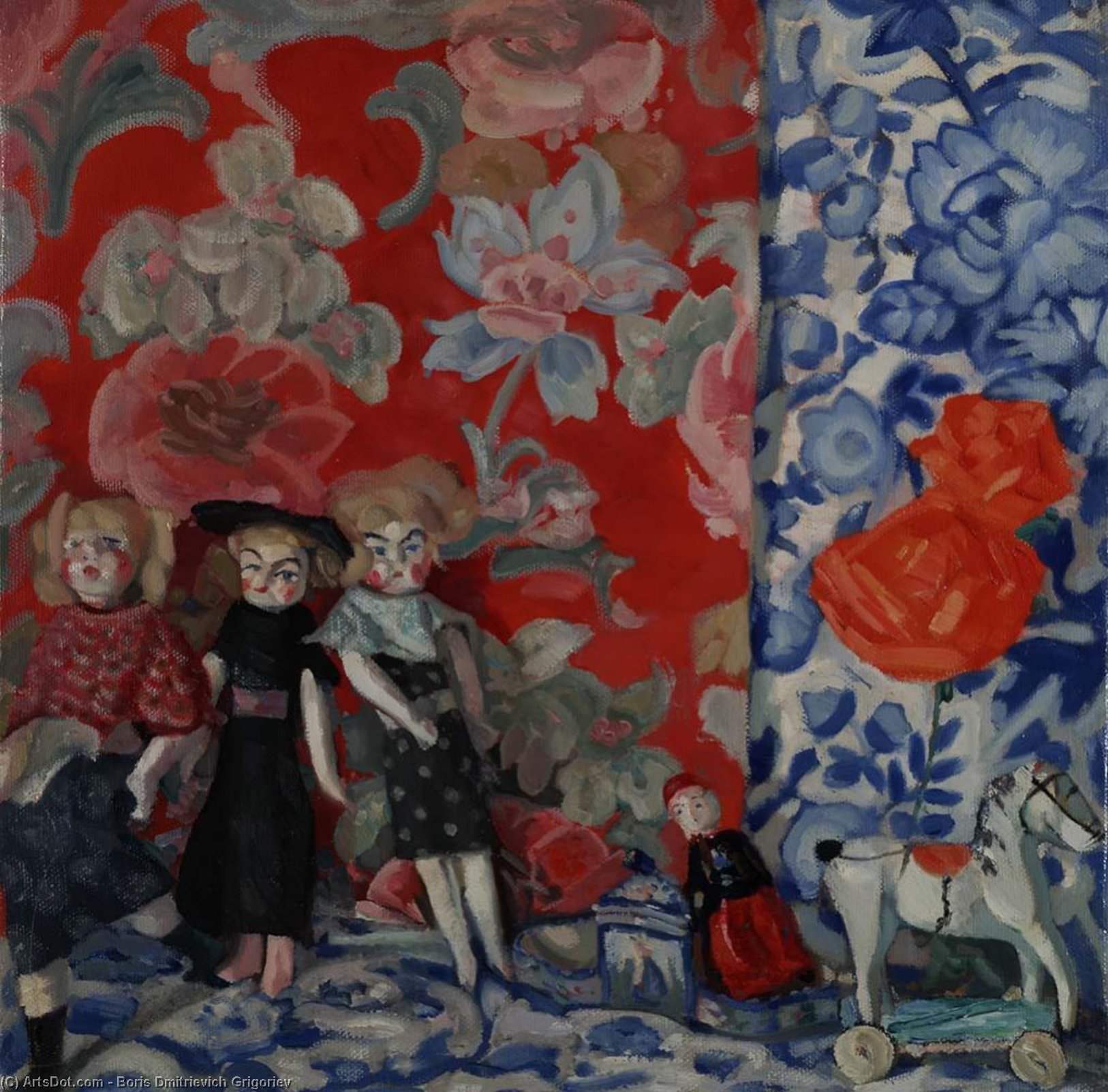
Boris Dmitrievich Grigoriev's *Fair In Brittany* is a captivating and unsettling work that exemplifies the artist’s unique position within early 20th-century Russian art. Painted sometime during his period of stylistic exploration, this piece transcends simple representation, offering instead a potent blend of Expressionism and Symbolism that invites deep contemplation. It’s a painting that doesn't merely depict a scene; it evokes a mood – one of wistful melancholy and underlying tension.Subject & Composition: A Divided World
The artwork is strikingly divided into two distinct visual realms. On the left, we are immersed in a dense field of vibrant red, teeming with large, stylized floral blooms—roses and peonies dominating the space. Within this almost claustrophobic garden stand three figures, rendered as doll-like girls. Their elaborate costumes and pensive expressions suggest a sense of detachment or lost innocence. The right side offers a sharp contrast: a meticulously detailed scene reminiscent of blue and white porcelain, depicting a horse and rider. This juxtaposition is key to understanding the painting’s complexity; it's a dialogue between organic chaos and controlled order, passion and restraint.Technique & Style: Impasto & Emotional Color
Grigoriev masterfully employs contrasting techniques to reinforce this duality. The floral side explodes with loose, energetic brushwork and heavy *impasto* – thick layers of paint that create a tactile surface and heighten the emotional intensity. Conversely, the porcelain scene is executed with precision and control, showcasing a refined attention to detail. The color palette is equally significant. The dominant red evokes passion, perhaps even danger or suppressed emotion, while the cool blues and whites offer a counterpoint, suggesting distance or serenity. This deliberate use of color isn’t merely aesthetic; it's deeply emotive, driving the painting’s psychological impact.Historical Context: A Russian Artist in Transition
Born in 1886, Grigoriev navigated a period of immense artistic upheaval in Russia. He initially embraced Impressionism, becoming part of the “Studio of Impressionists” group, before aligning himself with the more avant-garde "World of Art" movement. *Fair In Brittany* reflects this stylistic evolution – it’s not purely Impressionistic but incorporates elements of Symbolism and Expressionism, demonstrating his willingness to experiment and push boundaries. His personal history—born out of wedlock—also subtly informs his work, often exploring themes of alienation and societal constraints.Symbolism & Interpretation: Dolls, Dreams & Disquiet
The doll-like figures are particularly compelling. Their stylized features and painted expressions suggest artificiality, fragility, and a sense of isolation. Are they representations of idealized femininity? Or perhaps symbols of lost childhood or societal expectations imposed upon women? The Breton setting—Brittany being a region steeped in folklore and Celtic mythology—adds another layer of intrigue. The painting feels dreamlike, almost hallucinatory, prompting viewers to question the reality presented before them. It’s a work that resists easy answers, inviting multiple interpretations.Emotional Impact & Aesthetic Appeal
*Fair In Brittany* is not a comfortable painting; it's designed to provoke thought and elicit an emotional response. The unbalanced composition, the unsettling juxtaposition of elements, and the melancholic figures all contribute to a sense of unease. However, this very disquiet is what makes the artwork so compelling. Its bold colors, dynamic brushwork, and intriguing symbolism make it a striking statement piece—ideal for collectors seeking unique and thought-provoking art or interior designers aiming to create spaces that are both visually stunning and intellectually stimulating. It’s a work that stays with you long after you've looked away.Kunstnerbiografi
Boris Dmitrievich Grigoriev: Et liv i russisk kunst
Tidlig liv og utdannelse
- Født: 11. juli 1886, i Rybinsk, Russland.
- Hans mor, Klara von Lindenberg, var av svensk herkomst, noe som preget hans kunstneriske sanselighet.
- Grigorievs tidlige liv var preget av at han ble født utenfor ekteskap, et tema som senere skulle dukke opp subtilt i hans verker.
- Han studerte ved Stroganov kunstskole fra 1903 til 1907 under Dmitri Shcherbinovsky.
- Han videreførte sin utdannelse ved Det keiserlige akademi for kunst i St. Petersburg, noe som sementerte hans kunstneriske fundament.
Kunstnerisk utvikling og påvirkninger
- Grigorievs stil utviklet seg gjennom ulike faser, og begynte med impresjonismen før han omfavnet avantgardistiske teknikker.
- I 1909 ble han medlem av «Impresjonistenes studio», noe som viste hans innledende dragning mot denne bevegelsen.
- Han ble medlem av den innflytelsesrike *Verdens kunst* (Mir Iskusstva)-bevegelsen i 1913, noe som knyttet ham til ledende russiske kunstnere og intellektuelle.
- Påvirkninger: Selv om spesifikke påvirkninger er gjenstand for debatt, viser hans arbeid en affinitet for europeiske impresjonister og post-impresjonister, side om side med en distinkt russisk sanselighet.
Viktige verk og temaer
- «Rasseïa» (1918): Et sentralt album som viser Grigorievs forsøk på å forstå det russiske folkets essens som et naturfenomen.
- Portretter: Bemmerkelsesverdige portretter inkluderer de av Vsevolod Meyerhold, Maxim Gorky og Sergei Rachmaninov, som fanger deres personligheter med dybde og sensitivitet.
- Seriene «Russlands ansikter» & «Verdens ansikter»: Disse samlingene demonstrerer hans interesse for å portrettere mangfoldige individer og kulturer.
- Store malerier: *Solsikker* (1917-1919), *Landsby* (1918) og *Bønder på marken* (1920) eksemplifiserer hans livlige fargepalett og rytmiske komposisjoner.
- Temaer: Grigoriev utforsket ofte temaer som nasjonal identitet, sosial observasjon og psykologisk dybde i sine arbeider.
Historisk betydning og ettermæle
- Grigoriev spilte en betydelig rolle i den russiske avantgarde-bevegelsen og bidro til dens innovative ånd.
- Hans arbeid reflekterer det turbulente sosiale og politiske klimaet i Russland tidlig på 1900-tallet.
- Selv om han ikke er like internasjonalt anerkjent som noen av sine samtidige, blir hans bidrag til russisk kunst stadig mer verdsatt.
- Hans malerier kan finnes i museer som Taganrog kunstmuseum, noe som bevarer hans arv for fremtidige generasjoner.
- Død: 1939. Hans tidlige død avbrøt en lovende karriere, men hans kunstneriske visjon fortsetter å inspirere.
Kunstnerisk stil og kjennetegn
- Grigorievs stil er preget av sin emosjonelle intensitet og ekspressive bruk av farger.
- Han benyttet rytmiske strukturer og dynamiske komposisjoner for å formidle en følelse av bevegelse og energi.
- Hans portretter er bemerkelsesverdige for sin psykologiske innsikt og evne til å fange sine subjekters indre liv.
- Alt i alt: Grigorievs arbeid representerer en unik blanding av impresjonistiske teknikker, avantgardistisk eksperimentering og distinkt russiske temaer.

boris dmitrievich grigoriev
1886 - 1939 , Russland
Kort om kunstneren
- Artistic Movement Or Style: Impressionism, Avant-garde
- Artists Or Movements Influenced By This Artist: ['World of Art']
- Artists Who Influenced This Artist:
- Dmitry Shcherbinovsky
- Alexander Kiselyov
- Date Of Birth: 1886-07-11
- Date Of Death: 1939-02-07
- Full Name: Boris Dmitrievich Grigoriev
- Nationality: Russisk
- Notable Artworks:
- Rasseïa
- Sunflowers
- Village
- Place Of Birth: Rybinsk, Russland
Relaterte artikler

Tysk Ekspresjonisme: 10 Mesterverk som Definerte en Kunstbevegelse | OriginalUniqueArt.no
Utforsk 10 ikoniske mesterverk fra tysk ekspresjonisme! Oppdag Munch, Kirchner og Kandinsky – historiene bak fargene, teknikkene & følelsene. Finn museumskvalitets kunsttrykk for ditt hjem på OriginalUniqueArt.com.
Raw Emotion & Bold Strokes: The Definitive Guide to the High-Impact World of Expressionism
Unleash raw emotion in your space. Explore the high-impact world of Expressionism through OriginalUniqueArt.com’s premium hand-painted oil reproductions and custom photo transformations. Bold, confident, and curated for those who live for visual impact. Shop the revolution today!

10 Kunstverk som Utstråler Mot og Dristighet | OriginalUniqueArt.no
Opplev 10 ikoniske kunstverk som utstråler mot og dristighet! Fra Van Goghs intense farger til Picassos revolusjonerende kubisme – lær historien bak mesterverkene. Finn din perfekte veggkunst & reproduksjon på OriginalUniqueArt.no.

Victor Vasnetsov: Myth, Nationalism & the Revival of Russian Fairy Tale Painting
Explore the captivating world of Victor Vasnetsov, a co-founder of Russian folklorist painting. Discover his iconic works, influence on national identity, and lasting legacy in this expert guide.

Ivan Bilibin: A Synthesis of Folklore, Modernism & National Identity in Russian Illustration
Explore the enchanting world of Ivan Bilibin, a master Russian illustrator who synthesized folklore, Art Nouveau & national identity. Discover his iconic fairy tale illustrations and legacy with OriginalUniqueArt.