

 Se i rommet
 Del som digitalt kort
 Del
Del
 Detaljer
 Studentguide

 Last ned
 Liknende objekter
 Røntgen
 Lysbildefremvisning
 Besøksstatistikk
Sleeping Diana Watched by Two Fauns
 Acrylic On Canvas
- WallArt
- Symbolist Painting
 1877
1877 50.0 x 774.0 cm
 Kunstpalast
 Les mer
Giclée / Kunsttrykk
Giclée- eller lerretsprint av museumskvalitet med rask produksjon og fleksible valgmuligheter for etterbehandling. ( Bestill håndmalt reproduksjon Gå til digitalt bilde)




P118B $10

P118H $10

P118W $10

P438Z $10

P508JH $12

P508YH $12

P805H $10

P805Z $10

P919BZ $10

P919G $10

P919XJ $10

P959ZH $10

P968JZ $12

W106C $8

W218G $10

W218JH $8

W218Y $10

W307PJ $10

W316G $10

W316PJ $8

W316Y $10

W398PJ $8

W4111J $10

W500HY $15

W500JH $15

W692G $12

W849H $8

W940BG $15

W953PJ $8




Velg mellom våre forhåndsdefinerte størrelser som bevarer kunstverkets opprinnelige proporsjoner.

Du kan oppgi egne mål for å tilpasse en spesifikk ramme eller et bestemt område. Dersom den valgte størrelsen ikke samsvarer med det originale bildets proporsjoner, vil vi enten beskjære kunstverket eller utvide bildet med en speilet eller ensfarget kant. En digital mockup vil bli sendt til din godkjenning før produksjonen starter.
Vennligst merk at forhåndsvisningen på skjermen ikke gjenspeiler den faktiske beskjæringen eller utvidelsen. Kun mockuppen vil vise den endelige komposisjonen nøyaktig.
Selv om tilpassede størrelser er tilgjengelige, anbefaler vi å velge et mål fra den forhåndsdefinerte listen for å bevare de originale proporsjonene.
Verdensomspennende levering () på 2 uker i stedet for standard 4/5 uker. (26 September)

Gratis ekspressfrakt over hele verden

Lerretsduk av høykvalitets lin

Full transportforsikring

Garanti for refusjon av toll og importavgifter

Garantert fargeekthet

100 dagers returrett ved fabrikasjonsfeil

100% pengene tilbake-garanti

Mengderabatt
 Glassalternativet er kun tilgjengelig i størrelser under 110 cm

Sleeping Diana Watched by Two Fauns
Giclée / Kunsttrykk
Format på reproduksjon
-


Totalpris
$ 80
The Enigmatic Realm of Arnold Böcklin’s “Sleeping Diana”
Arnold Böcklin's "Sleeping Diana Watched by Two Fauns," painted in 1877-85, is not merely a depiction of a serene woodland scene; it’s an immersion into a realm of potent symbolism and haunting beauty. This tempera on panel masterpiece, currently residing in the Museum Kunstpalast in Düsseldorf, immediately draws the viewer into a world where classical mythology intertwines with unsettling introspection. The painting's power lies not just in its exquisite detail – the dappled sunlight filtering through ancient trees, the delicate folds of Diana’s gown – but in the palpable tension between innocence and primal instinct, restraint and desire.
Böcklin, a key figure in the Symbolist movement, rejected the naturalism prevalent in earlier art. Instead, he sought to evoke emotions and ideas through suggestive imagery, often drawing upon folklore, mythology, and the darker aspects of human experience. His work frequently explores themes of death, decay, and the subconscious—elements subtly woven into this particular composition. The painting’s genesis is rooted in a fascination with the ancient world, particularly Roman art and literature, combined with a deeply personal exploration of mortality and the fleeting nature of beauty.
A Dance of Contrasts: Goddess and Creatures
At the heart of “Sleeping Diana” lies a captivating interplay of figures. The goddess Diana, depicted in a state of languid repose upon a moss-covered rock, embodies purity, chastity, and the hunt—attributes traditionally associated with her role as protector of young women. Her serene expression and graceful posture suggest both vulnerability and an underlying strength. However, this idealized image is dramatically contrasted by the two fauns flanking her. These creatures, rendered with a touch of unsettling realism, possess a distinctly animalistic quality, their hands almost touching in a gesture that hints at a suppressed, perhaps even forbidden, attraction.
The positioning of the fauns—one reaching out tentatively towards Diana, the other holding back—creates a dynamic tension. It’s not a violent confrontation, but rather a delicate negotiation between opposing forces: the divine and the earthly, the rational and the instinctual, the controlled and the wild. The subtle shift in their postures suggests a moment suspended in time, a fleeting glimpse into a primal drama.
Technique and Atmosphere – A Palette of Twilight
Böcklin’s masterful technique contributes significantly to the painting's evocative atmosphere. He employed a rich, layered application of tempera paint, creating a sense of depth and texture that captures the dappled light filtering through the trees. The color palette is dominated by muted greens, browns, and blues—tones reminiscent of twilight or early morning—which imbue the scene with a melancholic beauty. Böcklin’s use of chiaroscuro – the dramatic contrast between light and shadow – further enhances the painting's emotional impact, drawing attention to Diana’s form while simultaneously shrouding the surrounding landscape in mystery.
Notably, Böcklin was influenced by the Italian Renaissance color palettes, particularly those favored during the Early Renaissance. This influence is evident in the warm, earthy tones and the overall sense of harmony and balance within the composition. The meticulous detail in rendering the foliage and the subtle nuances of light and shadow demonstrate Böcklin’s exceptional skill as a landscape painter.
Symbolism and Enduring Resonance
“Sleeping Diana Watched by Two Fauns” is replete with symbolic meaning, inviting multiple interpretations. The painting can be read as an allegory for the tension between desire and restraint, innocence and experience, or perhaps even the struggle to maintain control over one’s impulses. The fauns themselves are often interpreted as representing the darker aspects of human nature—the primal instincts that lie beneath the surface of civilized society. Diana's sleep can be seen as a state of vulnerability, while the watchful fauns embody the constant threat of temptation and transgression.
Despite its somewhat unsettling undertones, “Sleeping Diana” remains a profoundly beautiful and captivating work of art. It’s a testament to Böcklin’s ability to capture not just visual beauty but also the complex emotions and psychological states that lie beneath the surface of human experience. Reproductions of this iconic painting continue to resonate with viewers today, offering a glimpse into a world where myth, symbolism, and timeless beauty converge.
Kunstnerbiografi
Early Life and Training
Arnold Böcklin, a name synonymous with haunting beauty and profound melancholy, was born on October 16, 1827, in Basel, Switzerland—a city that would profoundly shape his artistic vision. His father, Christian Frederick Böcklin, descended from an old family rooted in the silk trade of Schaffhausen, while his mother, Ursula Lippe, hailed from the same city as well. From a young age, Arnold displayed a keen interest in art, initially studying drawing at the Zeichenschule in Basel under the guidance of Ludwig Adam Kelterborn. This foundational training provided him with essential skills before he embarked on his formal artistic education at the Düsseldorf Academy in 1845. There, he honed his technique under the tutelage of Johann Wilhelm Schirmer, a renowned German landscape painter, and became acquainted with fellow artist Anselm Feuerbach—a connection that would undoubtedly influence his later work. Böcklin’s time in Düsseldorf marked a crucial period of artistic development, laying the groundwork for his distinctive style and thematic preoccupations.Artistic Career and Symbolism
Böcklin's artistic journey took him beyond the familiar landscapes of Northern Europe, leading him to explore the vibrant cultural currents of Paris and the evocative settings of Rome. In Paris, he worked at the Louvre, immersing himself in the masterpieces of the Old Masters—a period that deeply impacted his understanding of composition, color, and narrative. Subsequently, he traveled to Rome, where he was captivated by the city’s classical ruins, Renaissance art, and dramatic light. This Roman experience proved transformative, fueling his fascination with mythology, allegory, and the darker aspects of human existence. Böcklin's work consistently featured figures drawn from ancient myths and legends, often set against the backdrop of classical architecture—a deliberate choice that evoked a sense of timelessness and profound contemplation. He wasn’t simply depicting stories; he was exploring themes of mortality, loss, and the ethereal realm between life and death. Notable early works like *Great Park*, showcasing ancient mythology, and evocative pieces such as *Nymph and Satyr* (1858) and *Sappho* (1859), established his reputation and signaled the emergence of a unique artistic voice. The painting *Portrait of Myself with Death Playing the Violin* (1872) stands out as a particularly poignant example of his distinctive style, blending realism with symbolic elements to create a deeply unsettling yet captivating image.The Isle of the Dead and Last Years
Perhaps Böcklin’s most enduring legacy is his five versions of *Isle of the Dead* (1880-1886). Inspired by the English cemetery in Florence, where his daughter was buried, these paintings became a cornerstone of his artistic output. The series—each subtly different from the others—evokes a sense of profound melancholy and timelessness, capturing the beauty and sorrow inherent in mortality. *Isle of the Dead* wasn't merely a depiction of a graveyard; it was an exploration of the human condition, a meditation on loss, memory, and the inevitability of death. The work resonated deeply with audiences and artists alike, influencing composers like Sergey Rachmaninoff, who drew inspiration from its haunting atmosphere for his symphonic poem *The Isle of the Dead*. Böcklin’s later years were marked by increasing isolation and declining health, but he continued to create powerful and evocative works—such as *Odysseus and Calypso* (1883) and *The Pest* (1898)—that further cemented his place in art history.Legacy and Influence
Arnold Böcklin’s impact on the art world extends far beyond his own lifetime. His work is often associated with the Symbolist movement, a late-Romantic artistic trend characterized by its emphasis on emotion, imagination, and subjective experience. However, Böcklin's style was remarkably eclectic, drawing upon influences from various sources—including the Düsseldorf School of Painting, Pre-Raphaelite aesthetics, and the traditions of Northern European painting. Clement Greenberg famously described Böcklin’s work as “one of the most consummate expressions” of its time, recognizing its profound emotional depth and symbolic richness. His exploration of themes such as death, dreams, and the subconscious resonated with Surrealist artists like Salvador Dalí, who saw in his paintings a precursor to their own explorations of the irrational and the uncanny. Böcklin’s legacy continues to inspire artists today, demonstrating the enduring power of art to evoke profound emotions and challenge our understanding of the world.Museums and Collections
Böcklin's artistic output is preserved in several prominent museums around the world:- Öffentliche Kunstsammlung (Basel, Switzerland)
- Kunstmuseum Basel (Switzerland)
- Museum Kunsthaus Zürich (Zürich, Switzerland)
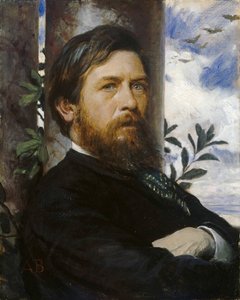
Arnold Böcklin
1827 - 1901 , Sveits
Kort om kunstneren
- Artistic Movement Or Style: Symbolist
- Artists Or Movements Influenced By This Artist:
- Hans Thoma
- Pre-Raphaelitter
- Artists Who Influenced This Artist:
- Schirmer
- Feuerbach
- Date Of Birth: 16. oktober 1827
- Date Of Death: 16. januar 1901
- Full Name: Arnold Böcklin
- Nationality: Sveitsisk
- Notable Artworks:
- Isle of the Dead
- Nymph og Satyr
- Sappho
- Selvportrett
- Place Of Birth: Basel, Sveits
Relaterte artikler

Timeless Legends: The Eternal Allure of Mythological Figures in Masterpiece Art
Explore the profound beauty of mythological figures through the lens of art history. From Renaissance masterpieces to custom oil reproductions, discover how legendary tales of heroism and divinity are immortalized in fine art for discerning collectors.

Echoes of Olympus: Mythological Narratives in Western Art Through the Ages
Explore the captivating history of mythological narratives in Western art! From ancient Greece to modern masterpieces, discover iconic artworks & symbolism. Expert analysis and high-quality reproductions at OriginalUniqueArt.
Timeless Legends: A Curated Guide to the Eternal Allure of Mythological Masterpieces
Embark on a sophisticated journey through the eternal allure of mythological art. Discover how master painters breathe life into ancient legends, from Greek deities to Baroque masterpieces, and learn to curate these timeless narratives within your own exquisite art collection.
Franz von Stuck: Symbolism, Decadence & the Pursuit of Ideal Beauty
Explore the captivating world of Franz von Stuck, a leading Symbolist painter. Discover his mythological masterpieces, decadent themes, & investment potential. Expert analysis for discerning collectors.
Personlige mytologier i oljemaleri: Å transformere livshistorier til symbolsk kunstnerisk uttrykk
Utforsk kunsten å skape personlige mytologier i oljemaleri! Lær hvordan du transformerer livshistorier til symbolsk kunst med ekspertråd og inspirasjon. Oppdag din unike stemme.
