Symbolism
La peste (Arnold Böcklin)
Arnold Böcklin (1827–1901) har laget La peste. Det tilhører Symbolism-bevegelsen. Den er laget i Oil On Canvas.
- Oil On Canvas

 Forhåndsvisning

 Håndmalt oljemaleri
 Send
 Del
 Faktablad


 Last ned bilde
 Liknende objekter
 Røntgenundersøkelse
 Lysbildefremvisning
 Spørsmål og svar

 Statistikk
La peste, kort fortalt
- Tittel
- La peste
- Kunstner
- Arnold Böcklin (1827–1901)
- Kunstner født i
- Basel, Sveits
- Medium
- Oil On Canvas
- Bevegelse
- Symbolism
- Periode
- 19th Century
- Motiv
- monster, rider, buildings, dead bodies, sky, red cloth
Hva forestiller La peste?
The Shadow of Mortality
In this unsettling scene, we find ourselves witnessing a moment of profound, inevitable decay. A monstrous, winged creature, reminiscent of a bat, moves through the narrow streets of a medieval European city. Atop this beast sits a skeletal figure, a personification of death that moves with a terrifying, silent purpose. The atmosphere is heavy, thick with a hazy, yellow-grey light that suggests a world choked by sickness. There is a sense of chaos here, yet it is a quiet, suffocating kind of chaos. The buildings, with their rigid, angular lines, seem to press in on the viewer, creating a claustrophobic environment where escape feels impossible.
The color palette is deliberately somber, leaning heavily into the earthy tones of ochre, brown, and grey. However, there is a specific, unsettling use of pale green—a hue often associated with the physical reality of decomposition—that permeates the work. This sickly tint contrasts sharply with the single, startling shock of red found in the foreground. A woman lies there, her clothing a vivid crimson against the muted, dying world around her, a stark reminder of the human cost of the plague passing through the streets.
Symbolic Elements and Composition
The composition is structured with a certain architectural precision that heightens the sense of dread. The rider and the beast form a central, pyramidal apex that draws the eye upward and then forces it back down toward the suffering below. The artist uses several layers of visual language to communicate the theme of pestilence:
- The winged creature, acting as a vessel for the plague, disrupts the orderly geometry of the urban landscape.
- The use of atmospheric perspective, where the background fades into a murky haze, suggests an endless, spreading contagion.
- The fallen figures in the foreground and middle ground represent the victims, their forms partially obscured by shadow and the weight of the scene.
- The contrast between organic, irregular shapes of the monster and the rigid, rectangular shapes of the architecture emphasizes the unnatural intrusion of death into civilization.
The technique involves a careful layering of oil paints, creating a texture that feels both rough and weathered. In certain areas, the impasto is visible, giving the creature a visceral, tactile presence. This physical depth mirrors the psychological depth of the subject matter, where the veil between the physical world and a nightmare state feels dangerously thin.
The Weight of the Unseen
There is a profound stillness in the way the figures are arranged, despite the violence of the subject. It is a stillness born of hopelessness. The lighting is diffused and uneven, casting deep shadows that hide as much as they reveal. This lack of a clear light source contributes to the sense of mystery and the feeling that the plague is an unstoppable, elemental force rather than a mere biological event. The work captures a specific tension between the tangible reality of a city and the intangible, spectral presence of death, leaving the viewer with a lingering sense of unease that remains long after the first glance.
Høyoppløselige bilder av La peste
Fritlig eiendom: kunstneren døde i 1901.
Arnold Böcklin, La peste. Felleseie
Spørsmål om La peste, besvart
Hvilket medium er "La peste" av Arnold Böcklin utført i?
"La peste" av Arnold Böcklin er utført i Oil On Canvas. Reproduksjonene har som mål å gjengi utseendet til denne teknikken.
Hva forestiller "La peste" av Arnold Böcklin?
Motivene i "La peste" er monster, rider, buildings, dead bodies, sky, red cloth, cityscape.
Er "La peste" av Arnold Böcklin i det frie domene?
Når det gjelder opphavsrett, er "La peste" fritt tilgjengelig – opphavsretten har utløpt.
Hvem har skapt "La peste"?
"La peste" tilskrives Arnold Böcklin.
Hvilken stilart tilhører "La peste"?
Kunstretningen knyttet til "La peste" av Arnold Böcklin er Symbolism. Denne klassifiseringen plasserer verket sammen med relaterte kunstnere og kunstverk.
Hvilken periode i Arnold Böcklin sin karriere tilhører "La peste"?
I Arnold Böcklin sin karriere tilhører "La peste" Late Period. Denne perioden gjør det mulig å sammenligne verket med kunstnerens øvrige arbeider.
Er "La peste" av Arnold Böcklin i det frie domene (public domain), og hvorfor?
"La peste" av Arnold Böcklin er fritt tilgjengelig – opphavsretten har utløpt. Opphavsretten løper fra kunstnerens dødsår, som var i 1901.
Hvordan passer "La peste" inn i Arnold Böcklin sin tematikk og stil?
"La peste" er et verk fra Arnold Böcklin sin periode innen Symbolism, der de dokumenterte temaene inkluderer symbolist movement, mythology and mortality, themes of death, war and pestilence, exploration of the subconscious.
Hvordan relaterer motivet i "La peste" seg til Arnold Böcklin sine vanlige temaer?
Arnold Böcklin sine tilbakevendende temaer inkluderer symbolist movement, mythology and mortality, themes of death, war and pestilence, exploration of the subconscious; "La peste" fokuserer på monster, rider, buildings, dead bodies, sky, red cloth, cityscape.
Om kunstneren, Arnold Böcklin
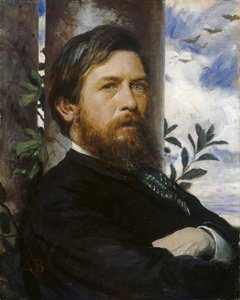
1827–1901, Sveits
Arnold Böcklin
Øyas skygge Basel i Sveits utgjør startpunktet for et liv definert av spenningen mellom det håndfaste og det spektrale. Den unge mannen, født 16. oktober 1827 av Christian Frederick Böcklin og Ursula Lippe, ville etter hvert bevege seg bort fra farens silkehandel og inn i de strenge salene ved Düsseldorf-akademiet. Under veiledning av Schirmer begynte han å absorbere landskapets språk, en ferdighet som senere skulle brukes til å kartlegge den menneskelige sjelens geografi.
Også av Arnold Böcklin
 Dødens øy (første versjon)1880
 Selvportrett med døden som spiller fiolin
 Kriget1896
 The Isle of the Dead (Version 2)1880
Essays om La peste
 Beyond Reality: Unveiling the Enigmatic Depths of Metaphysical Art and its Philosophical EchoesExplore the profound mystery of Metaphysical Art. Delve into the philosophical depths of Giorgio de Chirico’s dreamscapes and discover how …
 25 Essential Works by Arnold Böcklin: A Journey Through Myth and SymbolismExplore 25 iconic Arnold Böcklin paintings and Symbolist works. Discover the full collection online at OriginalUniqueArt.com.
 Swiss artworks of the 1890sSwiss Symbolism in the 1890s features the iconic works of Félix Vallotton and Arnold Hodler. View the full collection online at OriginalUni…