

 Se i rommet
 Del som digitalt kort
 Del
Del
 Detaljer
 Studentguide

 Last ned
 Liknende objekter
 Røntgen
 Lysbildefremvisning
 Besøksstatistikk
Autumn Flowers


 Les mer
Håndlaget oljereproduksjon
Håndmalt olje på lerret i din valgte størrelse og ramme, laget på bestilling av våre kunstnere. ( Bytt til trykkversjon Gå til digitalt bilde)




P118B Nkr10

P118H Nkr10

P118W Nkr10

P438Z Nkr10

P508JH Nkr12

P508YH Nkr12

P805H Nkr10

P805Z Nkr10

P919BZ Nkr10

P919G Nkr10

P919XJ Nkr10

P959ZH Nkr10

P968JZ Nkr12

W106C Nkr8

W218G Nkr10

W218JH Nkr8

W218Y Nkr10

W307PJ Nkr10

W316G Nkr10

W316PJ Nkr8

W316Y Nkr10

W398PJ Nkr8

W4111J Nkr10

W500HY Nkr15

W500JH Nkr15

W692G Nkr12

W849H Nkr8

W940BG Nkr15

W953PJ Nkr8




Velg mellom våre forhåndsdefinerte størrelser som bevarer kunstverkets opprinnelige proporsjoner.

Du kan angi egne mål for å tilpasse en spesifikk ramme eller plass. Dersom den valgte størrelsen ikke samsvarer med originalbildets proporsjoner, vil vi enten beskjære kunstverket eller utvide maleriet med ytterligere håndmalte elementer. En digital mockup vil bli sendt til din godkjenning før produksjonen starter.
Vennligst merk at forhåndsvisningen på skjermen ikke gjenspeiler den faktiske beskjæringen eller utvidelsen. Kun mockuppen vil vise den endelige komposisjonen nøyaktig.
Selv om tilpassede størrelser er tilgjengelige, anbefaler vi å velge et mål fra den forhåndsdefinerte listen for å bevare de originale proporsjonene.
Etter bestilling vil OriginalUniqueArt.com-teamet sende e-post til kunden for instruksjoner og sende et utkast (mockup) som forhåndsvisning.
Verdensomspennende levering () på 3–4 uker i stedet for standard 5 uker. (12 October). Ingen kompromisser med kvaliteten.

Gratis ekspressfrakt over hele verden

Lerretsduk av høykvalitets lin

Full transportforsikring

Garanti for refusjon av toll og importavgifter

Garantert fargeekthet

100 dagers returrett ved fabrikasjonsfeil

100% pengene tilbake-garanti

Mengderabatt
 Glassalternativet er kun tilgjengelig i størrelser under 110 cm

Autumn Flowers
Reproduksjonsmetode
Format på reproduksjon
-


Totalpris
Nkr 2788
A Portrait of a Moment: The Enigmatic Beauty of *Autumn Flowers*
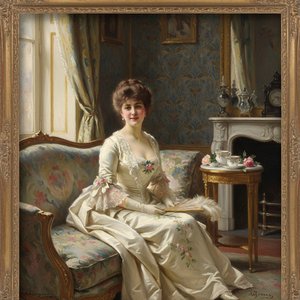
Alfred Stevens’s *Autumn Flowers*, painted in 1867, isn't merely a depiction of a woman amidst flowers; it’s an exquisitely crafted meditation on stillness, light, and the subtle poetry of everyday life. At first glance, the painting presents a seemingly simple arrangement: a seated lady, her posture suggesting quiet contemplation, surrounded by a still-life tableau of fabrics, blossoms, and a delicately rendered table. Yet, beneath this surface lies a profound exploration of form, color, and the very essence of observation – a hallmark of Stevens’s unique artistic vision.
Stevens, a pivotal figure in 19th-century Belgian art, deliberately eschewed the prevailing trends of his time. Rejecting the fleeting effects of Impressionism's vibrant light and atmosphere, he instead focused on capturing an immutable quality – the frozen gesture, the fixed expression, the enduring presence of the subject. This deliberate choice is powerfully evident in *Autumn Flowers*. The woman’s hand, poised as if about to touch a flower, isn’t caught in motion; it's suspended, imbued with a sense of timelessness. Her gaze, directed slightly off-canvas, invites us into her private world, suggesting an inner life beyond the immediate scene.
The Language of Color and Texture: Stevens’s Masterful Technique
What immediately draws the eye is Stevens's extraordinary command of color and texture. He employs a remarkably restrained palette – primarily shades of grey, black, and muted browns – punctuated by flashes of pastel pink, chestnut brown, and the glossy sheen of the table cover. This deliberate limitation isn’t a sign of restraint but rather a strategic choice to emphasize form and light. The artist masterfully utilizes chiaroscuro, creating dramatic contrasts between light and shadow that sculpt the figures and objects with remarkable precision. Notice how the highlights on the woman's chignon and the delicate folds of her dress draw our attention while simultaneously deepening the shadows around her face, lending a sense of mystery and depth.
Stevens’s technique is equally noteworthy for its meticulous detail. He employs a smooth, almost polished surface – reminiscent of 17th-century Dutch masters like Rembrandt and Vermeer – achieved through careful layering of paint and the use of a knife to blend colors seamlessly. This creates an illusion of tactile reality, inviting us to reach out and touch the fabrics, feel the texture of the flowers, and appreciate the subtle variations in color and tone. The artist’s attention to detail extends beyond mere representation; it's a deliberate attempt to capture the *essence* of each element within the composition.
Symbolism and the Portrait of Modernity
Beyond its technical brilliance, *Autumn Flowers* is rich in symbolic meaning. The woman herself represents a type of modern femininity – poised, elegant, and seemingly detached from the bustle of Parisian life. Her attire, with its jet frills and flounces, speaks to the fashionable trends of the era while simultaneously conveying a sense of quiet dignity. The surrounding still-life elements—the fabrics, flowers, and table—are not merely decorative; they function as a carefully constructed visual language, hinting at themes of luxury, domesticity, and the fleeting beauty of life.
Stevens’s comparison to Gustave Vanzype – that the painting is a still life composed of the fabrics in which she is dressed and the things around her – reveals a deeper intention. He wasn't simply depicting a woman; he was creating a miniature world, a carefully orchestrated tableau that captures a specific moment in time and reflects the values and aesthetics of his era. The reference to Whistler’s ambition to “use colours to compete with the musician who uses sounds” underscores Stevens’s own desire to elevate color from mere decoration to an expressive element within the painting.
A Legacy of Stillness: Stevens's Enduring Appeal
*Autumn Flowers* stands as a testament to Alfred Stevens’s singular artistic vision. It is a painting that rewards careful observation, inviting us to linger and contemplate its subtle nuances. Its enduring appeal lies not in dramatic gestures or fleeting effects but in its quiet beauty, its masterful technique, and its profound exploration of the human condition. Reproductions of this captivating work offer a window into a bygone era, capturing the elegance and sophistication of 19th-century Parisian life while simultaneously reminding us of the timeless power of stillness and observation.
Spørsmål og svar
Kan "Autumn Flowers" av Alfred Stevens, som er en del av samlingen til Koninklijke Musea voor Schone Kunsten van België, reproduseres lovlig?
"Autumn Flowers" av Alfred Stevens, som befinner seg i Koninklijke Musea voor Schone Kunsten van België, er i det frie domene – opphavsretten har utløpt. Denne statusen avgjør om det er tillatt å lage reproduksjoner av bildet.
Hvor harmoniske er fargene i "Autumn Flowers" av Alfred Stevens?
Fargeharmonien i "Autumn Flowers" er beskrevet som Strong Color Unity.
Hvilken størrelse og orientering anbefales for et trykk av "Autumn Flowers" av Alfred Stevens?
Medium størrelse, Portrait orientering: dette er den anbefalte trykkinnstillingen for "Autumn Flowers" av Alfred Stevens.
Kan jeg se "Autumn Flowers" som et lysbildefremvisning i fullskjerm?
"Autumn Flowers" av Alfred Stevens kan vises som et lysbildefremvisning på verkets Lysbildefremvisning-side.
Hvor intense er fargene i "Autumn Flowers" av Alfred Stevens?
"Autumn Flowers" av Alfred Stevens viser en Monochromatic fargeintensitet.
Hvilken teknikk ble brukt for "Autumn Flowers", og når ble den laget?
"Autumn Flowers" ble skapt i 1867 ved bruk av teknikken Oil On Canvas. Materiale og dato beskriver hvordan og når originalen ble laget.
Hvilke pseudonymer eller andre navn er Alfred Stevens kjent under?
Andre navn registrert for Alfred Stevens, skaperen av "Autumn Flowers", inkluderer Alfred Émile Léopold Stevens.
Hvordan er fargekomposisjonen i "Autumn Flowers" av Alfred Stevens bygget opp?
Fargeanalysen av "Autumn Flowers" av Alfred Stevens viser en Serene kontrast og en Strong Color Unity harmoni.
Kunstnerbiografi
Tidlig liv og utdanning
Alfred Émile Léopold Stevens, en anerkjent belgisk maler, ble født 11. mai 1823 i Brussel. Familien hans var dypt forankret i de visuelle kunstene; hans eldre bror Joseph (1816–1892) og sønn Léopold (1866–1935) var malere, mens en annen bror Arthur (1825–99) var kunsthandler og kritiker.Kunstnerisk karriere
Stevens startet sin kunstneriske reise ved Académie Royale des Beaux-Arts i Brussel, hvor han studerte under veiledning av François Navez, en nyklassisistisk maler. I 1843 flyttet han til Paris, der han ble med broren Joseph og fikk adgang til École des Beaux-Arts. Selv om det er uenighet om hvorvidt han ble elev av Jean Auguste Dominique Ingres, viser Stevens' tidlige verk, som The Pardon or Absolution (Hermitage, St. Petersburg), signert og datert 1849, hans mestring av en konvensjonell naturalistisk stil, påvirket av nederlandsk sjangermalerikunst fra det 17. århundre.Veien til berømmelse
Stevens' arbeid ble først offentlig utstilt i 1851 på Brussel-salongen, noe som ga ham en tredje klasse medalje på Paris-salongen i 1853 og en andre klasse medalje ved verdensutstillingen i Paris i 1855. Maleriet hans Ce qu'on appelle le vagabondage (Musée d'Orsay, Paris) fanget oppmerksomheten til Napoleon III og førte til en betydelig endring i fremstillingen av de fattige.Bemerkelsesverdige verk og ettermæle
- La Dame en Rose eller Woman in Pink (Musées Royaux des Beaux-Arts de Belgique, Brussel), malt i 1866, eksemplifiserer Stevens' arbeid i denne perioden ved å kombinere en moteutkledd kvinne med en detaljert utforskning av japanske objekter.
- Stevens mottok Legionen av ære (Chevalier) fra den franske regjeringen i 1863 og ble forfremmet til offiser i Legionen av ære i 1867.

Alfred Stevens
1823 - 1906 , Belgia
Kort om kunstneren
- Artistic Movement Or Style: Akademisk realisme
- Artists Who Influenced This Artist:
- Jean Auguste Dominique Ingres
- Nederlandske Mestre
- Date Of Birth: 11. mai 1823
- Date Of Death: 1906
- Full Name: Alfred Émile Léopold Stevens
- Nationality: Belgisk
- Notable Artworks:
- La Dame en Rose
- Besøk i atelieret
- Studie for 'Panorama du siècle', 'L'Impératrice Joséphine et sa Cour
- Place Of Birth: Brussel, Belgia
Relaterte artikler

Sir Alfred James Munnings' 25 Mesterverk: En Hyllest til Heste og Engelsk Landskap | OriginalUniqueArt.com
Oppdag Sir Alfred James Munnings' 25 mest ikoniske malerier! Fordyp deg i hestemalerier, engelsk landskapskunst og impresjonistisk skjønnhet. Finn museumskvalitets reproduksjoner & interiørinspirasjon på OriginalUniqueArt.com.

Alfred Stevens: Capturing Parisian Life with Intimate Realism & Symbolist Flair
Explore the captivating world of Alfred Stevens, a pioneer of intimate realism & Symbolist painting. Discover his elegant portraits of Parisian women and learn about his Dutch influences & lasting legacy. Art history insights at OriginalUniqueArt.
Alfred Stevens: Capturing Parisian Elegance & Fin-de-Siècle Intimacy
Discover the captivating world of Alfred Stevens, master of Parisian elegance & intimate portraiture. Explore his techniques, influences, and legacy – a prized collection for discerning art enthusiasts.

Romantic Realism's Finest: 10 Masterpieces for Your Home | OriginalUniqueArt
Explore 10 defining masterpieces of Romantic Realism! Discover Courbet, Millet & Daumier's powerful paintings—capturing emotion and social realities. Find museum-quality reproductions for your home at OriginalUniqueArt.com.
Realismens Mestre: Topp 10 Kunstverk som Definerer Virkeligheten – OriginalUniqueArt.no
Oppdag realismens 10 mest ikoniske kunstverk! Fra Courbet til Rembrandt – lær historiene bak mesterverkene, teknikken og fargene. Finn inspirasjon & museumskvalitets reproduksjoner på OriginalUniqueArt.com.