

 Se i rommet
 Del som digitalt kort
 Del
Del
 Detaljer
 Studentguide

 Last ned
 Liknende objekter
 Røntgen
 Lysbildefremvisning
 Besøksstatistikk
Lobster Trap and Fish Tail


 Les mer
Giclée / Kunsttrykk
Giclée- eller lerretsprint av museumskvalitet med rask produksjon og fleksible valgmuligheter for etterbehandling. ( Bestill håndmalt reproduksjon Gå til digitalt bilde)




P118B $10

P118H $10

P118W $10

P438Z $10

P508JH $12

P508YH $12

P805H $10

P805Z $10

P919BZ $10

P919G $10

P919XJ $10

P959ZH $10

P968JZ $12

W106C $8

W218G $10

W218JH $8

W218Y $10

W307PJ $10

W316G $10

W316PJ $8

W316Y $10

W398PJ $8

W4111J $10

W500HY $15

W500JH $15

W692G $12

W849H $8

W940BG $15

W953PJ $8




Velg mellom våre forhåndsdefinerte størrelser som bevarer kunstverkets opprinnelige proporsjoner.

Du kan oppgi egne mål for å tilpasse en spesifikk ramme eller et bestemt område. Dersom den valgte størrelsen ikke samsvarer med det originale bildets proporsjoner, vil vi enten beskjære kunstverket eller utvide bildet med en speilet eller ensfarget kant. En digital mockup vil bli sendt til din godkjenning før produksjonen starter.
Vennligst merk at forhåndsvisningen på skjermen ikke gjenspeiler den faktiske beskjæringen eller utvidelsen. Kun mockuppen vil vise den endelige komposisjonen nøyaktig.
Selv om tilpassede størrelser er tilgjengelige, anbefaler vi å velge et mål fra den forhåndsdefinerte listen for å bevare de originale proporsjonene.
Verdensomspennende levering () på 2 uker i stedet for standard 4/5 uker. (26 September)

Gratis ekspressfrakt over hele verden

Lerretsduk av høykvalitets lin

Full transportforsikring

Garanti for refusjon av toll og importavgifter

Garantert fargeekthet

100 dagers returrett ved fabrikasjonsfeil

100% pengene tilbake-garanti

Mengderabatt
 Glassalternativet er kun tilgjengelig i størrelser under 110 cm

Lobster Trap and Fish Tail
Giclée / Kunsttrykk
Format på reproduksjon
-


Totalpris
$ 80
Alexander Milne Calder’s Minimalist Dance of the Deep
Alexander Milne Calder's "Lobster Trap and Fish Tail," created in 1939, isn’t merely a depiction of marine life; it’s an embodiment of movement captured within a strikingly reductive aesthetic. This captivating abstract composition, rendered in the restrained palette of black, white, and varying shades of grey against a subtly lit expanse of pale gray, immediately draws the eye into its dynamic arrangement. The artwork speaks to a profound sense of fluidity and grace, achieved through the elongated, curving forms that dominate the canvas – stylized fish tails intertwined with what appears to be a lobster trap, creating an intriguing visual dialogue.
Calder’s approach leans heavily towards geometric abstraction, prioritizing line and form over realistic representation. The technique employed suggests a deliberate fusion of digital painting and illustration, resulting in a remarkably clean and precise execution. Notice the careful delineation of shapes – ovals morphing into elongated teardrops, culminating in simplified fins—each element contributing to the overall sense of controlled motion. Texture is subtly implied through variations in line weight and shading, rather than relying on literal surface detail, adding depth without sacrificing the artwork’s inherent minimalism.
A Reflection of Calder's Artistic Evolution
Understanding "Lobster Trap and Fish Tail" requires a brief journey into the life and work of Alexander Milne Calder. Born in Aberdeen, Scotland, in 1846, Calder initially trained as a sculptor under John Rhind, honing his skills at the Royal Academy in Edinburgh before migrating to London and working on the Albert Memorial. His subsequent move to Philadelphia in 1868 marked a pivotal moment, where he studied with Joseph A. Bailly and Thomas Eakins at the Pennsylvania Academy of Fine Arts. This period saw him gain recognition for monumental works like the Philadelphia City Hall sculpture – a complex undertaking involving over 250 individual pieces—and the colossal bronze statue of William Penn. Calder’s later career embraced kinetic art, experimenting with mobiles that responded to air currents and gravity, pushing the boundaries of sculptural form.
Interestingly, his grandson, Alexander “Sandy” Calder, continued this legacy, further developing the principles of chance and movement within sculpture. The influence of Joan Miró's biomorphic surrealism and Martha Graham’s choreography is palpable in Calder’s approach to motion – a deliberate harnessing of mechanical forces to evoke a sense of organic fluidity.
Symbolic Currents and Spatial Dynamics
Beyond its formal qualities, "Lobster Trap and Fish Tail" invites contemplation on deeper symbolic meanings. The arrangement of the fish tails, diagonally intersecting with a central mobile element, creates a powerful visual rhythm, suggesting an ongoing, almost perpetual movement. The lobster trap itself adds a layer of complexity, hinting at themes of capture, vulnerability, and perhaps even the precariousness of existence within the vastness of the ocean. The predominantly light gray background serves as a crucial anchor, emphasizing the shapes and contributing to the artwork’s serene yet dynamic mood.
Calder's masterful use of negative space—the expansive light gray field—is integral to the composition’s balance and overall impact. It allows the abstracted forms to breathe, preventing the piece from feeling cluttered or overwhelming. The flattened perspective, typical of abstract art, further enhances this sense of spaciousness, inviting viewers to lose themselves within the sculpture's graceful dance.
A Timeless Piece for Interior Spaces
"Lobster Trap and Fish Tail" is more than just a beautiful artwork; it’s a testament to Calder’s innovative spirit and his ability to capture the essence of movement. A hand-painted reproduction offers an exceptional opportunity to bring this captivating piece into your home or office, adding a touch of sophisticated serenity and visual intrigue. Its minimalist design complements a wide range of interior styles, while its subtle dynamism injects a sense of life and energy into any space. Consider it not just as decoration, but as a thoughtful meditation on form, motion, and the enduring beauty of the natural world.
Kunstnerbiografi
Introduction to Alexander Milne Calder
Alexander Milne Calder (MILL-nee) was a Scottish-American sculptor, born in Aberdeen, Scotland in 1846. He is best known for his architectural sculpture of Philadelphia City Hall, and both his son, Alexander Stirling Calder, and grandson, Alexander ‘sandy’ Calder, became significant sculptors in the 20th century.Early Life and Education
Calder began his artistic journey in Scotland, apprenticed to sculptor John Rhind while attending the Royal Academy in Edinburgh. He moved to London and worked on the Albert Memorial, immersing himself in Victorian sculpture traditions. His immigration to the United States in 1868 brought him to Philadelphia, where he honed his skills under Joseph A. Bailly and Thomas Eakins at the Pennsylvania Academy of Fine Arts, absorbing influences from Impressionism and Realism. He married Louisa Hale in 1873, establishing a family rooted in artistic pursuits. Calder’s father, Alexander Stirling Calder, was a celebrated sculptor who created numerous public installations, notably the equestrian statue of George Gordon Meade in Fairmount Park. His mother, Nanette Lederer Calder, possessed a talent for painting and studied at the Académie Julian and Sorbonne in Paris. Calder's sister, Margaret Calder Hayes, played an instrumental role in shaping the UC Berkeley Art Museum’s collection.Career Highlights
Calder achieved international acclaim with his monumental sculpture of William Penn on Philadelphia City Hall’s tower—a project that spanned two decades and demanded meticulous craftsmanship. He collaborated closely with architect John McArthur Jr., transforming the city hall into a breathtaking testament to artistic vision. Calder's pioneering approach to kinetic art revolutionized sculpture, introducing mobiles – delicately balanced sculptures propelled by air currents – which captured the essence of chance and movement. His work resonated deeply with Surrealist artists like Marcel Duchamp, who recognized the profound beauty in embracing spontaneity. Calder’s legacy extends beyond his own creations; he instilled artistic principles within his son and grandson, shaping a lineage of sculptors dedicated to innovation and aesthetic exploration.Notable Works
Calder's oeuvre encompasses a diverse range of sculptures, reflecting his fascination with both static forms and dynamic motion. Among his most iconic pieces are *Man Cub*, created in 1902—a poignant depiction of childhood innocence—and *Animal Zoo Puzzle*, crafted in 1931—a playful exploration of animal behavior. His monumental sculptures adorn public spaces across the United States, embodying a commitment to artistic expression and civic engagement. Calder’s enduring influence continues to inspire artists today, cementing his place as one of the foremost sculptors of the late nineteenth and early twentieth centuries.Legacy
Alexander Milne Calder's contribution to sculpture transcends mere technique; he championed an ethos of experimentation and openness—a belief that “theories may be all very well for the artist himself, but they shouldn’t be broadcast to other people.” His sculptures stand as symbols of artistic ingenuity and a celebration of the unpredictable beauty inherent in natural phenomena. Calder's influence can be seen in subsequent generations of sculptors who embraced similar principles of innovation and aesthetic contemplation.
Alexander Calder
1898 - 1976 , Skottland
Kort om kunstneren
- Artistic Movement Or Style: Architectural sculpture
- Artists Or Movements Influenced By This Artist:
- Kinetic art
- Surrealism
- Artists Who Influenced This Artist: ['John Rhind']
- Date Of Birth: August 23, 1846
- Date Of Death: June 14, 1923
- Full Name: Alexander Milne Calder
- Nationality: Scottish-American
- Notable Artworks:
- Philadelphia City Hall
- William Penn statue
- Place Of Birth: Aberdeen, Scotland
Relaterte artikler

Beyond Form & Color: Geometric Abstraction's Evolution in 20th/21st Century Art
Explore the evolution of geometric abstraction from Cubism to contemporary art. Discover key artists like Malevich & Mondrian, investment insights, and expert collecting advice at OriginalUniqueArt.
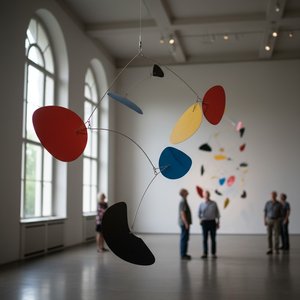
Alexander Calder: Kinetic Sculpture, Mobile Art & the Poetics of Chance
Explore the revolutionary world of Alexander Calder's kinetic sculptures & mobiles. Discover insights for collectors, acquisition advice, and the enduring legacy of this modern master. Expert analysis & art valuation.

Geometrisk Abstraksjon: Topp 10 Mesterverk for Kunstelskere – OriginalUniqueArt.com
Utforsk de 10 mest innflytelsesrike verkene innen geometrisk abstraksjon! Oppdag historiene bak Mondrian, Kandinsky og Malevich. Finn inspirasjon til interiøret med OriginalUniqueArt.coms eksklusive reproduksjoner – museumskvalitet for ditt hjem. Utforsk samlingen online!

Bronseklassikere: 10 skulpturer som revolusjonerte kunsten | OriginalUniqueArt
Utforsk 10 legendariske bronseskulpturer som formet kunsthistorien! Fra Rodin til Michelangelo – oppdag historiene, teknikkene og skjønnheten bak tidløse mesterverk. Finn din perfekte veggkunst eller interiørdekor på OriginalUniqueArt.com.

Neo-Abstract Art: The High-Impact Evolution of Modern Visual Energy and Geometric Sophistication
Discover the power of Neo-Abstract art. Explore how bold geometric forms and high-impact visual energy are redefining modern design. Learn to curate sophisticated, high-energy spaces with the latest trends in contemporary abstraction and structural color.
