

 Se i rommet
 Del som digitalt kort
 Del
Del
 Detaljer
 Studentguide

 Last ned
 Liknende objekter
 Røntgen
 Lysbildefremvisning
 Besøksstatistikk
René Vallery-Radot


 Les mer
Giclée / Kunsttrykk
Giclée- eller lerretsprint av museumskvalitet med rask produksjon og fleksible valgmuligheter for etterbehandling. ( Bestill håndmalt reproduksjon Gå til digitalt bilde)




P118B Nkr10

P118H Nkr10

P118W Nkr10

P438Z Nkr10

P508JH Nkr12

P508YH Nkr12

P805H Nkr10

P805Z Nkr10

P919BZ Nkr10

P919G Nkr10

P919XJ Nkr10

P959ZH Nkr10

P968JZ Nkr12

W106C Nkr8

W218G Nkr10

W218JH Nkr8

W218Y Nkr10

W307PJ Nkr10

W316G Nkr10

W316PJ Nkr8

W316Y Nkr10

W398PJ Nkr8

W4111J Nkr10

W500HY Nkr15

W500JH Nkr15

W692G Nkr12

W849H Nkr8

W940BG Nkr15

W953PJ Nkr8




Velg mellom våre forhåndsdefinerte størrelser som bevarer kunstverkets opprinnelige proporsjoner.

Skriv inn bredden og høyden du trenger, slik at den passer til din ramme eller vegg. Et trykk kan kun beskjæres, aldri gjøres større enn bildet, så et format med en annen form vil miste en del av motivet. Vi sender deg en digital mockup for godkjenning før vi trykker noe som helst. Bildet som vises på denne siden viser ikke den faktiske beskjæringen — det er kun mockuppen som gjør det.
Verdensomspennende levering () på 2 uker i stedet for standard 4/5 uker. (26 October)

Gratis ekspressfrakt over hele verden

Lerretsduk av høykvalitets lin

Full transportforsikring

Garanti for refusjon av toll og importavgifter

Garantert fargeekthet

100 dagers returrett ved fabrikasjonsfeil

100% pengene tilbake-garanti

Mengderabatt
 Glassalternativet er kun tilgjengelig i størrelser under 110 cm

René Vallery-Radot
Giclée / Kunsttrykk
Format på reproduksjon
-


Totalpris
Nkr 760
The Canvas as a Window: Albert Edelfelt’s Portrait of René Vallery-Radot
Albert Edelfelt's 1888 painting, “Portrait of René Vallery-Radot,” isn’t merely a likeness; it’s a carefully constructed tableau that speaks volumes about the man himself and the era in which he lived. Within the confines of a modestly sized canvas—measuring just over 45 by 31 centimeters—Edelfelt has captured not simply a face, but an entire life subtly interwoven with intellectual curiosity and familial devotion. The painting immediately draws the eye to René Vallery-Radot himself, seated at his desk, bathed in the soft glow of diffused light. His posture is relaxed yet attentive, suggesting a man deeply absorbed in thought – perhaps reviewing research notes or contemplating the implications of his scientific work alongside his role as husband and father.
Edelfelt’s masterful technique reveals a deliberate balance between realism and impressionistic sensitivity. He employs a meticulous attention to detail, evident in the rendering of René's features—the thoughtful furrow of his brow, the subtle lines around his eyes, and the precise brushstrokes defining his mustache. Yet, he avoids a photographic likeness, instead opting for a looser, more atmospheric approach to color and light. The background is deliberately muted, allowing the focus to remain firmly on the subject, while still hinting at the domestic setting—a testament to Edelfelt’s ability to capture not just what is seen but also the essence of a scene.
A Life in Science and Family: Contextualizing the Portrait
To fully appreciate “Portrait of René Vallery-Radot,” it's crucial to understand the context surrounding his life. René Vallery-Radot was a prominent figure in the scientific community, renowned for his work alongside Louis Pasteur in establishing pasteurization—a process that revolutionized food preservation and public health. He wasn’t simply an assistant; he played a vital role in developing and refining this groundbreaking technique. Simultaneously, he was a devoted husband to Marie-Louise Pasteur (Louis Pasteur's daughter) and a loving father to three children. Edelfelt skillfully portrays these dual roles—the scientist and the family man—without resorting to simplistic stereotypes.
The painting’s composition subtly reinforces this duality. The desk, laden with books, immediately establishes René’s intellectual pursuits. However, the inclusion of a small child's toy – a simple wooden horse – nestled amongst the scholarly volumes hints at his familial responsibilities and the joys of family life. This juxtaposition speaks to the harmonious balance he sought between his scientific endeavors and his personal relationships.
Symbolism and Emotional Resonance
Beyond its straightforward depiction, “Portrait of René Vallery-Radot” is rich in symbolic detail. The books on the desk represent knowledge, learning, and intellectual legacy—a direct reflection of René’s contributions to science. The muted colors and soft lighting evoke a sense of quiet contemplation and domestic tranquility. There's an underlying feeling of warmth and stability, suggesting a man grounded in his family and deeply committed to his work. The careful arrangement of the objects on the desk – from the inkwell to the writing implements—creates a visual rhythm that draws the eye inward, inviting the viewer to share in René’s focused attention.
Furthermore, the painting can be interpreted as a celebration of the Victorian ideal of domesticity. While acknowledging the scientific advancements of the era, Edelfelt subtly emphasizes the importance of family and intellectual pursuits within a stable home environment. It's a portrait that speaks to the values of hard work, dedication, and familial love—qualities highly esteemed in 19th-century society.
A Timeless Masterpiece: Reproductions and Artistic Legacy
Albert Edelfelt’s “Portrait of René Vallery-Radot” remains a captivating work of art, offering a glimpse into the life of a remarkable scientist and devoted family man. Reproductions of this painting are available in various sizes and formats, allowing art enthusiasts to bring this evocative image into their homes or offices. Whether displayed as a statement piece in a study or a thoughtful addition to a living room, this portrait continues to resonate with its quiet dignity, intellectual depth, and subtle emotional power—a testament to Edelfelt’s enduring artistic legacy.
Spørsmål og svar
Bruker "René Vallery-Radot" av Albert Edelfelt sterke kontraster eller myke harmonier?
I "René Vallery-Radot" blir en Bold kontrast parret med en Strong Color Unity harmoni.
Hvor kan jeg kjøpe et digitalt bilde av "René Vallery-Radot" av Albert Edelfelt?
For å få en digital fil av "René Vallery-Radot" av Albert Edelfelt, bestill nedlasting av et digitalt bilde i høy oppløsning på siden Digitalt bilde.
Hvilket rom foreslås det at "René Vallery-Radot" plasseres i, med tanke på fargepaletten?
De Earthy fargene i "René Vallery-Radot" av Albert Edelfelt harmonerer med det anbefalte rommet: et Living Room.
Kunstnerbiografi
Early Life and Education
Albert Gustaf Aristides Edelfelt, a renowned Finnish painter, was born on July 21, 1854, in Porvoo, Finland. His parents, Carl Albert Edelfelt, an architect of Swedish descent, and Alexandra Edelfelt (née Brandt), a kjøpmannsdatter from Borgå, faced considerable financial hardship after his father’s untimely death when Albert was young. Despite these difficulties, Alexandra tirelessly cared for her children, fostering Albert's innate passion for art from a tender age. He began formal artistic studies in 1869 at the Drawing School of the Finnish Art Society in Helsinki, where he honed his skills under the guidance of Adolf von Becker. This early training instilled in him a dedication to realism and observation—principles that would define his entire oeuvre.Artistic Journey
Edelfelt’s artistic trajectory led him through several prestigious institutions, shaping his understanding of European art history and technique: Antwerp Academy of Art (1873-74), where he immersed himself in the study of monumental history painting under Jean-Léon Gérôme; École nationale des beaux-arts in Paris (1874-78), where he benefited from Gérôme’s mentorship, refining his draftsmanship and mastering the nuances of tonal gradation. A brief period spent in Saint Petersburg exposed him to Russian artistic traditions and broadened his visual vocabulary. These formative experiences cemented Edelfelt's commitment to capturing the essence of human experience with meticulous detail and emotional resonance.Rise to Prominence and Notable Works
Edelfelt’s breakthrough arrived at the Paris Universal Exposition of 1889, securing him a gold medal—a testament to his burgeoning talent and artistic vision. Among his most celebrated paintings are “Portrait of Louis Pasteur,” which garnered him the Legion of Honour in 1886, capturing Pasteur's intellectual intensity with remarkable accuracy; “Young Woman in Her Boudoir,” an evocative depiction of feminine grace and vulnerability; and “Under the Birches,” a poignant landscape masterpiece that embodies Finnish rural life and conveys a profound sense of tranquility. His influence extended to younger Finnish artists like Akseli Gallen-Kallela and Gunnar Berndtson, whom he assisted in establishing their careers in Paris—a legacy that continues to inspire artistic creativity today.Legacy and Impact
Albert Edelfelt stands as one of Finland’s foremost painters from the late 19th century, marking a pivotal moment in Finnish art history. He championed realism as a means of portraying the natural world and human emotion with uncompromising honesty—a stylistic choice that resonated deeply with his contemporaries and established him as a pioneer of Finnish artistic expression. His works are housed in prominent museums across Finland, including Ateneum Museum in Helsinki, ensuring that Edelfelt’s artistic legacy endures for generations to come. Furthermore, his birth anniversary was commemorated with €100 albert edelfelt commemorative coin in 2004—a symbolic gesture honoring his enduring contribution to Finnish culture and art.Museum Collections and Commemoration
Edelfelt's paintings are showcased in Ateneum Museum in Helsinki, Finland, where visitors can admire masterpieces like “Young Woman in Her Boudoir” and “Under the Birches.” His artistic achievements were honored with a €100 albert edelfelt commemorative coin in 2004, celebrating his 150th birth anniversary—a lasting testament to his significance as a cultural icon.
Albert Edelfelt
1854 - 1905 , Finland
Kort om kunstneren
- Artistic Movement Or Style: Realism
- Artists Or Movements Influenced By This Artist:
- Akseli Gallen-Kallela
- Gunnar Berndtson
- Artists Who Influenced This Artist: ['Jean-Léon Gérôme']
- Date Of Birth: July 21, 1854
- Date Of Death: August 18, 1905
- Full Name: Albert Gustaf Aristides Edelfelt
- Nationality: Finnish
- Notable Artworks:
- Portrait of Louis Pasteur
- Young woman in her boudoir
- Under the birches
- Place Of Birth: Porvoo, Finland
Relaterte artikler

Romantic Realism's Finest: 10 Masterpieces for Your Home | OriginalUniqueArt
Explore 10 defining masterpieces of Romantic Realism! Discover Courbet, Millet & Daumier's powerful paintings—capturing emotion and social realities. Find museum-quality reproductions for your home at OriginalUniqueArt.com.

The Evocative Embrace of Reality: Exploring Romantic Realism in 19th-Century Painting
Explore the captivating world of Romantic Realism! Discover key artists like Courbet & Millet, masterpieces, and the social context behind this influential art movement. Expert insights for collectors at OriginalUniqueArt.
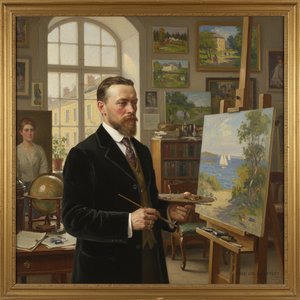
Albert Edelfelt: A Pioneer of Finnish Realism & International Impressionist Circles
Explore the life & work of Albert Edelfelt, a pioneering Finnish Realist painter who bridged Impressionism & national identity. Discover his masterpieces and lasting influence on art history.
Realism in Art: A Professional Guide to Authentic Detail and Lifelike Masterpieces for Large-Scale Interior Projects
Master the use of Realism in professional interiors. This expert guide explores 19th-century masterpieces, offering procurement managers and designers technical insights into selecting authentic, hand-painted oil reproductions for high-end hotel and corporate projects.

Echoes of Society: Exploring Social Realism's Enduring Legacy in Art
Explore the powerful world of Social Realism art! Discover key artists, masterpieces & its profound social commentary. Expert insights into this influential movement's history and enduring legacy.
