
 Forhåndsvisning
 Send
Send Del
Del
 Vis detaljer
 Utskriftsvennlig guide

 Last ned bilde
 Liknende objekter
 Røntgenundersøkelse
 Lysbildefremvisning
 Q&A
Q&A Statistikk
Louis Pasteur dans son laboratoire de l


 Vis hele teksten
Giclée / Kunsttrykk
Giclée- eller lerretsprint av museumskvalitet med rask produksjon og fleksible valgmuligheter for etterbehandling. ( Kjøp håndmalt maleri Bytt til digitalt bilde)




P118B Nkr10

P118H Nkr10

P118W Nkr10

P438Z Nkr10

P508JH Nkr12

P508YH Nkr12

P805H Nkr10

P805Z Nkr10

P919BZ Nkr10

P919G Nkr10

P919XJ Nkr10

P959ZH Nkr10

P968JZ Nkr12

W106C Nkr8

W218G Nkr10

W218JH Nkr8

W218Y Nkr10

W307PJ Nkr10

W316G Nkr10

W316PJ Nkr8

W316Y Nkr10

W398PJ Nkr8

W4111J Nkr10

W500HY Nkr15

W500JH Nkr15

W692G Nkr12

W849H Nkr8

W940BG Nkr15

W953PJ Nkr8




Velg mellom våre forhåndsdefinerte størrelser som bevarer kunstverkets opprinnelige proporsjoner.

Skriv inn ønsket bredde og høyde for å tilpasse trykket til din ramme eller vegg. Et trykk kan kun beskjæres, aldri skaleres opp utover motivets opprinnelige størrelse, noe som betyr at et format med andre proporsjoner vil føre til tap av deler av bildet. Vi sender deg en digital mockup for godkjenning før vi starter trykkeprosessen. Bildet som vises på denne siden viser ikke den faktiske beskjæringen — det er kun mockuppen som viser dette.
Verdensomspennende levering () på 2 uker i stedet for standard 4/5 uker. (3 November)

Gratis ekspressfrakt over hele verden

Lerretsduk av lin av høy kvalitet

Full transportforsikring

Garanti for refusjon av toll og importavgifter

Garantert fargegjengivelse

100 dagers returrett ved fabrikasjonsfeil

100% pengene tilbake-garanti

Rabatt ved flere kjøp
 Glassalternativet er kun tilgjengelig i størrelser under 110 cm

Louis Pasteur dans son laboratoire de l
Giclée / Kunsttrykk
Størrelse på reproduksjon
-


Totalpris for valgte alternativer
Nkr 769
A Vision of Scientific Eminence
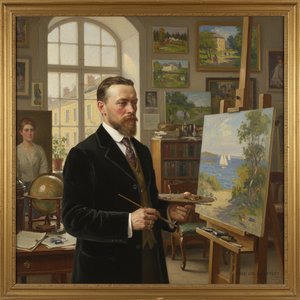
In the quiet, focused atmosphere of a late 19th-century laboratory, Albert Edelfelt captures a moment that transcends mere portraiture to become an icon of human intellect. Louis Pasteur dans son laboratoire is not simply a depiction of a man at work; it is a profound meditation on the dawn of modern medicine. The painting presents the legendary chemist and biologist amidst the glass and shadows of his sanctuary, surrounded by the very tools that would eventually dismantle the ancient myths of disease. As the viewer gazes upon Pasteur, there is an immediate sense of being drawn into a private ritual of discovery, where every flask and test tube holds the potential for a life-saving revelation.
Edelfelt, a master of Academic Realism, employs a technique that breathes life into the inanimate. Through the masterful use of chiaroscuro, the artist orchestrates a dramatic interplay of light and shadow that sculpts Pasteur’s figure with remarkable anatomical precision. The light does not merely illuminate; it directs our attention to the concentrated gaze of the scientist and the delicate transparency of the laboratory glassware. His brushstrokes are smooth and deliberate, creating a seamless texture that allows the viewer to feel the cool surface of the glass and the heavy, purposeful presence of the man himself. This meticulous approach ensures that the painting possesses a timeless, sculptural quality that commands attention in any sophisticated interior.
The Intersection of Art and Discovery
To understand the emotional weight of this masterpiece, one must consider the historical fervor of 1886. This was an era defined by the tension between old superstitions and the burgeoning power of empirical evidence. By placing Pasteur within his laboratory, Edelfeltt provides a visual testament to the Victorian values of progress and meticulous observation. The composition is rich with symbolic weight; the experimental apparatus serves as more than mere background detail—it represents the tangible instruments of the Germ Theory, the very foundation upon which modern public health was built. There is a palpable sense of quiet dignity in Pasteur’s posture, reflecting a man who carries the weight of scientific responsibility on his shoulders.
For the discerning collector or interior designer, this work offers an unparalleled opportunity to introduce a piece of intellectual history into a living space. The painting’s palette, characterized by deep, earthy tones and luminous highlights, provides a sophisticated anchor for a room, evoking a sense of stability, wisdom, and prestige. Whether placed in a private library, a study, or a grand salon, a high-quality reproduction of this work serves as a conversation piece that celebrates the enduring triumph of the human spirit over the unknown. It is an invitation to contemplate the beauty of logic and the profound impact of a single mind dedicated to the service of humanity.
Spørsmål og svar
Hvilken teknikk er brukt i "Louis Pasteur dans son laboratoire de l" av Albert Edelfelt?
"Louis Pasteur dans son laboratoire de l" av Albert Edelfelt er utført i Oil On Canvas. Reproduksjonene har som mål å gjengi utseendet til denne teknikken.
Hvilken teknikk og hvilket årstall er "Louis Pasteur dans son laboratoire de l" av Albert Edelfelt fra?
"Louis Pasteur dans son laboratoire de l" ble laget i 1886 med Oil On Canvas.
Hvilken kunstretning tilhører "Louis Pasteur dans son laboratoire de l" av Albert Edelfelt?
"Louis Pasteur dans son laboratoire de l" av Albert Edelfelt tilhører Impressionistic Portraiture-retningen. Denne retningen gir det stilistiske kontekstet til verket.
Om kunstneren
Early Life and Education
Albert Gustaf Aristides Edelfelt, a renowned Finnish painter, was born on July 21, 1854, in Porvoo, Finland. His parents, Carl Albert Edelfelt, an architect of Swedish descent, and Alexandra Edelfelt (née Brandt), a kjøpmannsdatter from Borgå, faced considerable financial hardship after his father’s untimely death when Albert was young. Despite these difficulties, Alexandra tirelessly cared for her children, fostering Albert's innate passion for art from a tender age. He began formal artistic studies in 1869 at the Drawing School of the Finnish Art Society in Helsinki, where he honed his skills under the guidance of Adolf von Becker. This early training instilled in him a dedication to realism and observation—principles that would define his entire oeuvre.Artistic Journey
Edelfelt’s artistic trajectory led him through several prestigious institutions, shaping his understanding of European art history and technique: Antwerp Academy of Art (1873-74), where he immersed himself in the study of monumental history painting under Jean-Léon Gérôme; École nationale des beaux-arts in Paris (1874-78), where he benefited from Gérôme’s mentorship, refining his draftsmanship and mastering the nuances of tonal gradation. A brief period spent in Saint Petersburg exposed him to Russian artistic traditions and broadened his visual vocabulary. These formative experiences cemented Edelfelt's commitment to capturing the essence of human experience with meticulous detail and emotional resonance.Rise to Prominence and Notable Works
Edelfelt’s breakthrough arrived at the Paris Universal Exposition of 1889, securing him a gold medal—a testament to his burgeoning talent and artistic vision. Among his most celebrated paintings are “Portrait of Louis Pasteur,” which garnered him the Legion of Honour in 1886, capturing Pasteur's intellectual intensity with remarkable accuracy; “Young Woman in Her Boudoir,” an evocative depiction of feminine grace and vulnerability; and “Under the Birches,” a poignant landscape masterpiece that embodies Finnish rural life and conveys a profound sense of tranquility. His influence extended to younger Finnish artists like Akseli Gallen-Kallela and Gunnar Berndtson, whom he assisted in establishing their careers in Paris—a legacy that continues to inspire artistic creativity today.Legacy and Impact
Albert Edelfelt stands as one of Finland’s foremost painters from the late 19th century, marking a pivotal moment in Finnish art history. He championed realism as a means of portraying the natural world and human emotion with uncompromising honesty—a stylistic choice that resonated deeply with his contemporaries and established him as a pioneer of Finnish artistic expression. His works are housed in prominent museums across Finland, including Ateneum Museum in Helsinki, ensuring that Edelfelt’s artistic legacy endures for generations to come. Furthermore, his birth anniversary was commemorated with €100 albert edelfelt commemorative coin in 2004—a symbolic gesture honoring his enduring contribution to Finnish culture and art.Museum Collections and Commemoration
Edelfelt's paintings are showcased in Ateneum Museum in Helsinki, Finland, where visitors can admire masterpieces like “Young Woman in Her Boudoir” and “Under the Birches.” His artistic achievements were honored with a €100 albert edelfelt commemorative coin in 2004, celebrating his 150th birth anniversary—a lasting testament to his significance as a cultural icon.
Albert Edelfelt
1854 - 1905 , Finland
Kort om kunstneren
- Artistic Movement Or Style: Realism
- Artists Or Movements Influenced By This Artist:
- Akseli Gallen-Kallela
- Gunnar Berndtson
- Artists Who Influenced This Artist: ['Jean-Léon Gérôme']
- Date Of Birth: July 21, 1854
- Date Of Death: August 18, 1905
- Full Name: Albert Gustaf Aristides Edelfelt
- Nationality: Finnish
- Notable Artworks:
- Portrait of Louis Pasteur
- Young woman in her boudoir
- Under the birches
- Place Of Birth: Porvoo, Finland
Relaterte artikler
Albert Edelfelt: A Pioneer of Finnish Realism & International Impressionist Circles
Explore the life & work of Albert Edelfelt, a pioneering Finnish Realist painter who bridged Impressionism & national identity. Discover his masterpieces and lasting influence on art history.

Paul Cézannes 25 Mesterverk: En Kunstnerisk Reise for Ditt Hjem
Utforsk Paul Cézannes 25 mest ikoniske malerier! Oppdag historien bak impresjonismens mesterverk, fra stilleben til landskap. Finn kunsttrykk av høy kvalitet og interiørinspirasjon på OriginalUniqueArt.com.

Albert Charles Lebourg: A Study in Atmospheric Impressionism & Rural France
Explore the serene landscapes of Albert Charles Lebourg, a master of the Rouen School Impressionists. Discover his atmospheric paintings of the Seine and enduring legacy in 19th-century French art.

Impressionismens Mesterverk: Topp 10 Kunstverk for Ditt Hjem
Oppdag impressionismens magi! Utforsk 10 ikoniske kunstverk av Monet, Renoir & Degas. Lær om historien bak maleriene og finn inspirasjon til din egen veggkunst på OriginalUniqueArt.com – museumskvalitet for hjemmet ditt.

Utover Lys og Farge: Impresjonisme vs. Postimpresjonisme for den kresne samleren
Dykk ned i impresjonismens og postimpresjonismens verden med vår ekspertguide. Lær å identifisere, vurdere og investere i mesterverk fra Monet, Van Gogh og Cézanne. For den kresne kunstsamleren.
