

 Se i rommet
 Del som digitalt kort
 Del
Del
 Detaljer
 Studentguide

 Last ned
 Liknende objekter
 Røntgen
 Lysbildefremvisning
 Besøksstatistikk
Conveying a Child
 Oil On Canvas
- WallArt
- Realism
 1879
1879- 19th Century
 204.0 x 120.0 cm
 Ateneum Art Museum
 Les mer
Håndlaget oljereproduksjon
Håndmalt olje på lerret i din valgte størrelse og ramme, laget på bestilling av våre kunstnere. ( Bytt til trykkversjon Gå til digitalt bilde)




P118B Nkr10

P118H Nkr10

P118W Nkr10

P438Z Nkr10

P508JH Nkr12

P508YH Nkr12

P805H Nkr10

P805Z Nkr10

P919BZ Nkr10

P919G Nkr10

P919XJ Nkr10

P959ZH Nkr10

P968JZ Nkr12

W106C Nkr8

W218G Nkr10

W218JH Nkr8

W218Y Nkr10

W307PJ Nkr10

W316G Nkr10

W316PJ Nkr8

W316Y Nkr10

W398PJ Nkr8

W4111J Nkr10

W500HY Nkr15

W500JH Nkr15

W692G Nkr12

W849H Nkr8

W940BG Nkr15

W953PJ Nkr8




Velg mellom våre forhåndsdefinerte størrelser som bevarer kunstverkets opprinnelige proporsjoner.

Skriv inn bredden og høyden du trenger, slik at den passer til din ramme eller vegg. Dette er håndmalt, så for en størrelse med en annen form kan kunstneren male litt mer rundt bildet, eller beskjære det noe — du velger selv. Vi sender deg en digital mockup for godkjenning før maleriet påbegynnes. Bildet som vises på denne siden viser ikke det faktiske resultatet — kun mockuppen gjør det.
Etter bestilling vil OriginalUniqueArt.com-teamet sende e-post til kunden for instruksjoner og sende et utkast (mockup) som forhåndsvisning.
Verdensomspennende levering () på 3–4 uker i stedet for standard 5 uker. (22 October). Ingen kompromisser med kvaliteten.

Gratis ekspressfrakt over hele verden

Lerretsduk av høykvalitets lin

Full transportforsikring

Garanti for refusjon av toll og importavgifter

Garantert fargeekthet

100 dagers returrett ved fabrikasjonsfeil

100% pengene tilbake-garanti

Mengderabatt
 Glassalternativet er kun tilgjengelig i størrelser under 110 cm

Conveying a Child
Reproduksjonsmetode
Format på reproduksjon
-


Totalpris
Nkr 2832
Albert Edelfelt’s ‘Conveying a Child’: A Window into Finnish Life and Sorrow
Albert Edelfelt's “Conveying a Child” (1879) is more than just a depiction of a boat journey; it’s a poignant meditation on mortality, family, and the quiet dignity found in accepting life’s inevitable sorrows. Painted during a pivotal moment in Edelfelt’s artistic development – his fervent embrace of plein-air realism – this large oil on canvas transports us to Haikko near Porvoo, Finland, a place steeped in both beauty and profound melancholy.
The scene unfolds with remarkable clarity. A group of individuals, rendered with meticulous detail, are gathered within a sturdy rowing boat navigating the waters of the Gulf of Finland. Men and women, dressed in the attire of the late 19th century, engage in conversation or simply bask in the tranquility of the moment. Two boats – a larger vessel dominating the foreground and a smaller one positioned to the right – add depth and visual interest to the composition. Edelfelt’s skill lies not just in his technical proficiency but in capturing the genuine warmth and connection between these figures, suggesting a shared experience of comfort and companionship.
Plein-Air Realism and the Rise of Finnish Art
“Conveying a Child” represents a significant shift in Edelfelt’s artistic approach. Following his time studying in Antwerp and Paris, he became increasingly committed to painting directly from nature – a revolutionary concept at the time. This dedication to *plein-air* realism was driven by a desire to capture the authentic essence of Finnish life, moving away from the idealized historical subjects favored by many of his contemporaries. Edelfelt’s decision to paint entirely outdoors, as evidenced by this work, aligns with the broader movement towards naturalism gaining traction within the European art world.
This commitment to realism was particularly important for Edelfelt, who sought to elevate Finnish culture on the international stage. His work served as a powerful visual record of rural life in Finland, showcasing its beauty and resilience – a crucial step toward establishing a distinct national identity amidst growing political pressures.
A Symbol of Loss and Remembrance
The inclusion of a coffin within the scene is undeniably the painting’s most arresting element. It immediately introduces an undercurrent of sadness and mortality, transforming what might otherwise be a simple depiction of leisure into a profound meditation on death and remembrance. The young girl in the boat, holding the coffin, adds to the emotional weight of the image – she represents innocence lost, a poignant reminder of life’s fragility.
Edelfelt's use of light and shadow further enhances this sense of solemnity. The soft, diffused sunlight creates an atmosphere of quiet contemplation, while the dark tones of the coffin contrast sharply with the brighter hues of the surrounding landscape. This juxtaposition amplifies the painting’s emotional impact, inviting viewers to reflect on themes of grief, loss, and the cyclical nature of life.
Technical Mastery and a Lasting Legacy
"Conveying a Child" is a testament to Edelfelt's mastery of oil paint. His brushwork is both precise and expressive, capturing the textures of the boat’s wood, the ripples on the water, and the subtle nuances of human expression. The painting’s scale – 204 x 120 cm – allows for a deeply immersive experience, drawing the viewer into the scene and fostering a powerful connection with the subjects.
Today, this remarkable artwork continues to resonate with audiences worldwide. Its timeless themes, combined with Edelfelt's exceptional artistic skill, ensure its place as a cornerstone of Finnish art history – a poignant reminder of life’s beauty and the inevitability of loss. OriginalUniqueArt offers a meticulously hand-painted reproduction that faithfully captures the essence of this iconic masterpiece, allowing you to bring its profound emotion into your own space.
Spørsmål og svar
Hvilken atmosfære har "Conveying a Child"?
"Conveying a Child" av Albert Edelfelt beskrives med en Calm stemning. Denne klassifiseringen kan bidra til å matche verket med et passende miljø.
Hvilken stemning og følelse forenes i "Conveying a Child"?
I "Conveying a Child" ledsages en Calm stemning av en Reflective følelse.
Hva er målene på det originale verket "Conveying a Child" av Albert Edelfelt?
Det originale verket "Conveying a Child" av Albert Edelfelt måler 204 x 120 cm.
Kunstnerbiografi
Early Life and Education
Albert Gustaf Aristides Edelfelt, a renowned Finnish painter, was born on July 21, 1854, in Porvoo, Finland. His parents, Carl Albert Edelfelt, an architect of Swedish descent, and Alexandra Edelfelt (née Brandt), a kjøpmannsdatter from Borgå, faced considerable financial hardship after his father’s untimely death when Albert was young. Despite these difficulties, Alexandra tirelessly cared for her children, fostering Albert's innate passion for art from a tender age. He began formal artistic studies in 1869 at the Drawing School of the Finnish Art Society in Helsinki, where he honed his skills under the guidance of Adolf von Becker. This early training instilled in him a dedication to realism and observation—principles that would define his entire oeuvre.Artistic Journey
Edelfelt’s artistic trajectory led him through several prestigious institutions, shaping his understanding of European art history and technique: Antwerp Academy of Art (1873-74), where he immersed himself in the study of monumental history painting under Jean-Léon Gérôme; École nationale des beaux-arts in Paris (1874-78), where he benefited from Gérôme’s mentorship, refining his draftsmanship and mastering the nuances of tonal gradation. A brief period spent in Saint Petersburg exposed him to Russian artistic traditions and broadened his visual vocabulary. These formative experiences cemented Edelfelt's commitment to capturing the essence of human experience with meticulous detail and emotional resonance.Rise to Prominence and Notable Works
Edelfelt’s breakthrough arrived at the Paris Universal Exposition of 1889, securing him a gold medal—a testament to his burgeoning talent and artistic vision. Among his most celebrated paintings are “Portrait of Louis Pasteur,” which garnered him the Legion of Honour in 1886, capturing Pasteur's intellectual intensity with remarkable accuracy; “Young Woman in Her Boudoir,” an evocative depiction of feminine grace and vulnerability; and “Under the Birches,” a poignant landscape masterpiece that embodies Finnish rural life and conveys a profound sense of tranquility. His influence extended to younger Finnish artists like Akseli Gallen-Kallela and Gunnar Berndtson, whom he assisted in establishing their careers in Paris—a legacy that continues to inspire artistic creativity today.Legacy and Impact
Albert Edelfelt stands as one of Finland’s foremost painters from the late 19th century, marking a pivotal moment in Finnish art history. He championed realism as a means of portraying the natural world and human emotion with uncompromising honesty—a stylistic choice that resonated deeply with his contemporaries and established him as a pioneer of Finnish artistic expression. His works are housed in prominent museums across Finland, including Ateneum Museum in Helsinki, ensuring that Edelfelt’s artistic legacy endures for generations to come. Furthermore, his birth anniversary was commemorated with €100 albert edelfelt commemorative coin in 2004—a symbolic gesture honoring his enduring contribution to Finnish culture and art.Museum Collections and Commemoration
Edelfelt's paintings are showcased in Ateneum Museum in Helsinki, Finland, where visitors can admire masterpieces like “Young Woman in Her Boudoir” and “Under the Birches.” His artistic achievements were honored with a €100 albert edelfelt commemorative coin in 2004, celebrating his 150th birth anniversary—a lasting testament to his significance as a cultural icon.
Albert Edelfelt
1854 - 1905 , Finland
Kort om kunstneren
- Artistic Movement Or Style: Realism
- Artists Or Movements Influenced By This Artist:
- Akseli Gallen-Kallela
- Gunnar Berndtson
- Artists Who Influenced This Artist: ['Jean-Léon Gérôme']
- Date Of Birth: July 21, 1854
- Date Of Death: August 18, 1905
- Full Name: Albert Gustaf Aristides Edelfelt
- Nationality: Finnish
- Notable Artworks:
- Portrait of Louis Pasteur
- Young woman in her boudoir
- Under the birches
- Place Of Birth: Porvoo, Finland
Relaterte artikler

Capturing Ephemeral Light: Plein Air Painting from Impressionism to Today
Explore the history of plein air painting, from its origins with the Barbizon school to Impressionism's revolution & contemporary practice. Discover techniques, artists like Monet & Renoir, and find museum-quality reproductions at OriginalUniqueArt.
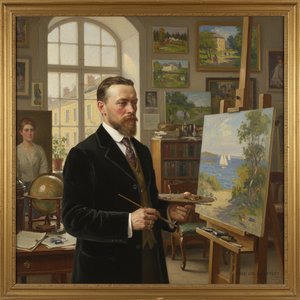
Albert Edelfelt: A Pioneer of Finnish Realism & International Impressionist Circles
Explore the life & work of Albert Edelfelt, a pioneering Finnish Realist painter who bridged Impressionism & national identity. Discover his masterpieces and lasting influence on art history.

Capturing Ephemeral Light: A Comprehensive Exploration of Plein Air Painting's History & Enduring Legacy
Explore the rich history of plein air painting, from its origins to Impressionism & beyond. Discover key artists, techniques, and the enduring legacy of capturing light in landscape art. Find museum-quality reproductions at OriginalUniqueArt.
The Allure of Open Airs: Exploring Representations of Outdoors in Art History
Explore the rich history of outdoor painting! From Romantic landscapes to Impressionism's revolution, discover key artists, techniques & the enduring legacy of capturing light and nature in art. Learn more at OriginalUniqueArt.

Capturing Ephemeral Light: A Comprehensive Exploration of Plein Air Painting's History & Enduring Legacy
Explore the rich history of plein air painting, from its origins with Constable & Corot to Impressionism's revolution. Discover techniques, key artists, and the enduring legacy of capturing light outdoors. Learn more at OriginalUniqueArt.
