Bytt til trykk
 Vis hele teksten







































 For kunstverk eller reproduksjoner som er større enn 105 cm (ca. 41 tommer) på noen side, vil rammen bli sendt som et sett som må monteres. Denne metoden sikrer trygg levering og forhindrer skader under transport.


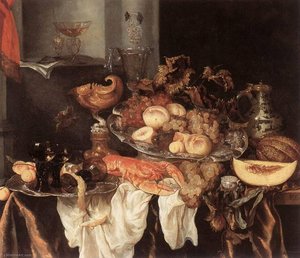
A Symphony of Light and Color: Exploring Abraham Hendricksz. van Beyeren’s Still Life
The Dutch Golden Age witnessed an unparalleled flourishing of artistic creativity, fueled by economic prosperity and an insatiable intellectual curiosity. Among the luminaries of this era stands Abraham Hendricksz. van Beyeren (1620 – 1690), a painter whose meticulous depictions of fruit, vegetables, and fish continue to captivate audiences centuries later. His masterpiece, “Still Life,” transcends mere representation; it embodies the spirit of its time—a profound appreciation for the natural world intertwined with masterful artistic execution. This work serves as a window into a period where the material abundance of the Netherlands was celebrated through the lens of extreme technical precision and luminous beauty.
The painting presents a breathtaking tableau, a tabletop adorned with an abundant assortment of nature's finest offerings. Apples, oranges, and bananas are arranged in a harmonious dance across the surface, accompanied by the delicate clusters of grapes that add a touch of organic elegance to the scene. The composition is thoughtfully balanced, featuring various bowls that suggest a bountiful feast, while a decorative vase on the left introduces a structural grace to the arrangement. For the discerning collector or interior designer, this piece offers more than just visual interest; it provides a sense of opulence and permanence, making it an ideal centerpiece for spaces that value classical sophistication and the quiet grandeur of the Baroque tradition.
The Master’s Touch: Technique and the Legacy of Light
Van Beyeren’s artistic journey was profoundly shaped by his connection to the masters of Delft, with many accounts suggesting the influence of Johannes Vermeer. This lineage is unmistakably evident in his sophisticated command of light—a quality that allows him to transform simple objects into luminous protagonists. He embraced the philosophy that "light is the soul of painting," striving to capture the subtle interplay between sunlight and shadow to create a sense of palpable presence. His technique involved a meticulous layering process known as glazing, where thin washes of translucent color are applied over opaque pigments. This method allowed him to build up tonal gradations with astonishing subtlety, creating an illusion of depth and texture that makes the skin of an orange or the dew on a grape feel almost touchable.
Beyond the technical brilliance, there is a deep emotional resonance within the work. As his career matured, van Beyeren moved away from the dramatic, theatrical intensity of early Baroque chiaroscuro toward a more serene and contemplative aesthetic. This evolution is captured perfectly in this piece, where the palette is soft and luminous, celebrating the quiet beauty of the natural world. The painting does not merely show food; it invites the viewer into a moment of stillness, encouraging a meditative appreciation for the fleeting beauty of life. For those seeking to infuse their homes with an atmosphere of tranquility and refined taste, this reproduction offers a timeless connection to the mastery of the seventeenth-century Dutch masters.
Spørsmål og svar
Hvordan kan jeg se "Still-Life" av Abraham Hendricksz. Van Beyeren som en lysbildefremvisning?
Se lysbildefremvisningen her: Bildekarusell for "Still-Life" av Abraham Hendricksz. Van Beyeren.
Finnes det et faktablad om "Still-Life" av Abraham Hendricksz. Van Beyeren for studenter?
Guiden til "Still-Life" er kunstverkets Faktablad for studenter-side – et utskrivbart faktablad som viser kunstverket med bildetekst, kreditering og informasjonstabell (kunstner, datoer, medium, original størrelse, samling).
Hva er årsaken til opphavsrettssituasjonen for "Still-Life" av Abraham Hendricksz. Van Beyeren?
"Still-Life" av Abraham Hendricksz. Van Beyeren er fritt tilgjengelig – opphavsretten har utløpt. Opphavsretten beregnes fra kunstnerens dødsår, og Abraham Hendricksz. Van Beyeren døde i 1690.
 Forhåndsvisning
 Send
Send Del
Del
 Vis detaljer
 Utskriftsvennlig guide

 Last ned bilde
 Liknende objekter
 Røntgenundersøkelse
 Lysbildefremvisning
 Spørsmål og svar
 Statistikk