Portret van Theo van Doesburg

Schilderijen van Theo van Doesburg: De 100 bekendste, door de ogen van een galerie

Bijgewerkt in november 2026 · gerangschikt op basis van onze populariteitsscore (zoekopdrachten, bezoeken en bestellingen per kunstwerk) · 225 werken van Theo van Doesburg in onze catalogus

Kortom

In het oog van de galerie is het beroemdste schilderij van Theo van Doesburg Counter composition XV (1925). Rhythm of a Russian Dance en Troelstra (1910) maken het trio compleet dat elk oog herkent. Van de 225 werken van Theo van Doesburg in onze catalogus presenteert de galerie hieronder de 100 bekendste werken, elk een origineel met de jaartal, het museum en wat het uniek maakt.

1883 – 1931, Utrecht De stijl Meeste werken: Centraal Museum

De top 10 schilderijen van Theo van Doesburg in de galerie

1
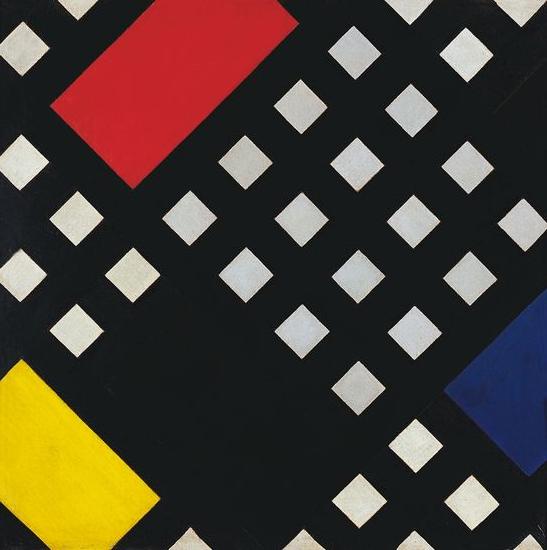
Counter composition XV (1925) door Theo van Doesburg

Counter composition XV

1925 · Acrylic On Canvas

Theo van Doesburg's "Counter Composition XV," painted in 1925, isn’t merely a painting; it’s a distilled essence of the De Stijl movement – a radical declaration of order and universal harmony. This deceptively simple work, executed against a stark white canvas, pulsates with an underlying tension born from the careful orchestration of geometric forms and primary colors. It represents a pivotal moment in 20th-century art, moving beyond representational imagery to…

2
Rhythm of a Russian Dance door Theo van Doesburg

Rhythm of a Russian Dance

Oil On Canvas

The composition consists of an arrangement of intersecting horizontal and vertical lines that form a series of rectangular and square shapes. These geometric forms overlap across the canvas, creating a sense of depth through visual layering rather than traditional perspective. The color palette is restricted to white, black, blue, pink, and gold or yellow hues. Each color is applied in flat planes with minimal shading, resulting in a smooth and…

3
Troelstra (1910) door Theo van Doesburg

Troelstra

1910 · Charcoal

The artwork Troelstra is a monochromatic portrait rendered in charcoal on paper, dating to 1910. The composition is tightly focused on the head and shoulders of the subject, creating an intimate and close-up view. The man's face occupies the majority of the frame, characterized by an asymmetrical arrangement where features are not proportionally accurate. A collar or cravat is visible around the neck, providing a sense of formality to the…

4
Study for Composition VIII (The Cow) (1918) door Theo van Doesburg

Study for Composition VIII (The Cow)

1918 · Oil

A cow is reduced to a series of intersecting planes. In this 1918 study, the animal is no longer a creature of flesh and breath, but a rhythmic arrangement of vertical and horizontal lines. The subject is stripped of its organic curves, replaced by the sharp precision of a geometric skeleton. Green blocks of color anchor the composition, cutting through a field of white and black. There is a tension…

5
Composition (The Cow) (1917) door Theo van Doesburg

Composition (The Cow)

1917 · Pencil

The eye meets Composition (The Cow), a work that captures a moment of radical transformation. Created by the artist Theo van Doesburg, this piece emerges from 1917, a time when the boundaries of representation begin to fracture. The subject, a cow, exists here not as a living creature of flesh and breath, but as a series of energetic, geometric investigations. It is a study of form that seeks to find…

6
Composition (1923) door Theo van Doesburg

Composition

1923 · Oil On Canvas

The canvas known as Composition emerges from the mind of Theo van Doesburg, a work that captures a specific moment in 1923. This piece exists as a precise arrangement of form and color, born from a period of intense creative focus. The artist, Theo van Doesburg, brings a sense of equilibrium to the surface, translating abstract thought into a tangible presence. It is a work that demands attention through its…

7
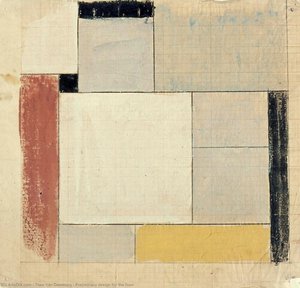
Preliminary design for the floor (1923) door Theo van Doesburg

Preliminary design for the floor

1923 · Pencil

The gaze meets Preliminary design for the floor, a work that breathes with the structured intent of Theo van Doesburg. Created in 1923, this piece exists as a vision for a specific space: a tiled floor intended for the De Vonk holiday home located in Noordwijkerhout. It is a moment of pure architectural thought captured on paper, where the abstract becomes a tangible plan for a lived environment.

8
Composition (1931) door Theo van Doesburg

Composition

1931 · Oil

The painting titled Composition is a work by the artist Theo van Doesburg. Created in 1931, this piece occupies a small, intimate space of 31 x 24 cm. It exists as a quiet arrangement of form and color, captured within its rectangular boundaries.

9
Portrait of a man with hat (1908) door Theo van Doesburg

Portrait of a man with hat

1908 · Oil On Board · Kunstmuseum Den Haag, Den Haag

The portrait presents a close-up, bust-length view of a man wearing a hat. The subject's face occupies the central portion of the frame, positioned slightly to the left. The lighting is low-key, catching the left side of the forehead and the cheek, while the remaining features recede into deep shadow. This use of chiaroscuro creates a sense of depth through the contrast between light and dark. The color palette is…

Schilderijen van Theo van Doesburg, gerangschikt van 11 tot 100

11Portrait of Agnita Feis (1904) door Theo van DoesburgPortrait of Agnita Feis1904 · Centraal Museum 12Female Nude (1904) door Theo van DoesburgFemale Nude1904 13Portrait of a Man with Hat (1909) door Theo van DoesburgPortrait of a Man with Hat1909 14Portrait of a Man with Hat (1908) door Theo van DoesburgPortrait of a Man with Hat1908 15Portrait of Christian Leibbrandt (1908) door Theo van DoesburgPortrait of Christian Leibbrandt1908 16Portrait of Agnita Feis (1906) door Theo van DoesburgPortrait of Agnita Feis1906 · Centraal Museum 17Smiling man (self-portrait?) (1907) door Theo van DoesburgSmiling man (self-portrait?)1907 · Centraal Museum 18Workman head (1906) door Theo van DoesburgWorkman head1906 · Centraal Museum 19Man with moustache and cap (self-portrait?) (1907) door Theo van DoesburgMan with moustache and cap (self-portrait?)1907 · Centraal Museum 20Portrait of a boy en profil (1906) door Theo van DoesburgPortrait of a boy en profil1906 · Centraal Museum 21Workmanshead (1906) door Theo van DoesburgWorkmanshead1906 · Centraal Museum 22Portrait of Agnita Feis with closed eyes (1906) door Theo van DoesburgPortrait of Agnita Feis with closed eyes1906 · Centraal Museum 23Portrait of een man met baret (1908) door Theo van DoesburgPortrait of een man met baret1908 24Don Juan (1910) door Theo van DoesburgDon Juan1910 25Burgerman (1910) door Theo van DoesburgBurgerman1910 26Archangel (1910) door Theo van DoesburgArchangel1910 27Abraham Kuyper (1910) door Theo van DoesburgAbraham Kuyper1910 28Farmer (1910) door Theo van DoesburgFarmer1910 29Alderman of education (1910) door Theo van DoesburgAlderman of education1910 30Quérido (1910) door Theo van DoesburgQuérido1910 31Frederik van Eeden (1910) door Theo van DoesburgFrederik van Eeden1910 32Old Faun (self portrait) (1909) door Theo van DoesburgOld Faun (self portrait)1909 33Dutch peasent girl (1913) door Theo van DoesburgDutch peasent girl1913 · Centraal Museum 34Portrait of A. J. J. de Winter (1916) door Theo van DoesburgPortrait of A. J. J. de Winter1916 35Study for Composition VIII (The Cow) (1917) door Theo van DoesburgStudy for Composition VIII (The Cow)1917 36Beggar (1914) door Theo van DoesburgBeggar1914 · Centraal Museum 37Abstract portrait (1915) door Theo van DoesburgAbstract portrait1915 · Museum de Lakenhal 38Portrait of Nelly van Doesburg (1899-1975) (1922) door Theo van DoesburgPortrait of Nelly van Doesburg (1899-1975)1922 · Museum de Lakenhal 39Self portrait (1928) door Theo van DoesburgSelf portrait1928 · Centraal Museum 40Nelly van Doesburg Viewed from behind, and a harbor scene (1924) door Theo van DoesburgNelly van Doesburg Viewed from behind, and a harbor scene1924 41Dancing man from sketchbook 60 (1931) door Theo van DoesburgDancing man from sketchbook 601931 42Archer (1919) door Theo van DoesburgArcher1919 · Szépművészeti Múzeum 43Tripartite stained glass window door Theo van DoesburgTripartite stained glass window 44Self portrait with hat (1909) door Theo van DoesburgSelf portrait with hat1909 · Centraal Museum 45Café Aubette, Strasbourg, France (Preliminary color scheme for ceiling and short walls of ballroom) (1927) door Theo van DoesburgCafé Aubette, Strasbourg, France (Preliminary color scheme for ceiling and short walls of ballroom)1927 · MoMA - Museum of Modern Art 46Self portrait with hat (1909) door Theo van DoesburgSelf portrait with hat1909 47Composition I (still life) (1916) door Theo van DoesburgComposition I (still life)1916 · Kröller-Müller Museum 48Landscape (1901) door Theo van DoesburgLandscape1901 49Figure on Bridge in Forest (1903) door Theo van DoesburgFigure on Bridge in Forest1903 50Woman in Landscape (1903) door Theo van DoesburgWoman in Landscape1903 · Centraal Museum 51Figure on a Bridge in a Forest (1903) door Theo van DoesburgFigure on a Bridge in a Forest1903 · Centraal Museum 52Landscape (1901) door Theo van DoesburgLandscape1901 · Centraal Museum 53River Landscape with Steeple and Mill (1900) door Theo van DoesburgRiver Landscape with Steeple and Mill1900 54A Child (1904) door Theo van DoesburgA Child1904 55Landscape with hay cart, church towers and windmill (1901) door Theo van DoesburgLandscape with hay cart, church towers and windmill1901 · Centraal Museum 56Still Life (1906) door Theo van DoesburgStill Life1906 57Tree (1906) door Theo van DoesburgTree1906 · Centraal Museum 58Banister post, Huis De Lange, Alkmaar door Theo van DoesburgBanister post, Huis De Lange, Alkmaar 59Portrait of Nelly van Doesburg door Theo van DoesburgPortrait of Nelly van Doesburg 60Self portrait (1906) door Theo van DoesburgSelf portrait1906 61Cover of ''The masks'' (1910) door Theo van DoesburgCover of ''The masks''1910 62The discarded basket (1913) door Theo van DoesburgThe discarded basket1913 · Centraal Museum 63Haystacks (1913) door Theo van DoesburgHaystacks1913 · Centraal Museum 64Study for Composition X (1917) door Theo van DoesburgStudy for Composition X1917 65Composition VI (on black fond) (1917) door Theo van DoesburgComposition VI (on black fond)1917 66Composition (The Cow) (1917) door Theo van DoesburgComposition (The Cow)1917 67Composition (The Cow) (8) (1917) door Theo van DoesburgComposition (The Cow) (8)1917 68Cover of "Balance" by J. Elgenhuis (1916) door Theo van DoesburgCover of "Balance" by J. Elgenhuis1916 69Composition (The Cow) (1917) door Theo van DoesburgComposition (The Cow)1917 70Composition (The Cow) (1917) door Theo van DoesburgComposition (The Cow)1917 71Composition (The Cow) (1917) door Theo van DoesburgComposition (The Cow)1917 72Krishna playing a flute (1916) door Theo van DoesburgKrishna playing a flute1916 73Lena in interieur (1917) door Theo van DoesburgLena in interieur1917 74Colour design for a chimney (1917) door Theo van DoesburgColour design for a chimney1917 75Design for a tile floor, and entrance hall (1917) door Theo van DoesburgDesign for a tile floor, and entrance hall1917 76Stained glass composition ''Woman'' (1917) door Theo van DoesburgStained glass composition ''Woman''1917 77Potrait of Evert Rinsema (1915) door Theo van DoesburgPotrait of Evert Rinsema1915 78Abstract church (1915) door Theo van DoesburgAbstract church1915 79Dance II (1917) door Theo van DoesburgDance II1917 80Street Music I (1915) door Theo van DoesburgStreet Music I1915 81Dance I (1917) door Theo van DoesburgDance I1917 82Street Music II (1915) door Theo van DoesburgStreet Music II1915 83Design for a tile floor, and entrance hall (1917) door Theo van DoesburgDesign for a tile floor, and entrance hall1917 84Leaded glass composition I (1917) door Theo van DoesburgLeaded glass composition I1917 85The Cardplayers (1916) door Theo van DoesburgThe Cardplayers1916 86Composition with window with coloured glass III (1917) door Theo van DoesburgComposition with window with coloured glass III1917 87Composition II (Still life) (1916) door Theo van DoesburgComposition II (Still life)1916 88Landscape (1916) door Theo van DoesburgLandscape1916 89Portrait of Lena Milius (1915) door Theo van DoesburgPortrait of Lena Milius1915 90Dunes and sea (1912) door Theo van DoesburgDunes and sea1912 · Kröller-Müller Museum 91Still Life with Bottle (1919) door Theo van DoesburgStill Life with Bottle1919 · Museum de Lakenhal 92Still Life (1918) door Theo van DoesburgStill Life1918 93Plastic garden (Vases) (1919) door Theo van DoesburgPlastic garden (Vases)1919 94Study for Rhythm of a Russian Dance (1918) door Theo van DoesburgStudy for Rhythm of a Russian Dance1918 95Study for Rhythm of a Russian Dance (1918) door Theo van DoesburgStudy for Rhythm of a Russian Dance1918 96Landscape (study for composition XII) (1918) door Theo van DoesburgLandscape (study for composition XII)1918 97Composition in gray (Rag Time) (1919) door Theo van DoesburgComposition in gray (Rag Time)1919 · Solomon R. Guggenheim Museum 98Cover design for magazine ''Klei'' (1920) door Theo van DoesburgCover design for magazine ''Klei''1920 99Cover of ''Classic, Modern, Baroque'' (1920) door Theo van DoesburgCover of ''Classic, Modern, Baroque''1920 100Cover of ''Three lectures about the new art'' (1919) door Theo van DoesburgCover of ''Three lectures about the new art''1919

De beroemde schilderijen van Theo van Doesburg, periode voor periode

De onderwerpen die de aandacht van Theo van Doesburg troffen

De vier onderwerpen die het meest voorkomen in deze originelen, elk met zijn mooiste voorbeeld.

De musea waar de originele werken van Theo van Doesburg worden bewaard

De 7 musea met de meeste schilderijen op deze pagina.

Museum Stad Werken van Theo van Doesburg Schilderijen uit deze lijst
Centraal Museum, UtrechtCentraal Museum Utrecht 33 Self-portrait with beard, Portrait of Agnita Feis, Portrait of Agnita Feis
Museum de Lakenhal, LeidenMuseum de Lakenhal Leiden 9 Abstract portrait, Portrait of Nelly van Doesburg (1899-1975), Still Life with Bottle
Kröller-Müller Museum, OtterloKröller-Müller Museum Otterlo 12 Composition I (still life), Dunes and sea
MoMA - Museum of Modern Art, New York CityMoMA - Museum of Modern Art New York City 9 Café Aubette, Strasbourg, France (Preliminary color scheme for ceiling and short walls of ballroom)
Kunstmuseum Den Haag, Den HaagKunstmuseum Den Haag Den Haag 4 Portrait of a man with hat
Solomon R. Guggenheim Museum, New YorkSolomon R. Guggenheim Museum New York 3 Composition in gray (Rag Time)
Szépművészeti Múzeum, BoedapestSzépművészeti Múzeum Boedapest 1 Archer

Theo van Doesburg, één iconisch schilderij per decennium

Werken per decennium

Kies een decennium om het origineel te zien dat dit tijdperk definieert.

Schilderijen van Theo van Doesburg: de galerie geeft antwoord

Welk schilderij van Theo van Doesburg is het beroemdste van allemaal?Onthul het antwoord

Counter composition XV (1925). Rhythm of a Russian Dance en Troelstra (1910) volgen.

Hoe oud was Theo van Doesburg bij de voltooiing van Counter composition XV?Onthul het antwoord

42 jaar oud: Counter composition XV dateert uit 1925, en Theo van Doesburg werd geboren in 1883.

Wat zijn de top 10 schilderijen van Theo van Doesburg?Onthul het antwoord

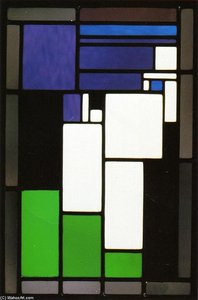
Counter composition XV, Rhythm of a Russian Dance, Troelstra, Study for Composition VIII (The Cow), Composition (The Cow), Composition, Preliminary design for the floor, Composition, Portrait of a man with hat en Self-portrait with beard. De bovenstaande ranglijst vermeldt het jaar en het museum van elk werk.

Hoeveel werken heeft Theo van Doesburg gemaakt?Onthul het antwoord

Onze catalogus bevat 225 werken van Theo van Doesburg, daterend van 1900 tot 1931.

Waar hangen de beroemdste originele werken van Theo van Doesburg?Onthul het antwoord

Voornamelijk in Centraal Museum (Utrecht), Museum de Lakenhal (Leiden) en Kröller-Müller Museum (Otterlo). De bovenstaande museumtabel bevat een volledig overzicht.

Wanneer creëerde Theo van Doesburg de beroemdste schilderijen?Onthul het antwoord

In 1910s: 56 van de 100 werken op deze pagina werden toen gemaakt, waaronder Troelstra.

Wat zijn de vroegste en laatste beroemde werken van Theo van Doesburg?Onthul het antwoord

Op deze pagina is het vroegste River Landscape with Steeple and Mill (1900) en het laatste Composition (1931).

Welke onderwerpen keerde Theo van Doesburg het vaakst naar terug?Onthul het antwoord

Men (12), Designs and sketches (11) en Characters (8), verspreid over de 100 werken op deze pagina.

In welk medium werkte Theo van Doesburg het meest?Onthul het antwoord

Oil On Canvas, voor 3 van de 100 werken op deze pagina.

Bij welke stroming wordt Theo van Doesburg gerekend?Onthul het antwoord

De stijl, te oordelen aan de originelen op deze pagina.

Welke originelen van Theo van Doesburg zijn in de collectie van het Centraal Museum?Onthul het antwoord

Self-portrait with beard, Portrait of Agnita Feis en Portrait of Agnita Feis: het Centraal Museum, Utrecht herbergt 20 van de werken op deze pagina.

Theo van Doesburg: de kunstenaar

The Architect of Abstraction: A Life in Geometric Harmony

Theo van Doesburg, born Christian Emil Marie Küpper in Utrecht on August 30, 1883, wasn’t merely a painter; he was a revolutionary force who fundamentally reshaped the landscape of modern art. His journey began not within the familiar embrace of Impressionism or Post-Impressionism, but amidst their fading echoes – initially mirroring styles reminiscent of Vincent van Gogh, both in the raw emotion conveyed and the directness of his brushstrokes. However, this early phase served as a crucial, almost instinctive, prelude, a necessary stepping stone towards the radical transformation that would define his enduring legacy. A pivotal moment arrived in 1913 with an encounter that irrevocably altered his artistic trajectory: Wassily Kandinsky’s *Rückblicke*. This text, a profound exploration of spirituality and abstraction, ignited within van Doesburg a seismic realization – true artistic expression wasn't found in faithfully replicating the external world but in channeling an inner, spiritual reality through pure, unadulterated form. It was this conviction that birthed Neoplasticism, more commonly known as De Stijl – a movement he founded and fiercely championed, becoming its most ardent and uncompromising advocate.

Forging a New Visual Language: The Principles of De Stijl

De Stijl wasn’t simply an artistic style; it was a comprehensive philosophical manifesto translated into visual form, a radical attempt to distill art down to its purest essence. Van Doesburg believed in stripping away all extraneous detail, reducing painting, architecture, design, and even everyday objects to their most fundamental elements: straight lines, right angles, and the primary colors of red, yellow, and blue, alongside black, white, and gray. This austere palette wasn’t born from limitation or a desire for bleakness; rather, it represented a profound belief in universality – a conviction that these elemental forms resonated with an underlying cosmic order, a hidden harmony governing all existence. He envisioned a *total* work of art, extending far beyond the confines of the canvas to encompass architecture, furniture design, typography, and even the very fabric of daily life. Collaboration was paramount; van Doesburg worked in close partnership with architects like J.J.P. Oud and Gerrit Rietveld, designing stained glass windows for churches, meticulously crafted furniture pieces that embodied De Stijl’s principles, and entire interiors—creating spaces where form and function converged in a harmonious synthesis. His collaborations extended beyond the architectural realm, encompassing fellow artists such as Piet Mondrian, with whom he co-founded the influential journal *De Stijl*, a platform for disseminating their ideas and attracting a vibrant community of like-minded creatives. However, despite this initial shared vision, tensions gradually emerged between van Doesburg and Mondrian regarding the rigidity of Neoplasticism – a divergence that ultimately led to a significant schism within the movement, revealing van Doesburg’s restless spirit and his constant pursuit of artistic evolution.

Beyond Painting: A Multifaceted Artistic Vision

While celebrated primarily as a painter, Theo van Doesburg's artistic pursuits were remarkably diverse and far-reaching. He wasn’t content to remain confined to the canvas; he was a prolific writer, poet, critic, and theorist, meticulously articulating the theoretical underpinnings of De Stijl and challenging conventional notions of art and aesthetics. His engagement with Dadaism in the early 1920s further broadened his artistic horizons, leading him to experiment with collage, typography, and photomontage – techniques that reflected a growing interest in exploring the relationship between image and reality. This period also saw him teaching at the Bauhaus in Weimar, where he shared his radical ideas with a new generation of artists and designers, influencing their approaches to form, color, and spatial organization. He wasn’t simply imparting technical skills; van Doesburg sought to instill within his students a fundamental shift in perspective – a recognition that art could be more than just representation; it could be a powerful tool for shaping the world around us. His designs for interiors and furniture weren't merely aesthetic exercises; they were carefully considered attempts to create harmonious living spaces—spaces that reflected the principles of De Stijl and fostered a sense of balance, clarity, and spiritual connection. A prime example is his collaboration with Sophie Taeuber-Arp and Georges Vantongerloo on designing artist residences in Paris, showcasing a holistic approach to artistic creation – an attempt to build a world *in* the image of his ideals.

The Schism and Elementarism

The tensions between van Doesburg and Mondrian ultimately culminated in a significant rift within De Stijl. Van Doesburg, dissatisfied with the increasingly rigid formalism of Neoplasticism, introduced “Elementarism” in 1926 – a radical departure that sought to inject dynamism into the movement. Elementarism retained the core principles of De Stijl—straight lines, right angles, and primary colors—but crucially incorporated diagonal lines, tilted planes, and variations in tone. This subtle yet profound shift allowed for greater complexity and visual interest, moving beyond the static geometry of Neoplasticism towards a more fluid and expressive aesthetic. He argued that true abstraction wasn’t about eliminating all traces of the external world but about revealing its underlying structure through carefully controlled manipulation of form and color. This evolution didn't sit well with Mondrian, who staunchly defended the purity of Neoplasticism, leading to a permanent parting of ways.

Legacy and Enduring Influence

Despite his tragically short life – Theo van Doesburg died in Davos, Switzerland on March 7, 1931 – at the age of 47 – his impact on modern art remains profound and enduring. De Stijl, though relatively short-lived as a cohesive movement, exerted an enormous influence on subsequent artistic developments, shaping movements ranging from Bauhaus design to Minimalism and Constructivism. His emphasis on geometric abstraction, pure color, and functionalism continues to resonate with artists and designers today. Van Doesburg’s legacy extends far beyond his paintings and designs; it lies in his unwavering commitment to artistic innovation, his belief in the transformative power of abstraction, and his vision of a world where art could play a vital role in shaping human experience. His work serves as a timeless reminder that art is not merely about representation but about exploring fundamental forms, ideas, and ultimately, the very essence of beauty.

Key Works & Lasting Impact

  • Study for Simultaneous Compositions XXII (1922): A quintessential example of Neoplasticism, showcasing the movement’s signature geometric forms and limited color palette.
  • Composition with half values (1928): Demonstrates van Doesburg's exploration of tonal variations within the De Stijl aesthetic.
  • Dancers (1917-1918): Represents a transitional phase in his work, blending figurative elements with emerging abstract tendencies.
  • Collaboration on *De Stijl* journal: A crucial platform for disseminating the movement’s ideas and fostering dialogue among artists and intellectuals.
  • Elementarism (1926): Van Doesburg's attempt to inject dynamism into Neoplasticism, introducing diagonal lines and a more fluid approach to composition.