Portret van Ando Hiroshige

Schilderijen van Ando Hiroshige: De 100 bekendste, door de ogen van een galerie

Bijgewerkt in oktober 2026 · gerangschikt op basis van onze populariteitsscore (zoekopdrachten, bezoeken en bestellingen per kunstwerk) · 353 werken van Ando Hiroshige in onze catalogus

Kortom

Volgens de visie van de galerie is het beroemdste schilderij van Ando Hiroshige Early Department from a Daimyo, waarvan het origineel in het Nakagawa-machi Bato Hiroshige Museum of Art in Nagasaki hangt. The maple leaves of Mama, Tekona shrine and Tsugi bridge (1857) en Hakone (1834) maken het trio compleet dat elk oog herkent. Van de 353 werken van Ando Hiroshige in onze catalogus presenteert de galerie hieronder de 100 bekendste werken, elk een origineel met de jaartal, het museum en wat het uniek maakt.

1797 – 1858, Edo Japanese landscape painting Meeste werken: Nakagawa-machi Bato Hiroshige Museum of Art

De top 10 schilderijen van Ando Hiroshige in de galerie

1
Early Department from a Daimyo door Ando Hiroshige

Early Department from a Daimyo

Woodblock Print · Nakagawa-machi Bato Hiroshige Museum of Art, Nagasaki

In the delicate dance of lines and muted pigments, Utagawa Hiroshige’s Early Department from a Daimyo invites us to step through a portal into the heart of Edo-period Japan. This exquisite woodblock print captures a moment of vibrant communal life along a bustling riverside, where the rigid structures of social hierarchy melt into the shared leisure of a sunny afternoon. As we gaze upon the scene, we are not merely…

2
The maple leaves of Mama, Tekona shrine and Tsugi bridge (1857) door Ando Hiroshige

The maple leaves of Mama, Tekona shrine and Tsugi bridge

1857 · Woodblock Print · Van Gogh Museum, Amsterdam

Utagawa Hiroshige (1797-1858), arguably the last titan of *ukiyo-e*, didn't merely depict landscapes; he crafted them into meditations on beauty and impermanence. “The Maple Leaves of Mama, Tekona Shrine and Tsugi Bridge,” created in 1857 during a period of significant societal transformation—the waning influence of feudal Japan as Western ideas crept in—stands as a testament to his enduring artistic legacy. More than just a visual record, it’s an embodiment of…

3
Hakone (1834) door Ando Hiroshige

Hakone

1834 · Woodblock Print · Indianapolis Museum of Art, Indianapolis

Utagawa Hiroshige’s “Hakone,” created in 1834, is more than just a landscape; it's a poetic meditation on the beauty and transience of nature within Edo-period Japan. This woodblock print, part of his renowned series "The Fifty-three Stations of the Tōkaidō," captures a specific moment along the vital trade route connecting Tokyo (then Edo) with Kyoto. However, Hiroshige elevates this seemingly simple depiction of a mountain pass into something profoundly evocative,…

4
Station 36, Goyu; Kyoka Tokaido Series (1855) door Ando Hiroshige

Station 36, Goyu; Kyoka Tokaido Series

1855 · Woodblock Print · Indianapolis Museum of Art, Indianapolis

In the delicate interplay of ink and paper, Utagawa Hiroshige’s "Station 36, Goyu; Kyoka Tokaido Series" offers much more than a mere topographical record of a journey. Completed in 1855, this exquisite woodblock print serves as a profound distillation of Edo-period sensibilities, capturing a yearning for tranquility amidst the burgeoning dynamism of a Japan in transition. As the nation stood at a pivotal crossroads between ancient feudal traditions and the…

5
Fushimi Station #51 (1842) door Ando Hiroshige

Fushimi Station #51

1842 · Houtsnede · Indianapolis Museum of Art, Indianapolis

Een Poëtische Visie van Edo Japan: Het Leven en Werk van Utagawa Hiroshige Utagawa Hiroshige, geboren Andō Tokutarō in 1797 in het bruisende stadje Edo (modern Tokio), staat als een belangrijke figuur in de wereld van *ukiyo-e*, of “beelden uit de drijvende wereld.” Ondanks zijn diepe wortels in de tradities van Japanse houtsnijkunst, oversteg Hiroshige simpelweg het kopiëren ervan en verlevendigde hij zijn landschappen met een poëtische gevoeligheid die resonerde…

6
Ichikoku Bridge in the Eastern Capital (Tōto: Ichikoku bashi) (1858) door Ando Hiroshige

Ichikoku Bridge in the Eastern Capital (Tōto: Ichikoku bashi)

1858 · Woodblock Print · Indianapolis Museum of Art, Indianapolis

The Ichikoku Bridge spans a quiet stretch of water in the Eastern Capital. Beneath its wooden arch, two boats drift through the current. People move across the structure, some carrying backpacks and others clutching small handbags. A mountain rises in the distance, watching over the scene. Trees frame the edges of the view, their leaves casting shadows near the water's edge.

7
Shinagawa Sunrise from the series Fifty-three Stations on the Tokaido Road (1834) door Ando Hiroshige

Shinagawa Sunrise from the series Fifty-three Stations on the Tokaido Road

1834 · Woodblock Print · Hill-Stead Museum, Farmington

In the soft, burgeoning light of a nineteenth-century morning, Utagawa Hiroshige invites us to witness a moment of profound stillness along the Tōkaidō road. Shinagawa Sunrise is not merely a depiction of a coastal village; it is a masterclass in the art of atmosphere. As the sun begins its ascent, the boundary between the heavens and the earth dissolves into a luminous haze. The water of the bay reflects a…

8
The Rokugo River Ferry, Kawasaki, from the series the Fifty-three Stations of the Tokaido (Hoeido edition ) door Ando Hiroshige

The Rokugo River Ferry, Kawasaki, from the series the Fifty-three Stations of the Tokaido (Hoeido edition )

Woodblock Print · Nakagawa-machi Bato Hiroshige Museum of Art, Nagasaki

In the delicate dance of woodblock printing, few masters captured the ephemeral beauty of Japanese life as profoundly as Utagawa Hiroshige. His masterpiece, The Rokugo River Ferry, Kawasaki, serves as a breathtaking window into the Edo period, inviting the viewer to step onto the bustling banks of one of the most vital crossings on the Tokaido road. This evocative scene from his legendary series, The Fifty-three Stations of the Tokaido,…

9
Itsukushima in Aki Province (1858) door Ando Hiroshige

Itsukushima in Aki Province

1858 · Woodblock Print · Brooklyn Museum, Brooklyn

In the delicate interplay of mist and water, Itsukushima in Aki Province offers more than a mere glimpse of a Japanese landmark; it provides a profound meditation on the ephemeral nature of existence. Created by the legendary ukiyo-e master Ando Hiroshige in 1858, this woodcut print captures the spiritual essence of the Itsukushima shrine area with a poetic sensitivity that remains unparalleled. As one gazes upon the composition, the eye…

10
Tenryu River Ferry Crossing, Mitsuke, from the series The Fifty-three Stations of the Tokaido (Gyosho Edition) door Ando Hiroshige

Tenryu River Ferry Crossing, Mitsuke, from the series The Fifty-three Stations of the Tokaido (Gyosho Edition)

Woodblock Print · Nakagawa-machi Bato Hiroshige Museum of Art, Nagasaki

The woodblock print depicts a section of the Tenryu River near the station of Mitsuke. In the center of the composition, a large sandbank divides the water into two distinct currents. Several small wooden boats occupy the river, with figures positioned within them to manage the crossing. Some vessels are moored directly against the central sandbank, while others navigate the moving water. The far shore is visible in the distance,…

Schilderijen van Ando Hiroshige, gerangschikt van 11 tot 100

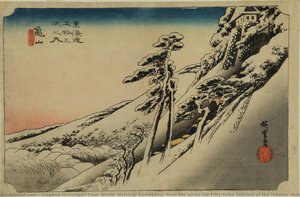
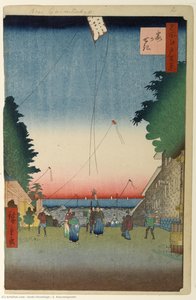
11Papegaai en wijnranken (1800) door Ando HiroshigePapegaai en wijnranken1800 · Indianapolis Museum of Art 12The Pine Woods of Miho in Suruga Province (Suruga Miho no matsubara) (1858) door Ando HiroshigeThe Pine Woods of Miho in Suruga Province (Suruga Miho no matsubara)1858 · Indianapolis Museum of Art 1362 (55) Komakata Hall and Azuma Bridge (1857) door Ando Hiroshige62 (55) Komakata Hall and Azuma Bridge1857 · Brooklyn Museum 14Evening Snow at Kanbara (1834) door Ando HiroshigeEvening Snow at Kanbara1834 · Los Angeles County Museum of Art 15Dawn in the licensed quarters (1857) door Ando HiroshigeDawn in the licensed quarters1857 · Art Gallery of New South Wales 16Nachtzicht van Saruwakacho door Ando HiroshigeNachtzicht van Saruwakacho 17Station 28, Fukuroi (1855) door Ando HiroshigeStation 28, Fukuroi1855 · Indianapolis Museum of Art 18Evening Snow at Asakusa or Woman with Umbrella from the series Eight Views of the Environs of Edo (1800) door Ando HiroshigeEvening Snow at Asakusa or Woman with Umbrella from the series Eight Views of the Environs of Edo1800 · Hill-Stead Museum 19Keishi (Kyoto), Capital (1834) door Ando HiroshigeKeishi (Kyoto), Capital1834 · Indianapolis Museum of Art 20Hara: View of Ashitakayama and Fuji (1855) door Ando HiroshigeHara: View of Ashitakayama and Fuji1855 · Indianapolis Museum of Art 21Yokkaichi (Station #44) (1834) door Ando HiroshigeYokkaichi (Station #44)1834 · Indianapolis Museum of Art 22Desolate Wintry Scene, Hamamatsu, from the series the Fifty-three Stations of the Tokaido (Hoeido edition) door Ando HiroshigeDesolate Wintry Scene, Hamamatsu, from the series the Fifty-three Stations of the Tokaido (Hoeido edition)Nakagawa-machi Bato Hiroshige Museum of Art 23Noge and Yokohama in Musashi Province (Musashi, Noge, Yokohama) (1858) door Ando HiroshigeNoge and Yokohama in Musashi Province (Musashi, Noge, Yokohama)1858 · Indianapolis Museum of Art 24Wild sea breaking on the rocks (1856) door Ando HiroshigeWild sea breaking on the rocks1856 25Shirasuga, Shiomi-zaka zu (Bekijk de Slope Shima) (1833) door Ando HiroshigeShirasuga, Shiomi-zaka zu (Bekijk de Slope Shima)1833 · Indianapolis Museum of Art 26Mt.Fuji on the Left, Yoshiwara, from the series the Fifty-three Stations of the Tokaido (Hoeido edition) door Ando HiroshigeMt.Fuji on the Left, Yoshiwara, from the series the Fifty-three Stations of the Tokaido (Hoeido edition)Nakagawa-machi Bato Hiroshige Museum of Art 27Tsukuda Offing in the Eastern Capital (Tōto: Tsukuda oki) (1858) door Ando HiroshigeTsukuda Offing in the Eastern Capital (Tōto: Tsukuda oki)1858 · Indianapolis Museum of Art 28Kawachi (1853) door Ando HiroshigeKawachi1853 · Indianapolis Museum of Art 29The Dye Craft Shops of Arimatsu, Narumi, from the series The Fifty-three Stations of the Tokaido (Gyosho edition) door Ando HiroshigeThe Dye Craft Shops of Arimatsu, Narumi, from the series The Fifty-three Stations of the Tokaido (Gyosho edition)Nakagawa-machi Bato Hiroshige Museum of Art 30View of Shiomi Slope, Shirasuka, from the series The Fifty-three Stations of the Tokaido (Gyosho edition) door Ando HiroshigeView of Shiomi Slope, Shirasuka, from the series The Fifty-three Stations of the Tokaido (Gyosho edition)Nakagawa-machi Bato Hiroshige Museum of Art 31Entrance to Enoshima in Sagami Province (Sagami Enoshima iriguchi) (1858) door Ando HiroshigeEntrance to Enoshima in Sagami Province (Sagami Enoshima iriguchi)1858 · Indianapolis Museum of Art 32Morning Mist, Mishima, from the series the Fifty-three Stations of the Tokaido (Hoeido edition ) door Ando HiroshigeMorning Mist, Mishima, from the series the Fifty-three Stations of the Tokaido (Hoeido edition )Nakagawa-machi Bato Hiroshige Museum of Art 33The Imagire Sea Ferry, Maisaka, from the series The Fifty-three Stations of the Tokaido (Gyosho edition) door Ando HiroshigeThe Imagire Sea Ferry, Maisaka, from the series The Fifty-three Stations of the Tokaido (Gyosho edition)Nakagawa-machi Bato Hiroshige Museum of Art 34Sukiya Riverbank in the Eastern Capital (Tōto sukiya kaigan) (1858) door Ando HiroshigeSukiya Riverbank in the Eastern Capital (Tōto sukiya kaigan)1858 · Indianapolis Museum of Art 35Satta Pass, Yui, from the series the Fifty-three Stations of the Tokaido (Hoeido edition) door Ando HiroshigeSatta Pass, Yui, from the series the Fifty-three Stations of the Tokaido (Hoeido edition)Nakagawa-machi Bato Hiroshige Museum of Art 36True View of Imagire, Maisaka, from the series the Fifty-three Stations of the Tokaido (Hoeido edition) door Ando HiroshigeTrue View of Imagire, Maisaka, from the series the Fifty-three Stations of the Tokaido (Hoeido edition)Nakagawa-machi Bato Hiroshige Museum of Art 37Clear Winter Morning, Kameyama, from the series the Fifty-three Stations of the Tokaido (Hoeido edition) door Ando HiroshigeClear Winter Morning, Kameyama, from the series the Fifty-three Stations of the Tokaido (Hoeido edition)Nakagawa-machi Bato Hiroshige Museum of Art 38The Tenryu River, Mitsuke, from the series the Fifty-three Stations of the Tokaido (Hoeido edition) door Ando HiroshigeThe Tenryu River, Mitsuke, from the series the Fifty-three Stations of the Tokaido (Hoeido edition)Nakagawa-machi Bato Hiroshige Museum of Art 39The Seven-ri Ferry Crossing, Kuwana, from the series the Fifty-three Stations of the Tokaido (Hoeido edition) door Ando HiroshigeThe Seven-ri Ferry Crossing, Kuwana, from the series the Fifty-three Stations of the Tokaido (Hoeido edition)Nakagawa-machi Bato Hiroshige Museum of Art 40Aronia and Bullfinch door Ando HiroshigeAronia and Bullfinch 41ZWANZEN TERUGKEREND BIJ KATATA (1834) door Ando HiroshigeZWANZEN TERUGKEREND BIJ KATATA1834 · Indianapolis Museum of Art 42Yugyoji Temple, Fujisawa, from the series the Fifty-three Stations of the Tokaido (Hoeido edition) door Ando HiroshigeYugyoji Temple, Fujisawa, from the series the Fifty-three Stations of the Tokaido (Hoeido edition)Nakagawa-machi Bato Hiroshige Museum of Art 43Travellers and Soliciting Women, Goyu, from the series the Fifty-three Stations of the Tokaido (Hoeido edition) door Ando HiroshigeTravellers and Soliciting Women, Goyu, from the series the Fifty-three Stations of the Tokaido (Hoeido edition)Nakagawa-machi Bato Hiroshige Museum of Art 44The Totoumi Bank of the Oi River, Kanaya, from the series the Fifty-three Stations of the Tokaido (Hoeido edition) door Ando HiroshigeThe Totoumi Bank of the Oi River, Kanaya, from the series the Fifty-three Stations of the Tokaido (Hoeido edition)Nakagawa-machi Bato Hiroshige Museum of Art 45The Suruga Bank of the Oi River, Shimada, from the series the Fifty-three Stations of the Tokaido (Hoeido edition) door Ando HiroshigeThe Suruga Bank of the Oi River, Shimada, from the series the Fifty-three Stations of the Tokaido (Hoeido edition)Nakagawa-machi Bato Hiroshige Museum of Art 46Kyoka Tokaido Series, Kanagawa (Yokohama) door Ando HiroshigeKyoka Tokaido Series, Kanagawa (Yokohama)Indianapolis Museum of Art 47Distant View of Miho, Ejiri, from the series the Fifty-three Stations of the Tokaido (Hoeido edition) door Ando HiroshigeDistant View of Miho, Ejiri, from the series the Fifty-three Stations of the Tokaido (Hoeido edition)Nakagawa-machi Bato Hiroshige Museum of Art 48Mt. Fuji in the Morning, Hara, from the series the Fifty-three Stations of the Tokaido (Hoeido edition) door Ando HiroshigeMt. Fuji in the Morning, Hara, from the series the Fifty-three Stations of the Tokaido (Hoeido edition)Nakagawa-machi Bato Hiroshige Museum of Art 49A Horse Fair, Chiriu, from the series the Fifty-three Stations of the Tokaido (Hoeido edition) door Ando HiroshigeA Horse Fair, Chiriu, from the series the Fifty-three Stations of the Tokaido (Hoeido edition)Nakagawa-machi Bato Hiroshige Museum of Art 50Wakasa (1853) door Ando HiroshigeWakasa1853 · Indianapolis Museum of Art 51Distant View of Mt.Akiba, Kakegawa, from the series the Fifty-three Stations of the Tokaido (Hoeido edition) door Ando HiroshigeDistant View of Mt.Akiba, Kakegawa, from the series the Fifty-three Stations of the Tokaido (Hoeido edition)Nakagawa-machi Bato Hiroshige Museum of Art 52The Ichiri-Han Sea Ferry, Arai, from the series The Fifty-three Stations of the Tokaido (Gyosho edition) door Ando HiroshigeThe Ichiri-Han Sea Ferry, Arai, from the series The Fifty-three Stations of the Tokaido (Gyosho edition)Nakagawa-machi Bato Hiroshige Museum of Art 53Gateway Entrance to the Atsuta Shrine on the Beach, Miya, from the series The Fifty-three Stations of the Tokaido (Gyosho edition) door Ando HiroshigeGateway Entrance to the Atsuta Shrine on the Beach, Miya, from the series The Fifty-three Stations of the Tokaido (Gyosho edition)Nakagawa-machi Bato Hiroshige Museum of Art 54Akasaka, from the series The Fifty-three Stations of the Tokaido (Gyosho edition) door Ando HiroshigeAkasaka, from the series The Fifty-three Stations of the Tokaido (Gyosho edition)Nakagawa-machi Bato Hiroshige Museum of Art 55The Sakawa River, Odawara, from the series the Fifty-three Stations of the Tokaido (Hoeido edition) door Ando HiroshigeThe Sakawa River, Odawara, from the series the Fifty-three Stations of the Tokaido (Hoeido edition)Nakagawa-machi Bato Hiroshige Museum of Art 56A Footpath between Ricefield, Hiratsuka, from the series the Fifty-three Stations of the Tokaido (Hoeido edition) door Ando HiroshigeA Footpath between Ricefield, Hiratsuka, from the series the Fifty-three Stations of the Tokaido (Hoeido edition)Nakagawa-machi Bato Hiroshige Museum of Art 57Awa Province: Whirlpool at Naruto (1853) door Ando HiroshigeAwa Province: Whirlpool at Naruto1853 5873 The City Flourishing, the Tanabata Festival (1857) door Ando Hiroshige73 The City Flourishing, the Tanabata Festival1857 59Sarugababa Plain, Futagawa, from the series the Fifty-three Stations of the Tokaido (Hoeido edition) door Ando HiroshigeSarugababa Plain, Futagawa, from the series the Fifty-three Stations of the Tokaido (Hoeido edition)Nakagawa-machi Bato Hiroshige Museum of Art 60Local Specialty Teahouse, Mariko, from the series the Fifty-three Stations of the Tokaido (Hoeido edition) door Ando HiroshigeLocal Specialty Teahouse, Mariko, from the series the Fifty-three Stations of the Tokaido (Hoeido edition)Nakagawa-machi Bato Hiroshige Museum of Art 61Sakanoshita door Ando HiroshigeSakanoshitaIndianapolis Museum of Art 62Station 23, Fujieda door Ando HiroshigeStation 23, FujiedaIndianapolis Museum of Art 63Marsh Grasses and Mandarin Ducks door Ando HiroshigeMarsh Grasses and Mandarin Ducks 6450th station, Minakuchi door Ando Hiroshige50th station, Minakuchi 65Sakanoshita: the Throwing Away the Brush Peak (1834) door Ando HiroshigeSakanoshita: the Throwing Away the Brush Peak1834 · Brooklyn Museum 66Shibaura Bay of Musashi Province (801) door Ando HiroshigeShibaura Bay of Musashi Province801 · Metropolitan Museum of Art 67Koyurugi Beach of Sagami Province (801) door Ando HiroshigeKoyurugi Beach of Sagami Province801 · Metropolitan Museum of Art 68Honmoku Bay of Musashi Province (801) door Ando HiroshigeHonmoku Bay of Musashi Province801 · Metropolitan Museum of Art 69Untitled (Two Rabbits, Pampas Grass, and Full Moon) (1851) door Ando HiroshigeUntitled (Two Rabbits, Pampas Grass, and Full Moon)1851 7011. Kiyomizu Hall and Shinobazu Pond at Ueno (1857) door Ando Hiroshige11. Kiyomizu Hall and Shinobazu Pond at Ueno1857 7185. Kinokuni Hill and Distant View of Akasaka and the Tameike Pond (1857) door Ando Hiroshige85. Kinokuni Hill and Distant View of Akasaka and the Tameike Pond1857 7276 Bamboo Quay by Kyōbashi Bridge (1857) door Ando Hiroshige76 Bamboo Quay by Kyōbashi Bridge1857 7358 (52) Sudden Shower over Shin-Ōhashi bridge and Atake (1857) door Ando Hiroshige58 (52) Sudden Shower over Shin-Ōhashi bridge and Atake1857 · Tokyo Fuji Art Museum 74103. Senju Great Bridge (1857) door Ando Hiroshige103. Senju Great Bridge1857 7518. The Ōji Inari Shrine (1857) door Ando Hiroshige18. The Ōji Inari Shrine1857 76113. Aoi Slope Outside Toranomon Gate (1857) door Ando Hiroshige113. Aoi Slope Outside Toranomon Gate1857 77114. Bikuni Bridge in Snow (1857) door Ando Hiroshige114. Bikuni Bridge in Snow1857 7870 (60) The Mouth of the Nakagawa River (1857) door Ando Hiroshige70 (60) The Mouth of the Nakagawa River1857 792. Kasumigaseki (1857) door Ando Hiroshige2. Kasumigaseki1857 8015. Suwa Bluff in Nippori (1857) door Ando Hiroshige15. Suwa Bluff in Nippori1857 8163 (69) The Ayase River and Kanegafuchi (1857) door Ando Hiroshige63 (69) The Ayase River and Kanegafuchi1857 82115. The Takata Riding Grounds (1857) door Ando Hiroshige115. The Takata Riding Grounds1857 8386. Naitō Shinjuku in Yotsuya (1857) door Ando Hiroshige86. Naitō Shinjuku in Yotsuya1857 8416. Flower Park and Dangozaka Slope in Sendagi (1857) door Ando Hiroshige16. Flower Park and Dangozaka Slope in Sendagi1857 8568 (59) Open Garden at the Hachiman Shrine in Fukagawa (1857) door Ando Hiroshige68 (59) Open Garden at the Hachiman Shrine in Fukagawa1857 8610. Sunrise at Kanda Myōjin Shrine (1857) door Ando Hiroshige10. Sunrise at Kanda Myōjin Shrine1857 87Peach and Long-tailed Bird door Ando HiroshigePeach and Long-tailed Bird 88Golden Pheasant in Bracken door Ando HiroshigeGolden Pheasant in Bracken 89The Imado Bridge at the Foot of Mount Matsuchi (801) door Ando HiroshigeThe Imado Bridge at the Foot of Mount Matsuchi801 · Metropolitan Museum of Art 90Dog (1858) door Ando HiroshigeDog1858 · Indianapolis Museum of Art 91118. Kitsunebi on New Year's Night Under the Enoki Tree near Ōji (1857) door Ando Hiroshige118. Kitsunebi on New Year's Night Under the Enoki Tree near Ōji1857 92109. Minami Shinagawa and Samezu Coast (1857) door Ando Hiroshige109. Minami Shinagawa and Samezu Coast1857 93Night View of Matsuchiyama and the San (1857) door Ando HiroshigeNight View of Matsuchiyama and the San1857 · Los Angeles County Museum of Art 94Akasaka door Ando HiroshigeAkasakaIndianapolis Museum of Art 95Shiojiri Pass in Shinano Province (Shinano Shiojiritōge) (1858) door Ando HiroshigeShiojiri Pass in Shinano Province (Shinano Shiojiritōge)1858 · Indianapolis Museum of Art 96Yoshiwara door Ando HiroshigeYoshiwaraIndianapolis Museum of Art 97Fuchu, No. 20 door Ando HiroshigeFuchu, No. 20Indianapolis Museum of Art 98Woman Walking in the Snow (1850) door Ando HiroshigeWoman Walking in the Snow1850 · Metropolitan Museum of Art 9982. Moon Viewing (1857) door Ando Hiroshige82. Moon Viewing1857 100Station 27, Kakegawa (1855) door Ando HiroshigeStation 27, Kakegawa1855 · Indianapolis Museum of Art

De beroemde schilderijen van Ando Hiroshige, periode voor periode

De onderwerpen die de aandacht van Ando Hiroshige troffen

De vier onderwerpen die het meest voorkomen in deze originelen, elk met zijn mooiste voorbeeld.

De musea waar de originele werken van Ando Hiroshige worden bewaard

De 8 musea met de meeste schilderijen op deze pagina.

Museum Stad Werken van Ando Hiroshige Schilderijen uit deze lijst
Nakagawa-machi Bato Hiroshige Museum of Art, NagasakiNakagawa-machi Bato Hiroshige Museum of Art Nagasaki 30 Early Department from a Daimyo, The Rokugo River Ferry, Kawasaki, from the series the Fifty-three Stations of the Tokaido (Hoeido edition ), Tenryu River Ferry Crossing, Mitsuke, from the series The Fifty-three Stations of the Tokaido (Gyosho Edition)
Indianapolis Museum of Art, IndianapolisIndianapolis Museum of Art Indianapolis 35 Hakone, Station 36, Goyu; Kyoka Tokaido Series, Fushimi Station #51
Metropolitan Museum of Art, New YorkMetropolitan Museum of Art New York 8 Shibaura Bay of Musashi Province, Koyurugi Beach of Sagami Province, Honmoku Bay of Musashi Province
Brooklyn Museum, BrooklynBrooklyn Museum Brooklyn 4 Itsukushima in Aki Province, 62 (55) Komakata Hall and Azuma Bridge, Sakanoshita: the Throwing Away the Brush Peak
Hill-Stead Museum, FarmingtonHill-Stead Museum Farmington 3 Shinagawa Sunrise from the series Fifty-three Stations on the Tokaido Road, Evening Snow at Asakusa or Woman with Umbrella from the series Eight Views of the Environs of Edo
Los Angeles County Museum of Art, Los AngelesLos Angeles County Museum of Art Los Angeles 2 Evening Snow at Kanbara, Night View of Matsuchiyama and the San
Van Gogh Museum, AmsterdamVan Gogh Museum Amsterdam 1 The maple leaves of Mama, Tekona shrine and Tsugi bridge
Art Gallery of New South Wales, SydneyArt Gallery of New South Wales Sydney 1 Dawn in the licensed quarters

Ando Hiroshige, één iconisch schilderij per decennium

Werken per decennium

Kies een decennium om het origineel te zien dat dit tijdperk definieert.

Schilderijen van Ando Hiroshige: de galerie geeft antwoord

Welk schilderij van Ando Hiroshige is het beroemdste van allemaal?Onthul het antwoord

Early Department from a Daimyo, Nakagawa-machi Bato Hiroshige Museum of Art, Nagasaki. The maple leaves of Mama, Tekona shrine and Tsugi bridge (1857) en Hakone (1834) volgen.

Wat zijn de top 10 schilderijen van Ando Hiroshige?Onthul het antwoord

Early Department from a Daimyo, The maple leaves of Mama, Tekona shrine and Tsugi bridge, Hakone, Station 36, Goyu; Kyoka Tokaido Series, Fushimi Station #51, Ichikoku Bridge in the Eastern Capital (Tōto: Ichikoku bashi), Shinagawa Sunrise from the series Fifty-three Stations on the Tokaido Road, The Rokugo River Ferry, Kawasaki, from the series the Fifty-three Stations of the Tokaido (Hoeido edition ), Itsukushima in Aki Province en Tenryu River Ferry Crossing, Mitsuke, from the series The Fifty-three Stations of the Tokaido (Gyosho Edition). De bovenstaande ranglijst vermeldt het jaar en het museum van elk werk.

Hoeveel werken heeft Ando Hiroshige gemaakt?Onthul het antwoord

Onze catalogus bevat 353 werken van Ando Hiroshige, daterend van 1833 tot 1858.

Waar hangen de beroemdste originele werken van Ando Hiroshige?Onthul het antwoord

Voornamelijk in Nakagawa-machi Bato Hiroshige Museum of Art (Nagasaki), Indianapolis Museum of Art (Indianapolis) en Metropolitan Museum of Art (New York). De bovenstaande museumtabel bevat een volledig overzicht.

Wanneer creëerde Ando Hiroshige de beroemdste schilderijen?Onthul het antwoord

In 1850s: 44 van de 100 werken op deze pagina werden toen gemaakt, waaronder The maple leaves of Mama, Tekona shrine and Tsugi bridge.

Wat zijn de vroegste en laatste beroemde werken van Ando Hiroshige?Onthul het antwoord

Op deze pagina is het vroegste Shirasuga, Shiomi-zaka zu (Bekijk de Slope Shima) (1833) en het laatste Ichikoku Bridge in the Eastern Capital (Tōto: Ichikoku bashi) (1858).

Welke onderwerpen keerde Ando Hiroshige het vaakst naar terug?Onthul het antwoord

Edo period (33), Ukiyo-e (22) en Woodblock print (21), verspreid over de 100 werken op deze pagina.

In welk medium werkte Ando Hiroshige het meest?Onthul het antwoord

Woodblock Print, voor 62 van de 100 werken op deze pagina.

Bij welke stroming wordt Ando Hiroshige gerekend?Onthul het antwoord

Japanese landscape painting, te oordelen aan de originelen op deze pagina.

Welke originelen van Ando Hiroshige zijn in de collectie van het Nakagawa-machi Bato Hiroshige Museum of Art?Onthul het antwoord

Early Department from a Daimyo, The Rokugo River Ferry, Kawasaki, from the series the Fifty-three Stations of the Tokaido (Hoeido edition ) en Tenryu River Ferry Crossing, Mitsuke, from the series The Fifty-three Stations of the Tokaido (Gyosho Edition): het Nakagawa-machi Bato Hiroshige Museum of Art, Nagasaki herbergt 29 van de werken op deze pagina.

Ando Hiroshige: de kunstenaar

A Poetic Vision of Edo Japan: The Life and Art of Utagawa Hiroshige

Utagawa Hiroshige, geboren als Andō Tokutarō in 1797 in de bruisende stad Edo (het moderne Tokio), staat als een cruciale figuur in de wereld van *ukiyo-e*, of “afbeeldingen van de drijvende wereld.” Hoewel diep geworteld in de tradities van Japanse houtsnipkunst, overstond Hiroshige het simpele nabootsen, door zijn landschappen te verzegelen met een poëtische gevoeligheid die resoneren deed zowel binnen Japan als later, over de hele wereld. Zijn leven ontviel tijdens een periode van relatieve vrede en welvaart onder het Tokugawa-shogunaat, maar ook één gemarkeerd door toenemende sociale veranderingen en uiteindelijk westernisatie – krachten die uiteindelijk bijdroegen aan de achteruitgang van *ukiyo-e*, hoewel ze tegelijkertijd zijn blijvende nalatenschap versterkten. In eerste instantie was hij bestemd voor een meer conventionele weg binnen een samurai-familie—zijn vader diende als brandwacht—Hiroshige’s artistieke neigingen leidden hem naar de leerling van Utagawa Toyohiro, een meester van de Utagawa school. Dit bleek een cruciale wending, die hem afstuurde van populaire afbeeldingen van hoerenshows en acteurs, die door velen in de *ukiyo-e*-wereld werden geprezen, naar een focus op landschap, een genre waar hij uiteindelijk zijn eigen stijl zou herdefiniëren.

Van Genre Scènes tot Evocative Landschappen

Hiroshige’s vroege werk volgde de conventies van zijn school, met portretten en scènes uit het dagelijks leven. Echter, zijn omhelzing van landschap was wat hem werkelijk onderscheidde. Hij werd beïnvloed door eerdere meesters zoals Hokusai—waarvan *Drie-en-zestig Uitzichten op Fuji* al publiek interesse wekte—Hiroshige ontwikkelde een unieke stijl gekenmerkt door atmosferische perspectieven, subtiele kleurenpaletten en een diepe gevoeligheid voor de veranderende seizoenen. Hij beschouwde plaatsen niet alleen; hij roepde hun stemming op, vastlegde de essentie van een bepaald moment in de tijd. De serie *De Vijftig-drie Posten van de Tōkaidō* (1833–1834), wellicht zijn meest beroemde prestatie, documenteerde het reisverloop langs de Tōkaidō-weg, de belangrijkste route tussen Edo en Kyoto, niet als een simpele reisgids maar als een reeks evocatieve bijschriften—een plotselinge regenbui in Shono, een verre blik op Fuji uit Kanaya, de drukte in Odawara. Elke prent is doordrenkt van een gevoel van vluchtigheid en rustige schoonheid, die kijkers uitnodigt om mee te reizen met de reizigers. Hij maakte meesterschappelijk *bokashi*, een techniek waarbij meerdere stempels worden gebruikt voor één kleur, waardoor hij subtiele schaduwen en atmosferische effecten kon creëren die moeilijk te repliceren waren. De delicate blauwtinten in zijn afbeeldingen van regen of mist, de warme tinten van herfstblaadwerk—dit was niet toevallig; het waren zorgvuldig overwogen elementen ontworpen om specifieke emoties en zintuigen op te roepen. Naast *bokashi* was Hiroshige bekwam in het gebruik van leegte – *ma*, een concept centraal in Japanse esthetiek, waardoor gebieden in de prent konden “ademen” en de algehele sfeer van sereniteit versterkten. Zijn serie *Eén Honderd Bekende Uitzichten van Edo* (1856–1858) toonde verder zijn meesterschap, waarbij intieme blikken werden geschenkt naar het leven en de landschappen in zijn geliefde stad.

Een Meester van Atmosfeer en Techniek

Hiroshige’s technische vaardigheid was net zo opmerkelijk als zijn artistieke visie. Hij was niet alleen geïnteresseerd in nauwkeurige weergave; hij zocht de *gevoel* van een plaats vast te leggen. Zijn gebruik van kleur, hoewel vaak ingetreden vergeleken met dat van sommige van zijn tijdgenoten, was cruciaal om dit effect te bereiken. Hij gebruikte vaak meerdere blokken voor één kleur, waardoor hij subtiele tinten en atmosferische effecten kon creëren die moeilijk te repliceren waren. De delicate washes van blauw in zijn afbeeldingen van regen of mist, de warme tonen van herfstblaadwerk—dit was niet toevallig; het waren zorgvuldig overwogen elementen ontworpen om specifieke emoties en zintuigen op te roepen. Buiten *bokashi* was Hiroshige bekwam in het gebruik van leegte – *ma*, een concept centraal in Japanse esthetiek, waardoor gebieden in de prent konden “ademen” en de algehele sfeer van rust versterkten. Zijn serie *Eén Honderd Bekende Uitzichten van Edo* (1856–1858) toonde verder zijn meesterschap, waarbij intieme blikken werden geschenkt naar het leven en de landschappen in zijn geliefde stad.

De Duurzaamheid: Japonisme en Verder

Hoewel de *ukiyo-e*-traditie aan het vervagen begon na Hiroshige’s dood in 1858—een achteruitgang versneld door de Meiji Restauratie en de daaropvolgende toestroom van westerse cultuur—zijn invloed op de kunstwereld bleek buitengewoon duurzaam. In de late negentiende eeuw stroomden Japanse prints naar Europa, wat leidde tot een fenomeen dat bekend staat als *Japonisme*. Kunstenaars zoals Édouard Manet, Claude Monet en Edgar Degas werden gefascineerd door de gedurfde composities, platte perspectieven en onconventionele kleurenschema’s van *ukiyo-e*, die deze elementen integreerden in hun eigen werk. Vincent van Gogh was bijzonder gefascineerd door Hiroshige’s prints, waarbij hij een aantal kopieën maakte, waaronder “Bloeiende Peer in Kameido,” wat zijn diepe bewondering voor de Japanse meester’s gebruik van kleur en compositie demonstreert. Hiroshige’s invloed strekte zich uit tot architectuur, design en zelfs literatuur. Vandaag de dag wordt Utagawa Hiroshige herinnerd niet alleen als een briljante kunstenaar maar ook als een culturele ambassadeur die de kloof tussen Oost en West heeft geslagen, een onuitwisbare stempel op de geschiedenis van de kunst heeft achtergelaten.

Bekende Werken

  • De Vijftig-drie Posten van de Tōkaidō: Hiroshige’s meest beroemde serie, die het reisverloop langs de belangrijkste route tussen Edo en Kyoto weergeeft.
  • Eén Honderd Bekende Uitzichten van Edo: Een boeiend portret van het leven en de landschappen in zijn geliefde stad.
  • Invloed op Vincent van Gogh’s Japonaiserie Serie: Inclusief “Bloeiende Peerboom na Hiroshige,” wat Van Gogh’s diepe bewondering voor de Japanse meester’s gebruik van kleur en compositie demonstreert.