Portret van Thomas Wijck

De 80 beroemdste schilderijen van Thomas Wijck, elk uniek

Bijgewerkt in november 2026 · gerangschikt op basis van onze populariteitsscore (zoekopdrachten, bezoeken en bestellingen per kunstwerk) · 89 werken van Thomas Wijck in onze catalogus

Kortom

St Anthony, Archbishop of Florence (1654) is het schilderij van Thomas Wijck dat de meeste aandacht trekt; het origineel bevindt zich in het Nationalmuseum, Stockholm. Daarna gaat de blik naar Interior of a Dutch Farm Cottage (1654) en The Alchemist (1650). Van de 89 werken van Thomas Wijck in onze catalogus zijn dit de 80 bekendste, elk een uniek origineel gepresenteerd met het jaar, het museum en de reden waarom het blijft voortbestaan.

1616 – 1677, Beverwijk Dutch golden age Meeste werken: Bayerische Staatsgemäldesammlungen

Top 10 schilderijen van Thomas Wijck, door de ogen van de galerie

1
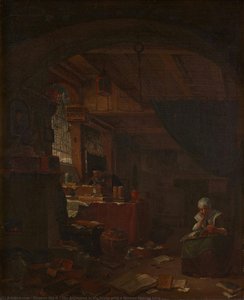
St Anthony, Archbishop of Florence (1654) door Thomas Wijck

St Anthony, Archbishop of Florence

1654 · Oil · Nationalmuseum, Stockholm

The saint stands within a frame of heavy, arched architecture. He is a pillar of white and black, his monastic habit catching a sharp, directional light from the upper left. This light carves the folds of his robes and illuminates a face set with solemn authority. In one hand, he holds a tall processional cross; in the other, a scale. The metal of the scale catches the light, a small…

2
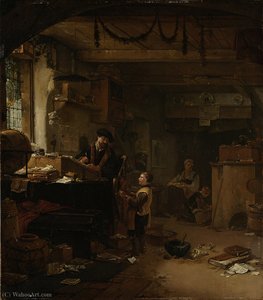
Interior of a Dutch Farm Cottage (1654) door Thomas Wijck

Interior of a Dutch Farm Cottage

1654 · Oil · Statens Museum for Kunst, Kopenhagen

In this 1654 work, we find ourselves drawn into the hushed, dim atmosphere of a rustic farm cottage. The composition is anchored by a heavy, dark architectural archway in the foreground, which acts as a threshold, inviting us to peer into a private, domestic world. A soft, directional light enters from a window on the left, casting a gentle glow across the scene. This light catches the subtle textures of…

3
The Alchemist (1650) door Thomas Wijck

The Alchemist

1650 · Oil · Mauritshuis, Den Haag

The Alchemist is a detailed 17th-century genre painting that captures a cluttered workshop filled with a sense of intense scholarly focus. The composition is densely packed, utilizing a deep, shadowed interior that directs the viewer's eye toward a light source entering from a window on the left. The color palette is dominated by earthy tones, such as ochres and browns, which are sharply interrupted by the vibrant, saturated red of…

4
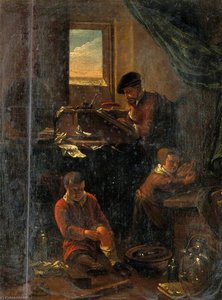
The Tinker (1654) door Thomas Wijck

The Tinker

1654 · Oil On Canvas · Statens Museum for Kunst, Kopenhagen

The Tinker is a genre painting by the Dutch artist Thomas Wijck. Created about 1654, the work depicts a man engaged in his manual trade within a workshop setting. The subject matter focuses on the specific activities of a laborer, providing a view into the daily existence of a traveling repairman. This depiction of a craftsman at work places the figure within the tradition of seventeenth-century Dutch genre scenes.

5
Almsgiving (1660) door Thomas Wijck

Almsgiving

1660 · Oil On Canvas · Philadelphia Museum of Art, Philadelphia

Almsgiving is a somber and atmospheric genre painting from 1660 that depicts a scene of charity within an old European setting. The composition is framed by a large, dark architectural archway in the foreground, which creates a sense of depth and directs the viewer's eye toward the central group of figures. The subject matter focuses on the interaction between people in a moment of social welfare, evoking themes of piety,…

6
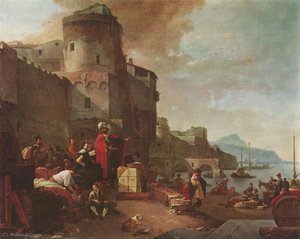
Capriccio of a Fort by the Sea, with Orientals and an Antique Statue (1673) door Thomas Wijck

Capriccio of a Fort by the Sea, with Orientals and an Antique Statue

1673 · Oil On Canvas · National Trust, Thames

To gaze upon this magnificent Capriccio of a Fort by the Sea is to step directly into a sun-drenched moment plucked from the heart of the Dutch Golden Age. Thomas Wyck’s masterful oil painting, dated 1673, transports us to a vibrant, almost theatrical harbor scene where the solidity of classical architecture meets the ephemeral energy of human endeavor. It is more than just a depiction of a port; it is…

7
Woman at Her Sewing Table (1655) door Thomas Wijck

Woman at Her Sewing Table

1655 · Oil On Canvas · Städel Museum, Frankfurt

In this intimate scene from 1655, we find ourselves drawn into a private, domestic moment. A woman sits at her sewing table, her attention entirely consumed by the needlework in her hands. The composition is tightly framed, pulling the viewer into the stillness of her world. Light enters from an unseen source to the left, washing over the bright white of her linen collar and the fabric she works upon,…

8
View of the Bay of Naples with Orientals and an Antique Statue (1673) door Thomas Wijck

View of the Bay of Naples with Orientals and an Antique Statue

1673 · Oil On Canvas · National Trust, Thames

Gaze upon this exquisite vision of the Bay of Naples, a scene that transports the viewer directly to an era of opulent leisure and artistic contemplation. The composition is alive with the gentle murmur of activity—the distant sails catching the sun, the figures gathered along the shore engaging in moments of quiet enjoyment. It is more than just a depiction of a beautiful vista; it is an immersion into a…

9
A rustic interior (1654) door Thomas Wijck

A rustic interior

1654 · Oil On Panel · Museum Boijmans Van Beuningen, Rotterdam

The air inside this room feels heavy and still, thick with the scent of woodsmoke and old stone. A low, heavy ceiling presses down upon the scene, creating a sense of profound intimacy that wraps around the figures like a shroud. Light enters from a single, unseen source to the left, slicing through the gloom to catch the bright white of a woman's headscarf. This sudden brightness pulls the eye…

10
An Alchemist in His Studio (1600) door Thomas Wijck

An Alchemist in His Studio

1600 · Oil · Science History Institute, Philadelphia

A soft, warm light spills across a cluttered desk, illuminating an old man lost in the silent labor of thought. He sits hunched over a book, his eyes tracing lines of text that perhaps hold the secrets of the universe. The room feels heavy with the scent of old parchment and the stillness of a life dedicated to study. Around him, the tools of his obsession are scattered like fragments…

De beroemde schilderijen van Thomas Wijck, nummer 11 tot 80

11Harbor Scene (1646) door Thomas WijckHarbor Scene1646 · Bayerische Staatsgemäldesammlungen 12An Alchemist (1646) door Thomas WijckAn Alchemist1646 · Bayerische Staatsgemäldesammlungen 13Italian Landscape with Figures at a Fountain among Antique Ruins (1647) door Thomas WijckItalian Landscape with Figures at a Fountain among Antique Ruins1647 · Städel Museum 14man reading in his laboratory (1641) door Thomas Wijckman reading in his laboratory1641 15Southern Sea-Harbour with architecture; tradesmen (1641) door Thomas WijckSouthern Sea-Harbour with architecture; tradesmen1641 16Morra-Players (1640) door Thomas WijckMorra-Players1640 · Academy of Fine Arts Vienna 17On the Gulf of Naples (1650) door Thomas WijckOn the Gulf of Naples1650 · Bayerische Staatsgemäldesammlungen 18Interior with Two Men and a Woman with a Baby (1656) door Thomas WijckInterior with Two Men and a Woman with a Baby1656 19Merchants with commodities in a Levante Harbour (1660) door Thomas WijckMerchants with commodities in a Levante Harbour1660 · Musée Fabre 20Painting (1656) door Thomas WijckPainting1656 · National Museum of Art, Architecture and Design 21The Gipsy Woman Telling the Soldiers their Fortunes (1660) door Thomas WijckThe Gipsy Woman Telling the Soldiers their Fortunes1660 · Statens Museum for Kunst 22The Yard of an Italian Tavern (1654) door Thomas WijckThe Yard of an Italian Tavern1654 · Statens Museum for Kunst 23The Weaver at Work in his Home (1654) door Thomas WijckThe Weaver at Work in his Home1654 · Statens Museum for Kunst 24A scholar in his Study (1660) door Thomas WijckA scholar in his Study1660 · Hallwyl Museum 25Alchemist in his laboratory (1650) door Thomas WijckAlchemist in his laboratory1650 · Staatliches Museum Schwerin 26An alchemist's workshop (1654) door Thomas WijckAn alchemist's workshop1654 · Gemäldegalerie 27The Alchemist in his Study with a Woman Making Lace (1660) door Thomas WijckThe Alchemist in his Study with a Woman Making Lace1660 · Science History Institute 28An Alchemist in his Laboratory (1654) door Thomas WijckAn Alchemist in his Laboratory1654 · Statens Museum for Kunst 29An Alchemist and His Family (1660) door Thomas WijckAn Alchemist and His Family1660 · Science History Institute 30Landscape with Arch Bridge (1646) door Thomas WijckLandscape with Arch Bridge1646 · Bayerische Staatsgemäldesammlungen 31Italian street scene door Thomas WijckItalian street scene 32Alchemist door Thomas WijckAlchemistRijksmuseum 33Mountain Monastery (1646) door Thomas WijckMountain Monastery1646 · Bayerische Staatsgemäldesammlungen 34Rock Landscape (1646) door Thomas WijckRock Landscape1646 · Bayerische Staatsgemäldesammlungen 35At the Seaport (1646) door Thomas WijckAt the Seaport1646 · Bayerische Staatsgemäldesammlungen 36Vegetable Market (1646) door Thomas WijckVegetable Market1646 · Bayerische Staatsgemäldesammlungen 37Italian Harbor with Fortifications and Staffage (1641) door Thomas WijckItalian Harbor with Fortifications and Staffage1641 38Italian Coastal Landscape (1640) door Thomas WijckItalian Coastal Landscape1640 39Interior of a Cave (1640) door Thomas WijckInterior of a Cave1640 40Apple Seller at a City Gate (1654) door Thomas WijckApple Seller at a City Gate1654 · National Museum in Wrocław 41A washerwoman and children by a river before a walled bridge (1654) door Thomas WijckA washerwoman and children by a river before a walled bridge1654 · Wallraf-Richartz-Museum 42Figures in the Courtyard of a House (1660) door Thomas WijckFigures in the Courtyard of a House1660 · Fairfax House 43An Alchemist at Work, with a Mother by a Cradle Beyond (1650) door Thomas WijckAn Alchemist at Work, with a Mother by a Cradle Beyond1650 · Science History Institute 44View of port of Ripa Grande. (1670) door Thomas WijckView of port of Ripa Grande.1670 · Musée Fabre 45A View of the Forum (1674) door Thomas WijckA View of the Forum1674 · National Trust 46An Alchemist in His Laboratory (1673) door Thomas WijckAn Alchemist in His Laboratory1673 · National Trust 47Capriccio of a Seaport with Orientals, Ruins, and an Antique Statue (1673) door Thomas WijckCapriccio of a Seaport with Orientals, Ruins, and an Antique Statue1673 · National Trust 48An Alchemist in His Laboratory, with an Assistant (1673) door Thomas WijckAn Alchemist in His Laboratory, with an Assistant1673 · National Trust 49Italian Courtyard (1677) door Thomas WijckItalian Courtyard1677 · Dulwich Picture Gallery 50Landscape with Bay (1646) door Thomas WijckLandscape with Bay1646 · Bayerische Staatsgemäldesammlungen 51Old Building door Thomas WijckOld BuildingKunsthistorisches Museum 52Interior of a Weaver's Cottage door Thomas WijckInterior of a Weaver's CottageNational Gallery of Ireland 53landscape with fountain and fig. door Thomas Wijcklandscape with fountain and fig. 54horsemen resting before an inn door Thomas Wijckhorsemen resting before an inn 55Figures outside a tavern with a woman sewing, travellers on a bridge beyond door Thomas WijckFigures outside a tavern with a woman sewing, travellers on a bridge beyond 56Whitehall and St James's Park, London door Thomas WijckWhitehall and St James's Park, London 57Capriccio of a Roman Ruins with Orientals, a Fountain and an Antique Statue door Thomas WijckCapriccio of a Roman Ruins with Orientals, a Fountain and an Antique StatueNational Trust 58An Alchemist door Thomas WijckAn AlchemistHermitage Museum 59Dancing couple + many people at ruins door Thomas WijckDancing couple + many people at ruins 60A church interior door Thomas WijckA church interior 61Washerwomen at the Foot of the Torre delle Milizie, Rome door Thomas WijckWasherwomen at the Foot of the Torre delle Milizie, Rome 62Italian port door Thomas WijckItalian port 63Levantijnse haven door Thomas WijckLevantijnse havenRijksmuseum 64Southern Landscape door Thomas WijckSouthern Landscape 65Washerwomen in a yard. door Thomas WijckWasherwomen in a yard.Nationaal Museum in Warschau 66The Alchemist door Thomas WijckThe AlchemistFitzwilliam College 67Riders by Italianate ruins with a seaport beyond door Thomas WijckRiders by Italianate ruins with a seaport beyond 68Italian Street Scene door Thomas WijckItalian Street SceneThe Ashmolean Museum of Art and Archaeology 69Spinning farmer door Thomas WijckSpinning farmerRijksmuseum 70View of the Thames at Westminster on Lord Mayor's Day door Thomas WijckView of the Thames at Westminster on Lord Mayor's Day 71The Poor Being Fed at a Monastery door Thomas WijckThe Poor Being Fed at a Monastery 72The Wreckers, Stormy Coast Scene with Tower door Thomas WijckThe Wreckers, Stormy Coast Scene with Tower 73A Philosopher in His Study, with Two Children door Thomas WijckA Philosopher in His Study, with Two Children 74Interior with an Alchemist door Thomas WijckInterior with an Alchemist 75Interior with an Alchemist Making a Gesture of Surprise, and a Female Assistant door Thomas WijckInterior with an Alchemist Making a Gesture of Surprise, and a Female Assistant 76Interior with an Alchemist Examining a Bowl Brought by a Boy door Thomas WijckInterior with an Alchemist Examining a Bowl Brought by a Boy 77Interior with an Alchemist Studying a Book, His Assistant Pouring Liquid into a Bowl door Thomas WijckInterior with an Alchemist Studying a Book, His Assistant Pouring Liquid into a Bowl 78Interior with an Alchemist Seated at a Table, Looking out of the Picture door Thomas WijckInterior with an Alchemist Seated at a Table, Looking out of the Picture 79Interior with an Alchemist Seated at a Table, Looking out of the Picture door Thomas WijckInterior with an Alchemist Seated at a Table, Looking out of the Picture 80Kitchen interior door Thomas WijckKitchen interiorFinnish National Gallery

De beroemde schilderijen van Thomas Wijck, periode voor periode

De onderwerpen die de aandacht van Thomas Wijck troffen

De vier onderwerpen die het meest voorkomen in deze originelen, elk met zijn mooiste voorbeeld.

De musea waar de originele werken van Thomas Wijck worden bewaard

De 8 musea met de meeste schilderijen op deze pagina.

Museum Stad Werken van Thomas Wijck Schilderijen uit deze lijst
Bayerische Staatsgemäldesammlungen, MünchenBayerische Staatsgemäldesammlungen München 9 Harbor Scene, An Alchemist, On the Gulf of Naples
National Trust, ThamesNational Trust Thames 7 Capriccio of a Fort by the Sea, with Orientals and an Antique Statue, View of the Bay of Naples with Orientals and an Antique Statue, A View of the Forum
Statens Museum for Kunst, KopenhagenStatens Museum for Kunst Kopenhagen 6 Interior of a Dutch Farm Cottage, The Tinker, The Gipsy Woman Telling the Soldiers their Fortunes
Science History Institute, PhiladelphiaScience History Institute Philadelphia 4 An Alchemist in His Studio, The Alchemist in his Study with a Woman Making Lace, An Alchemist and His Family
Rijksmuseum, AmsterdamRijksmuseum Amsterdam 3 Alchemist, Levantijnse haven, Spinning farmer
Städel Museum, FrankfurtStädel Museum Frankfurt 2 Woman at Her Sewing Table, Italian Landscape with Figures at a Fountain among Antique Ruins
Musée Fabre, MontpellierMusée Fabre Montpellier 2 Merchants with commodities in a Levante Harbour, View of port of Ripa Grande.
Nationalmuseum, StockholmNationalmuseum Stockholm 1 St Anthony, Archbishop of Florence

Thomas Wijck door de decennia heen: elk een uniek origineel

Werken per decennium

Kies een decennium om het origineel te zien dat dit tijdperk definieert.

Schilderijen van Thomas Wijck: vragen voor de galerie

Wat is het bekendste werk van Thomas Wijck?Onthul het antwoord

St Anthony, Archbishop of Florence (1654), Nationalmuseum, Stockholm. Interior of a Dutch Farm Cottage (1654) en The Alchemist (1650) volgen.

Op welke leeftijd creëerde Thomas Wijck St Anthony, Archbishop of Florence?Onthul het antwoord

38 jaar oud: St Anthony, Archbishop of Florence dateert uit 1654, en Thomas Wijck werd geboren in 1616.

Welke tien schilderijen van Thomas Wijck zijn het meest bekend?Onthul het antwoord

St Anthony, Archbishop of Florence, Interior of a Dutch Farm Cottage, The Alchemist, The Tinker, Almsgiving, Capriccio of a Fort by the Sea, with Orientals and an Antique Statue, Woman at Her Sewing Table, View of the Bay of Naples with Orientals and an Antique Statue, A rustic interior en An Alchemist in His Studio. De bovenstaande ranglijst vermeldt het jaar en het museum van elk werk.

Hoeveel werken van Thomas Wijck zijn er bekend?Onthul het antwoord

Onze catalogus bevat 89 werken van Thomas Wijck, daterend van 1640 tot 1677.

Waar kunnen de beroemdste originelen van Thomas Wijck worden bekeken?Onthul het antwoord

Voornamelijk in Bayerische Staatsgemäldesammlungen (München), National Trust (Thames) en Statens Museum for Kunst (Kopenhagen). De bovenstaande museumtabel bevat een volledig overzicht.

In welke periode creëerde Thomas Wijck de bekendste schilderijen?Onthul het antwoord

In 1650s: 17 van de 80 werken op deze pagina werden toen gemaakt, waaronder St Anthony, Archbishop of Florence.

Welk beroemd schilderij van Thomas Wijck is de vroegste, en welke de laatste?Onthul het antwoord

Op deze pagina is het vroegste Morra-Players (1640) en het laatste Italian Courtyard (1677).

Welke onderwerpen had Thomas Wijck de voorkeur?Onthul het antwoord

Man (14), Woman (12) en People (12), verspreid over de 80 werken op deze pagina.

Met welke materialen schilderde Thomas Wijck het meest?Onthul het antwoord

Oil, voor 24 van de 80 werken op deze pagina.

Bij welke stroming behoort het werk van Thomas Wijck?Onthul het antwoord

Dutch golden age en Baroque, te oordelen aan de originelen op deze pagina.

Welke originele werken van Thomas Wijck kan ik zien in het Bayerische Staatsgemäldesammlungen?Onthul het antwoord

Harbor Scene, An Alchemist en On the Gulf of Naples: het Bayerische Staatsgemäldesammlungen, München herbergt 9 van de werken op deze pagina.

Thomas Wijck: een portret van de kunstenaar

Het Leven en de Nalatenschap van Thomas Wyck

Geboren in een bloedlijn van makers, kwam Thomas Wyck naar voren als een vooraanstaand figuur binnen het levendige landschap van de schilderkunst uit de Nederlandse Gouden Eeuw. Zijn artistieke reis begon onder het waakzame oog van zijn vader, van wie hij zijn fundamentele training ontving; een begin dat hem diep wortelde in de tradities van zijn ambacht. Deze vroege onderdompeling in de technische nuances van de olieverfschilderkunst bereidde hem voor op een leven van ontdekking en stilistische evolutie. Als schilder van zowel havengezichten als genrestukken bezat Wyck het unieke vermogen om de bruisende energie van de maritieme handel en de intieme, vaak mysterieuze momenten van het dagelijks leven vast te leggen.

Het verloop van zijn carrière werd diepgaand gevormd door zijn reizen door het Middellandse Zeegebied. Hoewel historische verslagen over zijn exacte bewegingen onderwerp zijn van wetenschappelijk debat, suggereert het bewijs dat er rond 1640 een schilder bekend als Tommaso fiammingo actief was in Rome, een figuur die velen menen dat Wyck zelf was. Deze periode van Italiaanse invloed is tastbaar in zijn werk; zijn doeken ademen vaak met het licht en de atmosfeer van Romeinse landschappen en de kustschoonheid van Napels. In de omgeving van Napels maakte hij met uiterste precisie schetsen die later zouden uitgroeien tot gedetailleerde tekeningen van kustgezichten, waarmee hij een scherp oog toonde voor het snijvlak van natuurlijke grandeur en menselijke aanwezigheid.

Meesterschap in Genre en Maritieme Scènes

Wycks artistieke repertoire was opmerkelijk divers, variërend van de theatricaliteit van Italiaanse landschappen tot de diepe symboliek die in genrestukken te vinden is. Hij excelleerde in het creëren van capriccios—imaginair, vaak architecturale fantasieën—zoals zijn voorstellingen van forten aan zee, waar de klassieke oudheid de levendige beweging van het hedendaagse maritieme leven ontmoet. Zijn vermogen om deze scènes te bevolken met een veelheid aan figuren stelde hem in staat om complexe verhalen over handel, ontspanning en historische eerbied in één enkele compositie te verweven.

Voorbij de weidse panorama's van havens en baaien dook Wyck in de schaduwrijke, introspectieve hoeken van de menselijke ervaring. Zijn werk An Alchemist dient als een adembenemend voorbeeld van zijn vaardigheid in het vastleggen van intellectuele spanning. In dit stuk gebruikt de kunstenaar de setting van een afgelegen laboratorium om de vervagende grenzen tussen de opkomende wetenschap en oude mystiek te verkennen. Door de zorgvuldige schikking van objecten zoals klokken, boeken en manuscripten, nodigt hij de kijker uit om na te denken over thema's als tijd, volharding en de onvermoeibare zoektocht naar verborgen kennis.

Professionele Eminentie en Blijvende Invloed

Bij zijn terugkeer naar de noordelijke Nederlanden in 1642 vestigde Wyck zich als een pijler van de artistieke gemeenschap. Zijn professionele status werd bezegeld door zijn lidmaatschap van het Sint-Lucasgilde in Haarlem, een instituut waar hij uiteindelijk in 1660 de prestigieuze functie van deken zou bekleden. Deze periode in zijn leven markeerde een hoogtepunt van lokale invloed en erkenning, aangezien hij een centrale figuur werd in de Nederlandse kunstwereld.

De reikwijdte van Wycks invloed reikte ver voorbij de grenzen van de Nederlanden. Tijdens het tijdperk van de Engelse Restauratie reisde hij naar Engeland, waar zijn talenten zeer gezocht waren. Zijn nalatenschap werd verder versterkt door zijn rol als docent; zijn zoon en leerling, Jan Wyck, werd een belangrijk figuur in de ontwikkeling van de Engelse sportschilderkunst, terwijl zijn leerling Jan van der Vaart deze tradities ook naar nieuwe landen bracht. Door zijn nakomelingen en leerlingen bleef de technische briljantie en atmosferische gevoeligheid van Thomas Wyck door de eeuwen heen resoneren, waarbij hij een onuitwisbare stempel drukte op de geschiedenis van de Europese schilderkunst.