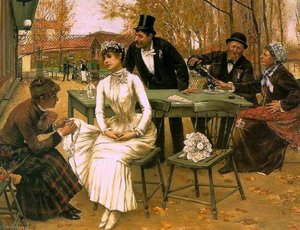
A Life Immersed in Light and Landscape: Norbert Goeneutte
Norbert Goeneutte, a name perhaps less celebrated than his Impressionist contemporaries, nevertheless occupies a significant place within the artistic milieu of
late 19th-century France. Born in Paris in 1854, Goeneutte’s life was one subtly interwoven with the threads of societal change and artistic innovation. His early years were marked by disruption; the family's relocation from Saint-Omer to Paris in 1850 coincided with a period of political unrest, and his formal education at the Lycée Condorcet was interrupted by the Franco-Prussian War and the tumultuous events of the Commune. This formative experience instilled in him, perhaps unconsciously, a sensitivity to the fleeting nature of stability and a keen observation of the world around him – qualities that would later define his artistic vision. Initially steered towards a legal career by his father, Goeneutte quickly discovered his true calling lay not within the confines of an attorney’s office but amidst the vibrant energy of the École des Beaux-Arts. He embarked on studies under
Isidore Pils, and following
Pils' death in 1875, briefly with
Henri Lehmann, though he soon sought a more independent path, establishing his own studio and forging connections that would shape his artistic trajectory.
The Artistic Circle and Early Recognition
Goeneutte’s Paris was a city teeming with creative ferment. He became a regular at the Père Lathuille cabaret, a legendary haunt for artists and intellectuals, where he encountered
Édouard Manet and was welcomed into the circle of painters who frequented the Café de la Nouvelle Athènes. This exposure proved pivotal. While he consistently exhibited at the Salon – a testament to his technical skill and developing style – Goeneutte remained deliberately outside the core group of Impressionists, choosing not to participate in their independent exhibitions. He wasn’t aloof; rather, his artistic temperament seemed to favor a more nuanced approach, one that blended observation with a delicate lyricism. A turning point arrived in 1879 with his marriage to
Eva Gonzalès, herself a talented painter and a favored model of
Manet. This union not only provided personal companionship but also deepened his connection to the Impressionist world, though he continued to carve out his own distinct artistic identity. His early works reveal a fascination with scenes of
Parisian life, rendered with a subtle palette and an emphasis on capturing the play of light and atmosphere.
Landscapes, Travel, and the Power of Illustration
The 1880s saw Goeneutte’s artistic focus shift increasingly towards landscapes and cityscapes. Supported financially by his brother, he embarked on a series of travels that broadened his horizons and enriched his visual vocabulary. Trips to London in 1880 and Venice in 1890 proved particularly influential, exposing him to different light conditions, architectural styles, and cultural perspectives. These journeys resulted in a prolific output of paintings depicting the charm of
English countryside and the romantic allure of Venetian canals. However, it was his commission to illustrate Émile Zola’s monumental novel *La Terre* (1887) that cemented his reputation beyond the Parisian art world. Goeneutte's illustrations weren't merely decorative accompaniments; they were powerful visual interpretations of Zola’s unflinching portrayal of
rural life, capturing both its beauty and its brutality with remarkable sensitivity and depth. The stark
realism of the novel found a compelling echo in Goeneutte’s evocative imagery, solidifying his position as a master illustrator capable of conveying complex narratives through visual means.
Founding a Society & A Premature End
Goeneutte's commitment to both painting and printmaking led him to become one of the founding members of the “Société des Peintres-Graveurs Français” in 1889, alongside friends like
Henri Guérard and
Félix Bracquemond. This society aimed to elevate the status of
engraving as a legitimate art form and provide a platform for artists working in this medium. He exhibited at the Exposition Universelle that same year, further broadening his public recognition. However, internal disagreements within the Société – particularly over the admission of
Camille Pissarro due to his non-French birth – caused friction, revealing Goeneutte’s strong principles and dedication to artistic inclusivity. Tragically, in 1891, Dr. Paul Gachet, a physician and
art collector known for his support of Impressionist artists, diagnosed Goeneutte with a weak heart and advised him to seek a quieter life in the countryside for his health. This diagnosis marked the beginning of a decline, and Norbert Goeneutte passed away in 1894 at the relatively young age of forty.
Legacy & Historical Significance
Though his career was cut short, Norbert Goeneutte left behind a substantial body of work that continues to resonate with viewers today. His landscapes possess a
quiet beauty and
atmospheric depth, reflecting a profound connection to nature and a mastery of
light and color.
His illustrations for *La Terre* remain particularly noteworthy, demonstrating his ability to translate complex literary themes into compelling visual narratives. Goeneutte’s art occupies an interesting space within the broader
Impressionist movement – he was undoubtedly influenced by its principles, yet he maintained a distinct artistic voice characterized by subtlety and lyricism.
His connection to Van Gogh is also of note; he shared a studio with Vincent in Auvers-sur-Oise during the latter’s final months, though their interactions were limited. Goeneutte's legacy lies not only in his individual achievements but also in his contribution to the artistic community and his dedication to promoting both painting and printmaking as vital forms of expression. He stands as a testament to the enduring power of observation, the beauty of landscape, and the evocative potential of art to capture the complexities of the human experience.