Portret van Leonard Bramer

Schilderijen van Leonard Bramer: De 65 bekendste, door de ogen van een galerie

Bijgewerkt in november 2026 · gerangschikt op basis van onze populariteitsscore (zoekopdrachten, bezoeken en bestellingen per kunstwerk) · 68 werken van Leonard Bramer in onze catalogus

Kortom

Volgens de visie van de galerie is het beroemdste schilderij van Leonard Bramer Soldiers with Horses before a House (1655), waarvan het origineel in het Museum Kunstpalast in Düsseldorf hangt. Adoration of the Magi (1639) en The Sacrifice of Iphigenia (1623) maken het trio compleet dat elk oog herkent. Van de 68 werken van Leonard Bramer in onze catalogus presenteert de galerie hieronder de 65 bekendste werken, elk een origineel met de jaartal, het museum en wat het uniek maakt.

1596 – 1674, Delft Baroque art Meeste werken: Nationalmuseum

De top 10 schilderijen van Leonard Bramer in de galerie

1
Soldiers with Horses before a House (1655) door Leonard Bramer

Soldiers with Horses before a House

1655 · Oil On Canvas · Museum Kunstpalast, Düsseldorf

In the masterful oil painting "Soldiers with Horses before a House," Leonaert Bramer invites viewers into a meticulously crafted moment from the Dutch Golden Age. The scene, captured with profound anatomical accuracy, centers on two mounted soldiers who command the viewer's attention through their expressive poses and the palpable energy of their movement. Bramer employs a sophisticated technique of hatching and cross-hashing, particularly evident in the metallic sheen of the…

2
Adoration of the Magi (1639) door Leonard Bramer

Adoration of the Magi

1639 · Oil On Panel · Hermitage Museum, Sint-Petersburg

The darkness of a vast, desolate landscape presses in from every side, swallowing the horizon in a heavy, nocturnal shroud. In this quiet, shadowy realm, a sudden, intense glow emanates from the center of the scene, cutting through the gloom like a physical presence. This light does not merely illuminate; it transforms. It spills across the figures in the lower left, catching the textures of ornate, heavy garments and the…

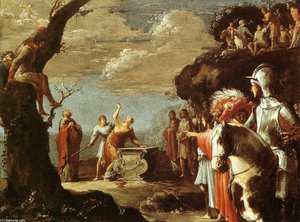
3
The Sacrifice of Iphigenia (1623) door Leonard Bramer

The Sacrifice of Iphigenia

1623 · Oil On Copper · Het Prinsenhof, Delft

Leonaert Bramer produced The Sacrifice of Iphigenia during his time in Italy. This work is one of the few paintings known to have been executed by the artist in Rome. It represents a significant period of his development, occurring after his departure from Delft and his involvement with the Bentvueghels.

4
The Adoration of the Magi (1642) door Leonard Bramer

The Adoration of the Magi

1642 · Oil On Copper · Statens Museum for Kunst, Kopenhagen

The Adoration of the Magi emerges from the shadows of 1639, a moment frozen in oil where the sacred meets the earthly. Leonaert Bramer captures the Holy Family and the Magi in a quiet, intense encounter. The scene centers on the Wise Men as they approach to present their precious gifts to the Christ-child. Every figure exists within a heavy, atmospheric stillness, caught in the act of reverence.

5
Four Latin Fathers of the Church and Saints (verso) (1650) door Leonard Bramer

Four Latin Fathers of the Church and Saints (verso)

1650 · Oil On Canvas · British Museum, Londen

Leonaert Bramer's "Four Latin Fathers of the Church and Saints (verso)" isn’t merely a painting; it’s an intimate portrait of artistic process, a whispered secret revealed through layers of paint, time, and deliberate obscurity. This remarkable work, currently housed in the British Museum, offers a captivating journey into the mind of a pivotal 17th-century Dutch artist – a man often dubbed “Leonardo della Notte” for his mastery of nocturnal scenes…

6
Allegory of Vanity (Vanitas) (1650) door Leonard Bramer

Allegory of Vanity (Vanitas)

1650 · Oil On Canvas · Kunsthistorisches Museum, Wenen

In this somber Dutch Golden Age composition, we find ourselves in a space defined by shadow and light. The scene is arranged in a triangular formation, drawing the eye toward a cluttered table where the objects of earthly pleasure lie scattered. A strong light source from the upper left cuts through the darkness, illuminating the polished wood of a lute and the metallic sheen of silver vessels. These textures—the soft…

7
Dying Vision of Mary Magdalene (1633) door Leonard Bramer

Dying Vision of Mary Magdalene

1633 · Oil On Panel · Hermitage Museum, Sint-Petersburg

The oil on panel titled Dying Vision of Mary Magdalene was created by Leonaert Bramer in 1633. This religious work captures a moment of spiritual revelation through the heavy application of pigment. The canvas holds the gaze of a woman kneeling in the shadows, her eyes turned toward a celestial light.

9
Crucifixion (1650) door Leonard Bramer

Crucifixion

1650 · Oil On Panel · Hermitage Museum, Sint-Petersburg

The air feels heavy, thick with the silence of a world gone dark. In this somber Baroque scene, the central figure of Christ hangs upon the cross, his body illuminated by a sudden, sharp light that cuts through the surrounding gloom. This light catches the pale tones of his flesh and the tension in his musculature, pulling him forward from a near-black background. Below him, the weight of grief takes…

10
Journey of the Three Magi to Bethlehem (1638) door Leonard Bramer

Journey of the Three Magi to Bethlehem

1638 · Oil On Canvas · New York Historical Society, New York City

In the quiet, shadowed corridors of the Dutch Golden Age, few artists possessed the ability to conjure atmosphere as masterfully as Leonaert Bramer. His 1638 masterpiece, Journey of the Three Magi to Bethlehem, is not merely a depiction of a biblical pilgrimage; it is a profound immersion into a world of divine mystery and dramatic tension. As the viewer approaches this canvas, they are immediately swept into the urgent movement…

Schilderijen van Leonard Bramer, gerangschikt van 11 tot 65

11St Peter"s Denial, Leonaert Bramer, 1642 (1642) door Leonard BramerSt Peter"s Denial, Leonaert Bramer, 16421642 · Rijksmuseum 12Christ before Pilate (1635) door Leonard BramerChrist before Pilate1635 · Bayerische Staatsgemäldesammlungen 13The Finding of Pyramus and Thisbe (1624) door Leonard BramerThe Finding of Pyramus and Thisbe1624 · Gemäldegalerie 14Five men playing music in an interior (1633) door Leonard BramerFive men playing music in an interior1633 · Staatliche Kunsthalle Karlsruhe 15The Adoration of the Shepherds (1635) door Leonard BramerThe Adoration of the Shepherds1635 · Nationalmuseum 16The Martyrdom of the Prophet Isaiah (1625) door Leonard BramerThe Martyrdom of the Prophet Isaiah1625 17Abraham and the Three Angels (1640) door Leonard BramerAbraham and the Three Angels1640 · Museo del Prado 18The circumcision of the Christ-child by the priest in the temple (1640) door Leonard BramerThe circumcision of the Christ-child by the priest in the temple1640 · Groninger Museum 19Solomon's idolatry (1 Kings 11:7-8) (1642) door Leonard BramerSolomon's idolatry (1 Kings 11:7-8)1642 · Wallraf-Richartz-Museum 20Saphan reads the book of Law aloud to Josiah (2 Kings 8-10) (1642) door Leonard BramerSaphan reads the book of Law aloud to Josiah (2 Kings 8-10)1642 21The presentation in the temple (1642) door Leonard BramerThe presentation in the temple1642 · New York Historical Society 22The Betrayal of Christ (1637) door Leonard BramerThe Betrayal of Christ1637 23Marcus Curtius Leaping into the Abyss on His Horse (1657) door Leonard BramerMarcus Curtius Leaping into the Abyss on His Horse1657 24Quevedo Sees Chicotus in the Battle (1659) door Leonard BramerQuevedo Sees Chicotus in the Battle1659 · Staatliche Graphische Sammlung 25Figures in a Loggia (1660) door Leonard BramerFigures in a Loggia1660 · Victoria and Albert Museum 26Jacob's Dream (1657) door Leonard BramerJacob's Dream1657 · Koninklijke Tichelaar 27The Judgment of Solomon (detail) (1640) door Leonard BramerThe Judgment of Solomon (detail)1640 · Metropolitan Museum of Art 28Geld bestrijdt de wereld, het vlees en het duivel (1659) door Leonard BramerGeld bestrijdt de wereld, het vlees en het duivel1659 · Staatliche Graphische Sammlung 29Het Laatste Oordeel van Salomon (1640) door Leonard BramerHet Laatste Oordeel van Salomon1640 · Metropolitan Museum of Art 30The Fall of Simon Magus (1623) door Leonard BramerThe Fall of Simon Magus1623 31The Quarrel between Ajax and Odysseus (1623) door Leonard BramerThe Quarrel between Ajax and Odysseus1623 · Het Prinsenhof 32Quevedo and the Skeletons of Juan de la Encina and King Perico (1659) door Leonard BramerQuevedo and the Skeletons of Juan de la Encina and King Perico1659 · Staatliche Graphische Sammlung 33Scene from the Metamorphoses (1660) door Leonard BramerScene from the Metamorphoses1660 34Scene from the Metamorphoses (1660) door Leonard BramerScene from the Metamorphoses1660 35Scenes from the Life of Christ (1660) door Leonard BramerScenes from the Life of Christ1660 36Allegory of Transitoriness (1640) door Leonard BramerAllegory of Transitoriness1640 · Kunsthistorisches Museum 37De Verleiding van Christus (1645) door Leonard BramerDe Verleiding van Christus1645 · Hessisches Landesmuseum 38Design for a wall decoration (1645) door Leonard BramerDesign for a wall decoration1645 · Nasjonalgalleriet 39Pashur Smiting Jeremiah in the Temple, Leonaert Bramer, c. 1648 (1648) door Leonard BramerPashur Smiting Jeremiah in the Temple, Leonaert Bramer, c. 16481648 · Rijksmuseum 40Musicians in an Interior (1660) door Leonard BramerMusicians in an Interior1660 · Rijksmuseum 41The Trials of Job (1630) door Leonard BramerThe Trials of Job1630 · Courtauld Gallery 42Joseph and Potiphar's Wife (1630) door Leonard BramerJoseph and Potiphar's Wife1630 · Courtauld Gallery 43A Peasant and Two Soldiers Playing Dice door Leonard BramerA Peasant and Two Soldiers Playing DiceNationalmuseum 44Soldiers Arguing door Leonard BramerSoldiers ArguingNationalmuseum 45Musical Company door Leonard BramerMusical CompanyNationalmuseum 46Company around a Table door Leonard BramerCompany around a TableNationalmuseum 47Anchias Fleeing Troy with His Father and Son door Leonard BramerAnchias Fleeing Troy with His Father and Son 48the curious ones door Leonard Bramerthe curious ones 49Résurrection de Jésus door Leonard BramerRésurrection de Jésus 50SCENE DE SORCELLERIE door Leonard BramerSCENE DE SORCELLERIE 51L'Arrestation de Jésus Jésus au Jardin des Oliviers door Leonard BramerL'Arrestation de Jésus Jésus au Jardin des Oliviers 52Christ among the Doctors door Leonard BramerChrist among the Doctors 53Salome Presented with the Head of St John the Baptist door Leonard BramerSalome Presented with the Head of St John the BaptistMusée des Beaux-Arts 54Christ before Caiaphas door Leonard BramerChrist before CaiaphasBirmingham Museum and Art Gallery 55LE DRAGON DE CADMUS door Leonard BramerLE DRAGON DE CADMUS 56LA DECOUVERTE DES CORPS DE PYRAME ET DE THISBE door Leonard BramerLA DECOUVERTE DES CORPS DE PYRAME ET DE THISBELouvre 57portrait of a man door Leonard Bramerportrait of a man 58Peasants by a Fire door Leonard BramerPeasants by a Fire 59Scenes from the Life of Christ door Leonard BramerScenes from the Life of Christ 60The Adoration of the Magi door Leonard BramerThe Adoration of the MagiDetroit Institute of Arts 61Concert of Angels (recto) door Leonard BramerConcert of Angels (recto) 62Musicians on a Terrace door Leonard BramerMusicians on a Terrace 63The Liberation of Saint Peter door Leonard BramerThe Liberation of Saint PeterLos Angeles County Museum of Art 64Christ among the Doctors door Leonard BramerChrist among the Doctors 65Circumcision of Christ (1640) door Leonard BramerCircumcision of Christ1640 · Nationaal Museum in Warschau

De beroemde schilderijen van Leonard Bramer, periode voor periode

De onderwerpen die de aandacht van Leonard Bramer troffen

De vier onderwerpen die het meest voorkomen in deze originelen, elk met zijn mooiste voorbeeld.

De musea waar de originele werken van Leonard Bramer worden bewaard

De 8 musea met de meeste schilderijen op deze pagina.

Museum Stad Werken van Leonard Bramer Schilderijen uit deze lijst
Nationalmuseum, StockholmNationalmuseum Stockholm 5 The Adoration of the Shepherds, A Peasant and Two Soldiers Playing Dice, Soldiers Arguing
Hermitage Museum, Sint-PetersburgHermitage Museum Sint-Petersburg 3 Adoration of the Magi, Dying Vision of Mary Magdalene, Crucifixion
Rijksmuseum, AmsterdamRijksmuseum Amsterdam 3 St Peter"s Denial, Leonaert Bramer, 1642, Pashur Smiting Jeremiah in the Temple, Leonaert Bramer, c. 1648, Musicians in an Interior
Staatliche Graphische Sammlung, MünchenStaatliche Graphische Sammlung München 3 Quevedo Sees Chicotus in the Battle, Geld bestrijdt de wereld, het vlees en het duivel, Quevedo and the Skeletons of Juan de la Encina and King Perico
Het Prinsenhof, DelftHet Prinsenhof Delft 2 The Sacrifice of Iphigenia, The Quarrel between Ajax and Odysseus
Kunsthistorisches Museum, WenenKunsthistorisches Museum Wenen 2 Allegory of Vanity (Vanitas), Allegory of Transitoriness
New York Historical Society, New York CityNew York Historical Society New York City 2 Journey of the Three Magi to Bethlehem, The presentation in the temple
Metropolitan Museum of Art, New YorkMetropolitan Museum of Art New York 2 The Judgment of Solomon (detail), Het Laatste Oordeel van Salomon

Leonard Bramer, één iconisch schilderij per decennium

Werken per decennium

Kies een decennium om het origineel te zien dat dit tijdperk definieert.

Schilderijen van Leonard Bramer: de galerie geeft antwoord

Welk schilderij van Leonard Bramer is het beroemdste van allemaal?Onthul het antwoord

Soldiers with Horses before a House (1655), Museum Kunstpalast, Düsseldorf. Adoration of the Magi (1639) en The Sacrifice of Iphigenia (1623) volgen.

Hoe oud was Leonard Bramer bij de voltooiing van Soldiers with Horses before a House?Onthul het antwoord

59 jaar oud: Soldiers with Horses before a House dateert uit 1655, en Leonard Bramer werd geboren in 1596.

Wat zijn de top 10 schilderijen van Leonard Bramer?Onthul het antwoord

Soldiers with Horses before a House, Adoration of the Magi, The Sacrifice of Iphigenia, The Adoration of the Magi, Four Latin Fathers of the Church and Saints (verso), Allegory of Vanity (Vanitas), Dying Vision of Mary Magdalene, The Raising of Lazarus (John 11: 43-44), Crucifixion en Journey of the Three Magi to Bethlehem. De bovenstaande ranglijst vermeldt het jaar en het museum van elk werk.

Hoeveel werken heeft Leonard Bramer gemaakt?Onthul het antwoord

Onze catalogus bevat 68 werken van Leonard Bramer, daterend van 1623 tot 1660.

Waar hangen de beroemdste originele werken van Leonard Bramer?Onthul het antwoord

Voornamelijk in Nationalmuseum (Stockholm), Hermitage Museum (Sint-Petersburg) en Rijksmuseum (Amsterdam). De bovenstaande museumtabel bevat een volledig overzicht.

Wanneer creëerde Leonard Bramer de beroemdste schilderijen?Onthul het antwoord

In 1640s: 15 van de 65 werken op deze pagina werden toen gemaakt, waaronder The Adoration of the Magi.

Wat zijn de vroegste en laatste beroemde werken van Leonard Bramer?Onthul het antwoord

Op deze pagina is het vroegste The Sacrifice of Iphigenia (1623) en het laatste Figures in a Loggia (1660).

Welke onderwerpen keerde Leonard Bramer het vaakst naar terug?Onthul het antwoord

People (12), Figures (11) en Shadows (10), verspreid over de 65 werken op deze pagina.

In welk medium werkte Leonard Bramer het meest?Onthul het antwoord

Oil On Canvas, voor 10 van de 65 werken op deze pagina.

Bij welke stroming wordt Leonard Bramer gerekend?Onthul het antwoord

Baroque art en Dutch golden age, te oordelen aan de originelen op deze pagina.

Welke originelen van Leonard Bramer zijn in de collectie van het Nationalmuseum?Onthul het antwoord

The Adoration of the Shepherds, A Peasant and Two Soldiers Playing Dice en Soldiers Arguing: het Nationalmuseum, Stockholm herbergt 5 van de werken op deze pagina.

Leonard Bramer: de kunstenaar

Een Verlicht Leven: De Wereld van Leonaert Bramer

Leonaert Bramer, een naam die resoneert met de echo's van het 17e-eeuwse Delft, was meer dan slechts een schilder; hij was een avonturier, een innovator en een spilfiguur in de Nederlandse Gouden Eeuw. Geboren in 1596, ontvouwde zijn leven zich als een meeslepend verhaal, geweven met uitgebreide reizen, artistieke experimenten en een diepe betrokkenheid bij het levendige culturele weefsel van zijn tijd. Bramers nalatenschap wordt niet enkel gedefinieerd door de doeken die hij volmaakte, maar door de unieke visie die hij daaraan gaf – een voorliefde voor dramatische nachtelijke scènes, doordrenkt met exotische details die hem onderscheidden van veel van zijn tijdgenoten. Hij legde niet simpelweg de werkelijkheid vast; hij creëerde werelden vol atmosfeer en mysterie, wat hem tijdens zijn verblijf in Italië de evocatieve bijnaam “Leonardo della Notte” of "Leonardo van de Nacht" opleverde.

Van Delft naar Rome: Een Reis van Artistieke Vorming

Bramers artistieke reis begon met een gedurfde vertrek uit zijn geboortestad Delft op de jonge leeftijd van achttien, waarmee hij aan een grote reis begon die zijn esthetische gevoel zou vormen. Dit was geen ontspannen verkenning, maar een onderdompeling in een meesterproef in het hart van de Europese kunstcentra. Via steden als Atrecht, Amiens en Parijs arriveerde hij uiteindelijk in 1616 in Rome, een smeltkroes voor artistieke ambitie. Daar sloot hij zich aan bij de rangen van de Bentvueghels, een genootschap van Noordelijke kunstenaars die satirische bijnamen aannamen en deelnamen aan levendige intellectuele discussies. Bramer werd bekend als “Nestelghat” (Onrustig), wat hintte naar een onstuitbare energie die zowel zijn leven als zijn kunst doordrong. Zijn tijd in Italië was niet zonder conflicten; verslagen beschrijven een fysieke vechtpartij met de beroemde Claude Lorraine, wat getuigt van een gepassioneerde geest die niet terugdeins voor confrontatie. Het was echter juist binnen deze dynamische omgeving dat Bramer zijn vaardigheden aanscherpte. Hij beheerste de fresco-techniek – een techniek die in Noord-Europa relatief ongebruikelijk was – terwijl hij de invloed van meesters als Adam Elsheimer en Agostino Tassi in zich opnam. Hij reisde uitgebreid door Italië, bezocht Mantua en Venetië, waarbij elke locatie een nieuwe laag toevoegde aan zijn ontwikkelende stijl.

Terugkeer naar Delft: Mecenaat, Innovatie en Artistieke Veelzijdigheid

Bij zijn terugkeer naar Delft in 1628 integreerde Bramer zich naadloos in de lokale kunstwereld en trad hij in 1629 toe tot het Sint-Lucasgilde. Hij verwierf al snel bescherming van prominente figuren, waaronder leden van het Huis van Oranje en invloedrijke lokale ambtenaren, waarmee hij een stabiele basis legende voor zijn artistieke ondernemingen. Maar Bramer was geen eendimensionale kunstenaar; hij omarmde diverse creatieve bezigheden buiten de schilderkunst. Hij ontwierp complexe patronen voor wandtapijtfabrieken, waardoor werken ontstonden die huizen door het hele Nederland sierden. Bovendien ondernam hij ambitieuze muurschilderingsprojecten, waarbij hij illusionistische technieken gebruikte om interieurs te transformeren tot meeslepende omgevingen. Helaas zijn veel van deze fresco's in de loop der tijd verloren gegaan door het harde Nederlandse klimaat, maar hun bestaan getuigt van Bramers opmerkelijke veelzijdigheid en zijn bereidheid om artistieke grenzen te verleggen. Zijn unieke stijl, gekenmerkt door een nerveuze energie en een meesterlijke weergave van lichtreflectie, gaf consequent de voorkeur aan Italiaanse thema's boven de meer conventionele Nederlandse landschappen of stillevens, wat hem markeerde als een individualist binnen zijn milieu.

De Aanraking van een Mentor: Bramers Invloed en Blijvende Nalatenschap

De invloed van Bramer reikte verder dan zijn eigen artistieke productie. Er wordt geloofd dat hij een cruciale rol speelde in de vroege carrière van Johannes Vermeer, door de jonge kunstenaar te verdedigen toen diens toekomstige schoonmoeder probeerde het huwelijk te verhinderen. Deze daad suggereert een nauwe band, wat veel wetenschappers doet speculeren dat Bramer als leraar van Vermeer heeft gediend – hoewel concreet bewijs hiervoor uitblijft. Zijn intellectuele nieuwsgierigheid werd verder aangetoond door de creatie van het “Album Bramer” (1642-1654), een verzameling tekeningen die onschatbare inzichten bieden in de kunstcollecties en artistieke praktijken die in Delft destijds gangbaar waren. Leonaert Bramer overleed in Delft voor 10 februari 1674, en liet een oeuvre na dat mensen tot op de dag van vandaag weet te boeien en te intrigeren. Hoewel zijn roem na zijn dood enige tijd vervaagde, heeft recent wetenschappelijk onderzoek gezorgd voor een hernieuwde belangstelling voor zijn leven en kunst, waardoor zijn positie als een belangrijke – en vaak over het hoofd geziene – figuur in de Nederlandse kunstgeschiedenis is verstevigd. Hij blijft een testament aan de kracht van individuele visie en de blijvende allure van een leven dat in het teken stond van artistieke excellentie.