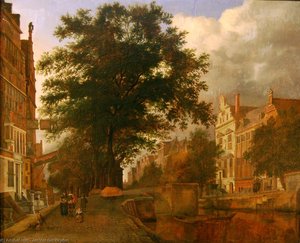
Portret van Jan van der Heyden

De 100 bekendste schilderijen van Jan van der Heyden, een selectie uit de galerie

Bijgewerkt in november 2026 · gerangschikt op basis van onze populariteitsscore (zoekopdrachten, bezoeken en bestellingen per kunstwerk) · 164 werken van Jan van der Heyden in onze catalogus

Kortom

Van alle originele werken die Jan van der Heyden heeft nagelaten, is The Oude Kerk on the Oude Delft in Delft (detail) (1675) het bekendst, in de collectie van het Nasjonalgalleriet, Oslo. Direct daarna volgen View of Delft with Old Church (1670) en A View of the Keizersgracht and the Westerkerk in Amsterdam (1667). Onze catalogus bevat 164 werken van Jan van der Heyden; de galerie heeft de 100 meest bewonderde werken ter wereld bewaard, elk voorzien van de datum, het museum en het verhaal erachter.

1637 – 1712, Gorinchem Dutch golden age Meeste werken: National Gallery

De top 10 schilderijen van Jan van der Heyden: de selectie van de galerie

1
The Oude Kerk on the Oude Delft in Delft (detail) (1675) door Jan van der Heyden

The Oude Kerk on the Oude Delft in Delft (detail)

1675 · Oil On Canvas · Nasjonalgalleriet, Oslo

In the quiet, meticulous strokes of Jan van der Heyden’s 1675 masterpiece, The Oude Kerk on the Oude Delft in Delft, we are invited to step through a portal into the heart of the Dutch Golden Age. This particular detail of the painting serves as more than just a topographical record; it is a living, breathing encapsulation of seventeenth-century urban life. As your eyes wander across the canvas, you encounter…

2
View of Delft with Old Church (1670) door Jan van der Heyden

View of Delft with Old Church

1670 · Oil On Canvas · Detroit Institute of Arts, Detroit

Jan van der Heyden’s “View of Delft with Old Church,” completed in 1670, stands as a cornerstone of Dutch Baroque painting and an enduring emblem of serene urban beauty. More than just a picturesque depiction of the city’s canals and rooftops, it embodies the intellectual and artistic fervor that characterized the Dutch Golden Age—a period marked by unprecedented prosperity, scientific advancement, and artistic innovation. As one gazes upon this masterpiece,…

3
A View of the Keizersgracht and the Westerkerk in Amsterdam (1667) door Jan van der Heyden

A View of the Keizersgracht and the Westerkerk in Amsterdam

1667 · Oil On Panel · Yale University Art Gallery, New Haven

Amsterdam’s Keizersgracht unfolds in this oil on panel composition, presenting a structured view of the city’s canal life. The Westerkerk, designed by Hendrick de Keyser, dominates the background with its distinctive bell tower and classical stone columns. Light settles upon the brickwork and cobblestones, defining the textures of a bustling 17th-century urban center. The scene captures a specific moment of tranquility, where the architectural weight of the church balances the…

4
An Architectural Fantasy (1665) door Jan van der Heyden

An Architectural Fantasy

1665 · Oil · National Gallery, Londen

An Architectural Fantasy is a painting by the artist Jan van der Heyden. This work is a signed oil on wood, specifically on a support of probably oak. The composition depicts a cityscape featuring various buildings, including a castle-like structure on the left and a more modern building on the right. Within the scene, a group of people stands near the center, and a horse is positioned in the middle…

5
Amsterdam, Dam Square with the Town Hall and the Nieuwe Kerk (1667) door Jan van der Heyden

Amsterdam, Dam Square with the Town Hall and the Nieuwe Kerk

1667 · Oil On Canvas · Galleria degli Uffizi, Florence

Jan van der Heyden produced Amsterdam, Dam Square with the Town Hall and the Nieuwe Kerk in 1667. This work captures a specific moment in the urban history of Amsterdam, documenting the city's architectural landscape during the Dutch Golden Age. The composition centers on the civic and religious structures that defined the heart of the city during this period.

6
View of the Garden of Huis ten Bosch (1668) door Jan van der Heyden

View of the Garden of Huis ten Bosch

1668 · Oil On Panel

View of the Garden of Huis ten Bosch, executed by Jan van der Heyden in 1668, presents a formal landscape centered on the Huis ten Bosch at The Hague and Its Formal Garden. The work captures a specific architectural and horticultural arrangement, focusing on the structured elegance of the palace grounds.

7
The Water Gate in Emmerich am Rhein (1664) door Jan van der Heyden

The Water Gate in Emmerich am Rhein

1664 · Oil · Rijksmuseum Twenthe, Enschede

In 1664, Jan van der Heyden captured the architectural bones of a town in The Water Gate in Emmerich am Rhein. The scene focuses on historical architecture, centering on a prominent gatehouse. Its pointed turrets reach upward, mirrored by the distant silhouette of a Gothic church tower. These stone structures anchor the view, providing a heavy, permanent frame for the life unfolding within the city walls.

8
Cityscape with a Church and a Square (1666) door Jan van der Heyden

Cityscape with a Church and a Square

1666 · Oil On Canvas · Guildhall Art Gallery, Londen

In this work, titled Cityscape with a Church and a Square, we encounter the precise architectural vision of Jan van der Heyden. The painting, which dates to about 1666, captures a moment of quiet grandeur within a meticulously rendered urban setting. It offers a view of a sprawling complex and a wide cobblestone street, grounding the monumental scale of the buildings within a human context through the presence of small…

9
The Huis ten Bosch at The Hague (1665) door Jan van der Heyden

The Huis ten Bosch at The Hague

1665 · Oil · National Gallery, Londen

The Huis ten Bosch at The Hague is a painting by Jan van der Heyden. Created about 1665, the work captures a grand Dutch Baroque palace estate. It presents the Huis ten Bosch, the country home of the widowed Princess of Orange, as a structured landscape of order and stone.

10
Emmerich View through a Gateway of the Waterpoort (1670) door Jan van der Heyden

Emmerich View through a Gateway of the Waterpoort

1670 · Oil On Canvas · National Trust, Waddesdon

The heavy stone arch of the Waterpoort frames a scene that feels caught in a quiet, suspended breath. Through this gateway, the eye is pulled from the immediate, textured reality of the foreground into the sprawling depth of a medieval townscape. A cobblestone street, worn by centuries of passage and scattered with the debris of daily life, leads the way. Here, the rhythm of life is slow and grounded; sheep…

De selectie van Jan van der Heyden gaat verder, van 11 tot 100

11A Street in Cologne with the Unfinished Cathedral in the Centre (1684) door Jan van der HeydenA Street in Cologne with the Unfinished Cathedral in the Centre1684 · Manchester Art Gallery 12A Castle Ruin (1660) door Jan van der HeydenA Castle Ruin1660 · Museum Boijmans Van Beuningen 13Still Life with a Bible (1664) door Jan van der HeydenStill Life with a Bible1664 · Mauritshuis 14Still Life with Books and a Globe (1667) door Jan van der HeydenStill Life with Books and a Globe1667 · Philadelphia Museum of Art 15Bull in a City Street (1670) door Jan van der HeydenBull in a City Street1670 · Detroit Institute of Arts 16Fantasized Amsterdam cityscape with moat door Jan van der HeydenFantasized Amsterdam cityscape with moatRijksmuseum Twenthe 17Library Interior with Still Life (1712) door Jan van der HeydenLibrary Interior with Still Life1712 · Norton Simon Museum 18LE HERENGRACHT A AMSTERDAM door Jan van der HeydenLE HERENGRACHT A AMSTERDAMLouvre 19The Black Pig Inn at Maarssen (1668) door Jan van der HeydenThe Black Pig Inn at Maarssen1668 · J. Paul Getty Museum 20Exterior of a Church (1665) door Jan van der HeydenExterior of a Church1665 · Wallace Collection 21The Garden of the Old Palace, Brussels (1670) door Jan van der HeydenThe Garden of the Old Palace, Brussels1670 · Toledo Museum of Art 22View Down a Dutch Canal (1670) door Jan van der HeydenView Down a Dutch Canal1670 · National Gallery of Art 23St Antony Gates in Amsterdam (1660) door Jan van der HeydenSt Antony Gates in Amsterdam1660 · Hermitage Museum 24Corner of a Library (1710) door Jan van der HeydenCorner of a Library1710 · Thyssen-Bornemisza Museum 25Street in Cologne (1603) door Jan van der HeydenStreet in Cologne1603 · Hermitage Museum 26View of Castle Nijenrode on the Vecht (1637) door Jan van der HeydenView of Castle Nijenrode on the Vecht1637 27Canal in a Dutch City (1660) door Jan van der HeydenCanal in a Dutch City1660 · Staatliche Kunsthalle Karlsruhe 28View of a Monastery Garden with the Back of the St. Cecilia Church in Cologne (1660) door Jan van der HeydenView of a Monastery Garden with the Back of the St. Cecilia Church in Cologne1660 29View of the Church in Veere from the South (1660) door Jan van der HeydenView of the Church in Veere from the South1660 30A Baroque Palace in a Town Square (1660) door Jan van der HeydenA Baroque Palace in a Town Square1660 31Monastery in a Landscape (1660) door Jan van der HeydenMonastery in a Landscape1660 · Gemäldegalerie Alte Meister 32View of a church on a square (1660) door Jan van der HeydenView of a church on a square1660 · Musée Fabre 33Fantasy Landscape with Aspects of Cologne (1660) door Jan van der HeydenFantasy Landscape with Aspects of Cologne1660 · Hermitage Museum 34Delft, view of the Oude Delft with the Gemeenlandshuis (1660) door Jan van der HeydenDelft, view of the Oude Delft with the Gemeenlandshuis1660 35Crossroad in a Wood (1660) door Jan van der HeydenCrossroad in a Wood1660 · Thyssen-Bornemisza Museum 36Water Tower, Cleve, The Netherlands (1660) door Jan van der HeydenWater Tower, Cleve, The Netherlands1660 · Guildhall Art Gallery 37The House on the Hill (1660) door Jan van der HeydenThe House on the Hill1660 38A View in Cologne (1660) door Jan van der HeydenA View in Cologne1660 · National Gallery 39View of Nyenrode Castle on the Vecht (1660) door Jan van der HeydenView of Nyenrode Castle on the Vecht1660 · Hermitage Museum 40View of a Small Town Square (1660) door Jan van der HeydenView of a Small Town Square1660 41View of the Boterbrug with the Tower of the Stadhuis, Delft, Holland (1653) door Jan van der HeydenView of the Boterbrug with the Tower of the Stadhuis, Delft, Holland1653 42Two Churches and a Town Wall (1660) door Jan van der HeydenTwo Churches and a Town Wall1660 · Dulwich Picture Gallery 43Architectural Fantasy, with the Old Town Hall, Amsterdam (1672) door Jan van der HeydenArchitectural Fantasy, with the Old Town Hall, Amsterdam1672 · English Heritage 44The Huis ten Bosch at The Hague and Its Formal Garden (View from the South) (1668) door Jan van der HeydenThe Huis ten Bosch at The Hague and Its Formal Garden (View from the South)1668 · Metropolitan Museum of Art 45A capriccio view of Arnhem (1666) door Jan van der HeydenA capriccio view of Arnhem1666 46A townscape with figures promenading, a church beyond (1670) door Jan van der HeydenA townscape with figures promenading, a church beyond1670 47On a Country Road (1667) door Jan van der HeydenOn a Country Road1667 · Städel Museum 48Forest Landscape with Staghunt (1669) door Jan van der HeydenForest Landscape with Staghunt1669 49A Church on a Square (1668) door Jan van der HeydenA Church on a Square1668 50Landscape with a Country House among Trees (1668) door Jan van der HeydenLandscape with a Country House among Trees1668 51Outside a Medieval Town, Mordecai Riding in State (1670) door Jan van der HeydenOutside a Medieval Town, Mordecai Riding in State1670 · Staatliches Museum Schwerin 52The Castle of Goudestein on the Vecht (1670) door Jan van der HeydenThe Castle of Goudestein on the Vecht1670 · Foundation E.G. Bührle Collection 53The Grounds of a Baroque Palace (1670) door Jan van der HeydenThe Grounds of a Baroque Palace1670 54Forest Landscape with Deer Hunt (1670) door Jan van der HeydenForest Landscape with Deer Hunt1670 55Nieuwezijds Voorburgwal with the Town Hall of Amsterdam (1670) door Jan van der HeydenNieuwezijds Voorburgwal with the Town Hall of Amsterdam1670 56Houses on the Herengracht, Amsterdam (1670) door Jan van der HeydenHouses on the Herengracht, Amsterdam1670 57View of a City Square with Weidenbach Cloister and St. Pantaleon, Cologne (1670) door Jan van der HeydenView of a City Square with Weidenbach Cloister and St. Pantaleon, Cologne1670 58View on the Tiber River, Rome (1670) door Jan van der HeydenView on the Tiber River, Rome1670 · Academy of Fine Arts Vienna 59Dutch Landscape (1670) door Jan van der HeydenDutch Landscape1670 · Calouste Gulbenkian Museum 60The Dam in Amsterdam towards the Townhall and Nieuwe Kerk (1670) door Jan van der HeydenThe Dam in Amsterdam towards the Townhall and Nieuwe Kerk1670 · Kunstmuseum Basel 61Castle Nijenrode (1665) door Jan van der HeydenCastle Nijenrode1665 · Kunstmuseum Basel 62The Old Amsterdam Exchange (Beurs) (1667) door Jan van der HeydenThe Old Amsterdam Exchange (Beurs)1667 · Staatsgalerie Stuttgart 63Townscape (1670) door Jan van der HeydenTownscape1670 · Norton Simon Museum 64Schloss Loenersloot in Holland (1668) door Jan van der HeydenSchloss Loenersloot in Holland1668 · Städel Museum 65A Park with Elaborate Gardens (1670) door Jan van der HeydenA Park with Elaborate Gardens1670 66View of Garden Pavilion at Goudestein (1666) door Jan van der HeydenView of Garden Pavilion at Goudestein1666 67Library Interior with Still Life (1669) (1669) door Jan van der HeydenLibrary Interior with Still Life (1669)1669 68Sint Anthonispoort, Former City Gate of Amsterdam (1663) door Jan van der HeydenSint Anthonispoort, Former City Gate of Amsterdam1663 · Staatliche Kunsthalle Karlsruhe 69The Old Palace in Brussels (1672) door Jan van der HeydenThe Old Palace in Brussels1672 · Staatliche Kunstsammlungen Dresden 70Landscape with Bathers (1670) door Jan van der HeydenLandscape with Bathers1670 · Rijksmuseum Twenthe 71The Dam and Damrak (1663) door Jan van der HeydenThe Dam and Damrak1663 · Fogg Museum 72A Square with Four Cologne Churches (1665) door Jan van der HeydenA Square with Four Cologne Churches1665 · Bayerische Staatsgemäldesammlungen 73A Country House on the Vliet near Delft (1665) door Jan van der HeydenA Country House on the Vliet near Delft1665 · Royal Collection 74Ideal Landscape with a Romanesque Church (1665) door Jan van der HeydenIdeal Landscape with a Romanesque Church1665 · Philadelphia Museum of Art 75An Architectural Fantasy (1670) door Jan van der HeydenAn Architectural Fantasy1670 · National Gallery of Art 76Huis Elswout, Overveen (1667) door Jan van der HeydenHuis Elswout, Overveen1667 · Frans Hals Museum 77The Andreas church in Dusseldorp (1667) door Jan van der HeydenThe Andreas church in Dusseldorp1667 · Mauritshuis 78view of a Amsterdam th west-church (1662) door Jan van der Heydenview of a Amsterdam th west-church1662 79Landscape with Buildings (1670) door Jan van der HeydenLandscape with Buildings1670 · Rijksmuseum 80View of a Fortified City (1670) door Jan van der HeydenView of a Fortified City1670 · Rijksmuseum 81Landscape with Farmhouse (1668) door Jan van der HeydenLandscape with Farmhouse1668 · Harvard Art Museums 82The Church of St Severin in Cologne in an Imaginary Setting, Jan van der Heyden, 1660 - 1672 (1672) door Jan van der HeydenThe Church of St Severin in Cologne in an Imaginary Setting, Jan van der Heyden, 1660 - 16721672 83View in Amsterdam, The Netherlands (1665) door Jan van der HeydenView in Amsterdam, The Netherlands1665 84A Wooded Landscape with Figures (1668) door Jan van der HeydenA Wooded Landscape with Figures1668 85A Fortified Moat (1670) door Jan van der HeydenA Fortified Moat1670 86The House in the Wood, The Hague (1665) door Jan van der HeydenThe House in the Wood, The Hague1665 · Cannon Hall Museum 87An Imaginary View of Nijenrode Castle and the Sacristy of Utrecht Cathedral (1665) door Jan van der HeydenAn Imaginary View of Nijenrode Castle and the Sacristy of Utrecht Cathedral1665 88Dam Square, Amsterdam (1668) door Jan van der HeydenDam Square, Amsterdam1668 · Amsterdam Museum 89An Imaginary Town Gate with a Triumphal Arch (1663) door Jan van der HeydenAn Imaginary Town Gate with a Triumphal Arch1663 90View of the Herengracht, Amsterdam (1670) door Jan van der HeydenView of the Herengracht, Amsterdam1670 · Los Angeles County Museum of Art 91A Farm among Trees (1670) door Jan van der HeydenA Farm among Trees1670 92A Canal Junction, near a Church (1670) door Jan van der HeydenA Canal Junction, near a Church1670 · National Trust 93A Farm among Trees (1670) door Jan van der HeydenA Farm among Trees1670 · National Gallery 94An Imaginary View of Nijenrode Castle and the Sacristy of Utrecht Cathedral (1665) door Jan van der HeydenAn Imaginary View of Nijenrode Castle and the Sacristy of Utrecht Cathedral1665 · National Gallery 95The Dom and Domhof, Cologne (1675) door Jan van der HeydenThe Dom and Domhof, Cologne1675 96A Capriccio of Cologne (1675) door Jan van der HeydenA Capriccio of Cologne1675 97Before a City Wall (1675) door Jan van der HeydenBefore a City Wall1675 98Park near Huis ten Bosch (1675) door Jan van der HeydenPark near Huis ten Bosch1675 · Stedelijk Museum Wuyts-Van Campen en baron Caroly 99The Hofstede 'Wolf en Hoeck' on the Purmer (1675) door Jan van der HeydenThe Hofstede 'Wolf en Hoeck' on the Purmer1675 · Städel Museum 100Wooded Landscape with Castle (1680) door Jan van der HeydenWooded Landscape with Castle1680 · Museum der bildenden Künste

De beroemde schilderijen van Jan van der Heyden, periode voor periode

De onderwerpen die de aandacht van Jan van der Heyden troffen

De vier onderwerpen die het meest voorkomen in deze originelen, elk met zijn mooiste voorbeeld.

De musea waar de originele werken van Jan van der Heyden worden bewaard

De 8 musea met de meeste schilderijen op deze pagina.

Museum Stad Werken van Jan van der Heyden Schilderijen uit deze lijst
National Gallery, LondenNational Gallery Londen 7 An Architectural Fantasy, The Huis ten Bosch at The Hague, A View in Cologne
Hermitage Museum, Sint-PetersburgHermitage Museum Sint-Petersburg 4 St Antony Gates in Amsterdam, Street in Cologne, Fantasy Landscape with Aspects of Cologne
Rijksmuseum Twenthe, EnschedeRijksmuseum Twenthe Enschede 3 The Water Gate in Emmerich am Rhein, Fantasized Amsterdam cityscape with moat, Landscape with Bathers
Städel Museum, FrankfurtStädel Museum Frankfurt 3 On a Country Road, Schloss Loenersloot in Holland, The Hofstede 'Wolf en Hoeck' on the Purmer
Rijksmuseum, AmsterdamRijksmuseum Amsterdam 6 Landscape with Buildings, View of a Fortified City
Mauritshuis, Den HaagMauritshuis Den Haag 4 Still Life with a Bible, The Andreas church in Dusseldorp
National Trust, WaddesdonNational Trust Waddesdon 3 Emmerich View through a Gateway of the Waterpoort, A Canal Junction, near a Church
Philadelphia Museum of Art, PhiladelphiaPhiladelphia Museum of Art Philadelphia 3 Still Life with Books and a Globe, Ideal Landscape with a Romanesque Church

Jan van der Heyden decennium voor decennium: het origineel dat elk tijdperk definieert

Werken per decennium

Kies een decennium om het origineel te zien dat dit tijdperk definieert.

Vragen van verzamelaars over de schilderijen van Jan van der Heyden

Waar is Jan van der Heyden het meest bekend om?Onthul het antwoord

The Oude Kerk on the Oude Delft in Delft (detail) (1675), Nasjonalgalleriet, Oslo. View of Delft with Old Church (1670) en A View of the Keizersgracht and the Westerkerk in Amsterdam (1667) volgen.

Hoe oud was Jan van der Heyden toen The Oude Kerk on the Oude Delft in Delft (detail) werd gemaakt?Onthul het antwoord

38 jaar oud: The Oude Kerk on the Oude Delft in Delft (detail) dateert uit 1675, en Jan van der Heyden werd geboren in 1637.

Wat zijn de tien beroemdste schilderijen van Jan van der Heyden?Onthul het antwoord

The Oude Kerk on the Oude Delft in Delft (detail), View of Delft with Old Church, A View of the Keizersgracht and the Westerkerk in Amsterdam, An Architectural Fantasy, Amsterdam, Dam Square with the Town Hall and the Nieuwe Kerk, View of the Garden of Huis ten Bosch, The Water Gate in Emmerich am Rhein, Cityscape with a Church and a Square, The Huis ten Bosch at The Hague en Emmerich View through a Gateway of the Waterpoort. De bovenstaande ranglijst vermeldt het jaar en het museum van elk werk.

Hoeveel schilderijen heeft Jan van der Heyden nagelaten?Onthul het antwoord

Onze catalogus bevat 164 werken van Jan van der Heyden, daterend van 1653 tot 1712.

In welke musea hangen de meesterwerken van Jan van der Heyden?Onthul het antwoord

Voornamelijk in National Gallery (Londen), Hermitage Museum (Sint-Petersburg) en Rijksmuseum Twenthe (Enschede). De bovenstaande museumtabel bevat een volledig overzicht.

In welke jaren schilderde Jan van der Heyden de beroemdste werken?Onthul het antwoord

In 1660s: 55 van de 100 werken op deze pagina werden toen gemaakt, waaronder A View of the Keizersgracht and the Westerkerk in Amsterdam.

Wat zijn de eerste en de laatste beroemde originelen van Jan van der Heyden?Onthul het antwoord

Op deze pagina is het vroegste View of the Boterbrug with the Tower of the Stadhuis, Delft, Holland (1653) en het laatste Library Interior with Still Life (1712).

Welke onderwerpen koos Jan van der Heyden het vaakst?Onthul het antwoord

Sky (53), Trees (45) en Architecture (38), verspreid over de 100 werken op deze pagina.

Welke techniek gebruikte Jan van der Heyden het meest?Onthul het antwoord

Oil On Canvas, voor 42 van de 100 werken op deze pagina.

Bij welke kunststroming behoort Jan van der Heyden?Onthul het antwoord

Dutch golden age, te oordelen aan de originelen op deze pagina.

Welke werken van Jan van der Heyden hangen in het National Gallery?Onthul het antwoord

An Architectural Fantasy, The Huis ten Bosch at The Hague en A View in Cologne: het National Gallery, Londen herbergt 5 van de werken op deze pagina.

Jan van der Heyden: leven en werk

A Pioneer of Urban Landscapes: The Life and Art of Jan van der Heyden

Jan van der Heyden, born in Gorinchem in 1637, emerged as a truly remarkable figure during the Dutch Golden Age – far more than just a painter. His story is one of extraordinary versatility, encompassing artistic mastery alongside innovative engineering, all deeply intertwined with his experiences and observations of Amsterdam’s vibrant life. The son of a Mennonite father, Van der Heyden's family relocated to Amsterdam in 1646, an event that irrevocably shaped the trajectory of his career and profoundly influenced his artistic vision. Early training likely occurred within the familial sphere, perhaps guided by his brother Goris, a skilled craftsman specializing in mirrors – a craft demanding precision and attention to detail, qualities that would undoubtedly have resonated with Van der Heyden’s future work. Some scholars suggest an apprenticeship with Jacob van der Ulft, a respected glass painter from Gorinchem; this association would have further honed his draftsmanship and understanding of color application, skills initially employed in creating *verre eglomisé*, decorative paintings on glass – a technique that demanded both artistic flair and technical skill.

From Decorative Arts to Architectural Precision

Van der Heyden’s artistic path gradually shifted towards a specialization that would secure his place in art history: the depiction of townscapes. He wasn't simply interested in capturing pretty scenes; he sought to represent the *reality* of urban life, meticulously documenting the intricate details of Amsterdam and other Dutch cities. While many of his contemporaries focused on portraits or historical subjects, Van der Heyden turned his gaze to the bustling streets, grand canals, and imposing buildings that defined the city’s character. His canvases offer remarkably detailed views – not just of familiar landmarks but also of lesser-known corners, capturing the play of light on brickwork, the textures of cobblestone streets, and the lively atmosphere of 17th-century life. He wasn't limited to existing locales; Van der Heyden was a true visionary, creating “architectural fantasies” – imaginative compositions that blended elements from different structures, anticipating artistic trends that would blossom in later centuries. These works demonstrate not only his technical mastery but also a playful creativity and an understanding of spatial relationships. Beyond city views, he occasionally ventured into still life painting, as seen in *Still-Life with Globe, Books and Chinese Silk*, showcasing his versatility and meticulous attention to detail across various subjects – a testament to his broad artistic interests.

An Engineer’s Vision: Innovation Beyond the Canvas

Van der Heyden's ingenuity extended far beyond the realm of art; he was a practical inventor and engineer who actively sought solutions to real-world problems, most notably in the area of firefighting. In 1672, collaborating with his brother Nicolaes – a hydraulic engineer – he devised significant improvements to the fire hose, addressing a critical need in densely populated urban areas like Amsterdam. This wasn’t merely a minor adjustment; it was a groundbreaking advancement in firefighting technology that dramatically increased the effectiveness and reach of water supplies during emergencies. He didn't stop there. Van der Heyden reorganized Amsterdam’s volunteer fire brigade in 1685, implementing more efficient strategies and protocols – transforming a chaotic system into a well-organized force for public safety. His dedication culminated in the publication of *Brandspuiten-boek*, widely considered the first comprehensive firefighting manual, complete with detailed illustrations and practical advice. This work wasn’t just a technical guide; it was a testament to his commitment to protecting the city and its inhabitants. Furthermore, he designed and implemented an innovative street lighting scheme for Amsterdam, illuminating the city's streets with strategically placed lanterns – dramatically improving nighttime visibility and security.

Key Works and Influences

Van der Heyden’s artistic output is remarkably extensive, encompassing over seventy known paintings. Among his most celebrated works are *View of Oudezijds Voorburgwal with the Oude Kerk in Amsterdam*, a masterful depiction of a bustling canal scene; *Architectural Fantasy*, showcasing his imaginative blending of architectural elements; and *View of Delft*, offering a detailed panorama of the city’s skyline. His work was influenced by several sources, including Jacob van der Ulft's glass painting techniques and the meticulous detail found in maps and urban plans. He also drew inspiration from contemporary artists like Willem van Aelst and Hendrick Avercamp, absorbing their approaches to perspective and composition. His ability to capture both the grandeur of buildings and the everyday details of street life set him apart from his contemporaries.

Legacy and Lasting Influence

Jan van der Heyden died in 1712 as a wealthy man, leaving behind a substantial estate that included over seventy of his own paintings – a testament to both his productivity and the value placed on his work during his lifetime. His only known pupil was his son, Jan, who continued some aspects of his father’s artistic legacy. Van der Heyden's influence resonated through subsequent generations of artists, particularly those specializing in architectural painting. He provided valuable insights into 17th-century urban life and architecture, offering a visual record of cities as they existed during that period. His detailed depictions serve as invaluable historical documents for modern scholars. His innovative approach to townscapes, combined with his practical engineering contributions, cemented his position as a unique and multifaceted figure in Dutch history. He wasn’t simply an artist capturing the world around him; he was actively shaping it, improving the lives of those who inhabited it. Van der Heyden's legacy endures not only through his captivating paintings but also through the enduring impact of his inventions on urban safety and infrastructure.