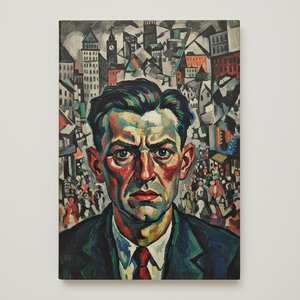
The Observational Eye of Fritz Reiss
Born in the heart of Prussia in 1857, Fritz Reiss emerged as a master of visual storytelling, a man whose artistic journey was defined by an unwavering commitment to the authentic pulse of daily life. His early years were steeped in the rich traditions of the lithographic arts, having been trained within his father’s established business in Düsseldorf. This foundational period under the tutelage of masters like Karl Müller and Heinrich Lauenstein instilled in him a technical precision that would later serve as the backbone for his more expansive, narrative works. As he moved through the vibrant artistic hubs of Stuttgart, Leipzig, and Freiburg, Reiss did not merely paint landscapes; he documented the very soul of the German territories, capturing the fleeting nuances of folk customs and the rugged beauty of the Black Forest with a clarity that felt both immediate and timeless.
Reiss’s artistry was characterized by a unique duality: he possessed the meticulous skill of a trained lithographer and the empathetic gaze of a social chronicler. His work often drifted between the delicate charm of watercolor and the robust presence of oil painting, yet a consistent thread of reportage-style realism bound his diverse output together. Unlike many of his contemporaries who retreated into the escapism of fantasy Orientalism, Reiss sought truth in the tangible. Whether he was illustrating children's literature or capturing the pastoral serenity of a sunlit glade, his compositions were imbued with a gentle humor and a subtle layer of social observation that prevented his work from becoming mere sentimentality.
A Legacy of Landscape and Line
The evolution of Reiss’s career saw him transition from a skilled craftsman in the family lithography firm to a respected member of the prestigious Breisgauer Fünfer artists' association. His travels were not merely geographic but deeply ethnographic; his time spent in the Gutach artists' colony allowed him to immerse himself in the rural rhythms of the Black Forest, a subject that would become central to his artistic identity. This period of intense observation resulted in a body of work that served as a vital visual record of a vanishing way of life, documenting the peasantry and the landscape with an intimacy that few could replicate.
Beyond his landscapes, Reiss’s influence extended into the realm of graphic design and illustration, where his ability to translate complex narratives into striking visual forms made him a sought-after talent for magazines, novels, and even ceramics. His legacy is perhaps most poignantly felt through the continuation of his artistic lineage; his son, Winold Reiss, would carry these lessons of ethnographic observation across the Atlantic, applying his father's principles to the study of Native American cultures in the United States. Through this connection, the spirit of Fritz Reiss’s disciplined, observant approach found a new and profound resonance in the modern era, ensuring that his dedication to capturing the essence of humanity remained an enduring contribution to the world of art.
Vraag en antwoord
Waar kan ik alle kunstwerken van Fritz Reiss bekijken?
Alle werken van Fritz Reiss op deze website zijn te bekijken op de Alle kunstwerken pagina van de kunstenaar.
Hoe heeft de kunst van Fritz Reiss zich in de loop der tijd ontwikkeld?
De carrière van Fritz Reiss ontvouwt zich periode voor periode op de Loopbaanoverzicht pagina van de kunstenaar: een horizontale tijdlijn van de kunstwerken, gegroepeerd in hoofdstukken per carrièreperiode.
Hoe populair zijn de kunstwerken van Fritz Reiss?
De Statistieken-pagina van Fritz Reiss bevat statistieken die zijn berekend op basis van de kunstwerken van de kunstenaar die op deze website staan vermeld.
Hoeveel kunstwerken van Fritz Reiss zijn beschikbaar om te bekijken?
U kunt 3 kunstwerken werken van Fritz Reiss bekijken op de Alle kunstwerken-pagina.