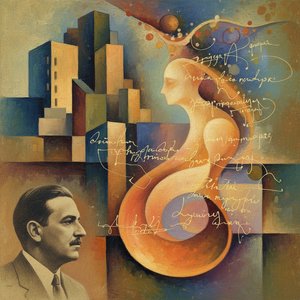
A Life Between Two Worlds
Born in Vienna, Austria, Ferdinand Piereck lived a life defined by movement and the shifting borders of the nineteenth century. His early years in the Austrian Empire provided a foundation of classical training, but his trajectory changed irrevocably when he relocated to Brazil during the latter half of the century. By 1901, he had become a naturalized Brazilian, settling into a landscape that offered entirely different light and subject matter than the European traditions of his youth.
His presence in the Brazilian art scene was marked by a unique technical intersection. In São Paulo, he became a key figure in a specialized niche of portraiture, working alongside the photographer Carlos Hoenen at Photographia Allemã. This collaboration produced what was known as fotopinturas, a process where Piereck would take photographic bases and enhance them with oil paint. These works were highly sought after, appearing in newspapers as a modern method for capturing a likeness.
Technical Innovations and Public Works
Piereck’s ability to blend the precision of photography with the texture of painting allowed him to navigate the changing tastes of the late 1800s. His work was not confined to the studio; he moved between the intimate scale of portraiture and the grand requirements of architectural decoration. His professional reach included:
- The creation of fotopinturas through collaboration with Carlos Hoenen.
- Large-scale ceiling paintings for prominent urban spaces.
- Oil on canvas portraits of local subjects, such as his 1886 depiction of a Brazilian boy with a guitar.
One of his most significant public contributions occurred in 1878, when he was commissioned to paint the ceiling of a room in the Grande Hotel. This undertaking was considered a major event in the visual arts of São Paulo at the time, demonstrating his capacity to handle expansive, decorative compositions that integrated with the architecture of the era.
The Final Years in Recife
As his career progressed, Piereck’s connection to the Brazilian landscape deepened. He moved from the bustling urban centers of the south toward the coast, eventually settling in Recife, Pernambuco. His life ended there in 1925, having transitioned from an immigrant from the Austrian Empire to a settled figure in the Brazilian artistic community. His legacy remains tied to that specific era of transition, where the emerging technology of the camera met the traditional hand of the painter.
Vraag en antwoord
Is er een tijdlijn van de werken van Ferdinand Piereck?
De kunstwerken van Ferdinand Piereck zijn in chronologische volgorde te bekijken op de Chronologie kunstwerken pagina van de kunstenaar.
Welke stemmingen drukken de kunstwerken van Ferdinand Piereck uit?
Op de Sfeercollectie pagina van de kunstenaar vindt u de kunstwerken van Ferdinand Piereck, gerangschikt op basis van hun sfeer.
Waar zijn de kunstwerken van Ferdinand Piereck gegroepeerd op trefwoorden te vinden?
Om werken van Ferdinand Piereck met een specifiek thema te vinden, kunt u de Op trefwoorden pagina van de kunstenaar gebruiken, waarop de kunstwerken per trefwoord zijn gegroepeerd.