A Luminosity Born of Two Worlds: The Artistry of Félix Ziem
Félix François Georges Philibert Ziem stands as a singular figure in the landscape of 19th-century French painting, bridging the gap between the grounded realism of the Barbizon School and the exotic, sun-drenched allure of Orientalism. Born in 1821 in the historic town of Beaune, within the Burgundy region of France, Ziem’s early life was marked by a fascinating tension between structure and spirit. The son of a professor of mathematics and astronomy, he inherited a meticulous eye for detail and an appreciation for scientific inquiry—traits that would later manifest in his breathtakingly accurate depictions of light and atmosphere. While he initially pursued the disciplined path of architecture, studying at the École des Beaux-Arts in Dijon, the irresistible call of the canvas eventually redirected his destiny toward the mastery of color and light.
His artistic journey was profoundly shaped by a restless wanderlust that propelled him far beyond the borders of France. Moving to Marseille in 1839, he received informal instruction from Adolphe Monticelli, an experience that likely planted the seeds for his later fascination with vibrant, textured light. This Mediterranean influence, combined with his expeditions to Egypt and Constantinople, allowed Ziem to document ancient monuments and bustling urban life with a unique perspective. He did not merely observe these distant lands; he translated their very essence onto canvas, blending the soulful traditions of French landscape painting with an evocative, almost dreamlike fascination for the East.
Venetian Visions and the Mastery of Light
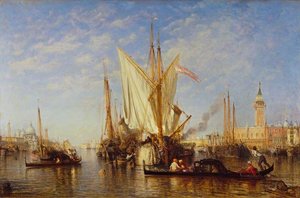
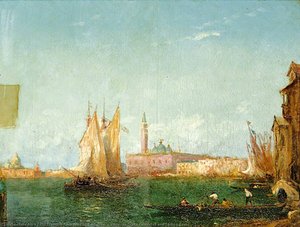
Perhaps Ziem’s most celebrated achievement lies in his profound connection to Venice. Through his series of Venetian landscapes, such as “Venice the Bacino di San Marco with Fishing Boats” and the dramatic “Venice in Flood,” he achieved a level of luminosity that remains unparalleled. Unlike many of his Impressionist contemporaries who sought to capture only the most fleeting, fragmented moments of light, Ziem painstakingly recreated the grandeur of St. Marc's Square and the complex, shimmering reflections of rising tides. His technical prowess was centered on a masterful use of glazing—applying thin, translucent layers of paint over opaque underlayers to create a sense of depth and inner radiance.
This technique allowed him to capture the rhythmic dance between water and sky with remarkable fidelity. Often characterized by a low horizon line, his compositions allow expansive, brilliant skies to dominate the frame, inviting the viewer into an infinite space where the air itself seems to hold a golden glow. Whether he was painting the misty horizons of Constantinople or the tranquil, sun-drenched canals of Martigues—a city often called the “Venice of Provence”—Ziem possessed an uncanny ability to distill the fleeting soul of an atmosphere, making his works feel less like static images and more like living, breathing memories.
A Lasting Legacy in Color and Spirit
The historical significance of Félix Ziem extends far beyond his individual canvases; he was a bridge between eras and styles. His work serves as a vital link between the rugged, earth-toned realism of the Barbizon masters and the more luminous, atmospheric explorations of the late 19th century. His dedication to his craft and his love for the landscapes he visited were so profound that he personally founded the Musée Félix Ziem in Martigues in 1908, ensuring that his passion for light and water would continue to inspire future generations.
Today, Ziem is remembered not just as a chronicler of beautiful places, but as an artist who mastered the alchemy of paint. His ability to marry scientific precision with poetic emotion allows his work to transcend time. To view a Ziem landscape is to experience:
- The shimmering reflections of water that seem to move beneath the viewer's gaze.
- A profound sense of atmosphere, where light and shadow tell stories of distant lands.
- An enduring connection to the 19th-century fascination with the exotic and the sublime.
Through his brush, the worlds of the Mediterranean, the Orient, and Venice are forever preserved in a state of eternal, luminous grace.
Vraag en antwoord
In welke perioden is de carrière van Félix François Georges Philibert Ziem onderverdeeld?
Een chronologisch overzicht van het werk van Félix François Georges Philibert Ziem is te vinden op de Loopbaanoverzicht pagina van de kunstenaar, waar de kunstwerken hoofdstuk voor hoofdstuk in volgorde van creatie worden gepresenteerd.
Hoeveel kunstwerken van Félix François Georges Philibert Ziem zijn beschikbaar om te bekijken?
U kunt 15 kunstwerken werken van Félix François Georges Philibert Ziem bekijken op de Alle kunstwerken-pagina.
Kan ik het kleurgebruik van Félix François Georges Philibert Ziem in al het werk bestuderen?
De Kleurenpalet van de kunstenaar van Félix François Georges Philibert Ziem presenteert het kleurprofiel van het oeuvre van de kunstenaar.