Portret van David Cox

De 100 bekendste schilderijen van David Cox, een selectie uit de galerie

Bijgewerkt in november 2026 · gerangschikt op basis van onze populariteitsscore (zoekopdrachten, bezoeken en bestellingen per kunstwerk) · 498 werken van David Cox in onze catalogus

Kortom

Van alle originele werken die David Cox heeft nagelaten, is Going to the Hayfield (1850) de bekendste. Direct daarna volgen George IV Embarking for Scotland at Greenwich (1823) en Going to the Hayfield (1849). Onze catalogus bevat 498 werken van David Cox; de galerie heeft de 100 meest bewonderde werken ter wereld bewaard, elk voorzien van de datum, het museum en het verhaal erachter.

1783 – 1859, Birmingham Romanticism Meeste werken: Birmingham Museum and Art Gallery

De top 10 schilderijen van David Cox: de selectie van de galerie

1
Going to the Hayfield (1850) door David Cox

Going to the Hayfield

1850 · Watercolor

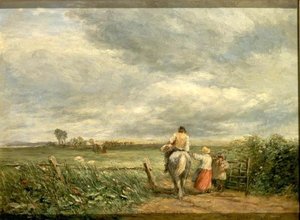
The scene unfolds in "Going to the Hayfield," a work created by the artist David Cox. In this 1849 composition, the quiet rhythms of rural life take center stage. Figures move through the landscape, their presence tied to the seasonal tasks of the countryside. The air feels heavy with the atmosphere of a specific afternoon, capturing a moment of simple, everyday activity within the English landscape.

2
George IV Embarking for Scotland at Greenwich (1823) door David Cox

George IV Embarking for Scotland at Greenwich

1823 · Watercolor

The watercolor depicts a bustling maritime scene at Greenwich, centered on the ceremonial embarkation of George IV for Scotland. Numerous vessels occupy the water, some positioned near the shore and others further out. These boats carry various figures, and several are adorned with flags. On the banks, crowds of people gather to observe the event, some standing near the water's edge while others remain further back. A horse is visible…

3
Going to the Hayfield (1849) door David Cox

Going to the Hayfield

1849 · Oil On Canvas · Birmingham Museum and Art Gallery, Birmingham

David Cox's "Going to the Hayfield," painted in 1849, isn’t merely a landscape; it’s a carefully constructed distillation of Romantic sensibility and a profound connection to the English countryside. This evocative piece, now beautifully reproduced, transports us to a specific moment – a quiet afternoon as figures journey towards a hayfield bathed in the diffused light of an overcast sky. Cox, a pivotal figure bridging the gap between earlier landscape…

4
Rhyl Sands (1854) door David Cox

Rhyl Sands

1854 · Oil On Canvas · Tate Gallery, Londen

David Cox’s “Rhyl Sands,” painted in 1854, isn't merely a depiction of a beach; it’s a carefully constructed evocation of the Romantic spirit – a yearning for the sublime beauty and untamed power of nature. Cox, a pivotal figure within the Birmingham School of watercolourists, masterfully captures a fleeting moment along the Welsh coast, imbuing the scene with an atmosphere of both tranquility and dramatic intensity. The painting transports us…

5
Study of a Dog (1840) door David Cox

Study of a Dog

1840 · Watercolor

In this intimate watercolor study, titled Study of a Dog, the viewer encounters a quiet moment of observation. The subject is a single dog, an animal captured in a state of repose. David Cox, a British artist who lived from 1783 to 1859, brings a sense of immediacy to this piece. The work emerges from the 1840s, a period when the artist's hand moved with increasing freedom. It belongs to…

6
The Skylark (1849) door David Cox

The Skylark

1849 · Oil On Canvas · Birmingham Museum and Art Gallery, Birmingham

In the vast tapestry of English landscape painting, few works capture the ephemeral beauty of the countryside with as much soul as David Cox’s The Skylark. Created in 1849, this masterpiece serves as a profound window into a serene, pastoral era, inviting the viewer to pause and breathe in the quietude of the rural landscape. The painting presents a sprawling field of grass that stretches toward a distant, hazy horizon,…

7
Storm off the Coast, Hastings (1813) door David Cox

Storm off the Coast, Hastings

1813 · Oil · Birmingham Museum and Art Gallery, Birmingham

There is a certain gravity in how the sky meets the sea in this 1813 work. The composition draws the eye along a diagonal path, moving from the heavy, dark presence of the cliffs in the foreground toward a lighter, mist-filled horizon. It is a scene of movement and tension, where the elements of sea, sky, and stone are caught in a moment of profound unrest. The palette relies on…

8
The Old Bridge at Bridgnorth, Shropshire (1809) door David Cox

The Old Bridge at Bridgnorth, Shropshire

1809 · Watercolor

The watercolor painting titled The Old Bridge at Bridgnorth, Shropshire, captures a quiet moment in the English countryside. Created by David Cox in 1809, the work presents a view of a small town nestled along the curves of a river. The scene focuses on the architecture of the bridge as it spans the water, anchoring the landscape within its natural setting.

9
Cornfield (1814) door David Cox

Cornfield

1814 · Watercolor

The air feels heavy and damp, thick with the scent of wet earth and the promise of rain. In this hazy landscape, a vast cornfield stretches toward a soft, clouded horizon, its breadth emphasized by long, horizontal strokes of ochre and muted green. Figures move through the middle ground, their forms softened by the mist, tending to a cart pulled by horses. There is a rhythmic, slow quality to their…

10
Near the Pont d'Arcole, Paris (1829) door David Cox

Near the Pont d'Arcole, Paris

1829 · Watercolor

The scene unfolds in the heart of a bustling Parisian street, captured in the work titled Near the Pont d'Arcole, Paris. This watercolor painting brings us into a moment of urban life, where the architecture of the city meets the movement of its people. The artist, David Cox, directs our gaze toward the structures and the atmosphere of the streets near the Pont d'Arcole.

De selectie van David Cox gaat verder, van 11 tot 100

11Pont Neuf from the Quai de l'Ecole, Paris (1829) door David CoxPont Neuf from the Quai de l'Ecole, Paris1829 12Place du Palais Royal, Paris (1829) door David CoxPlace du Palais Royal, Paris1829 · Birmingham Museum and Art Gallery 13The Welsh Funeral (1848) door David CoxThe Welsh Funeral1848 · Birmingham Museum and Art Gallery 14Untitled (AQTKGL) (1853) door David CoxUntitled (AQTKGL)1853 15The Cross Roads (1850) door David CoxThe Cross Roads1850 · Birmingham Museum and Art Gallery 16Rhyl Sands (1854) door David CoxRhyl Sands1854 · Birmingham Museum and Art Gallery 17Scene in a Lane (1858) door David CoxScene in a Lane1858 18Beach Scene Sunrise (1820) door David CoxBeach Scene Sunrise1820 · Yale Center for British Art 19Fishing off Hastings (1810) door David CoxFishing off Hastings1810 · Yale Center for British Art 20The Junction of the Severn and the Wye with Chepstow in the Distance (1830) door David CoxThe Junction of the Severn and the Wye with Chepstow in the Distance1830 · Yale Center for British Art 21The Wyndcliff, River Wye (1842) door David CoxThe Wyndcliff, River Wye1842 · Birmingham Museum and Art Gallery 22German Der Strand von Rhyl (1854) door David CoxGerman Der Strand von Rhyl1854 · Manchester Art Gallery 23Left at a Girls' School (1812) door David CoxLeft at a Girls' School1812 · Birmingham Museum and Art Gallery 24Lake Scene, North Wales (1811) door David CoxLake Scene, North Wales1811 · Birmingham Museum and Art Gallery 25A View of Westminster Bridge, Looking West towards Lambeth Palace and Westminster Abbey (1811) door David CoxA View of Westminster Bridge, Looking West towards Lambeth Palace and Westminster Abbey1811 26In Windsor Park (1807) door David CoxIn Windsor Park1807 27Westminster from Lambeth (1813) door David CoxWestminster from Lambeth1813 28Sunset, Hastings: Beached Fishing Vessels (1811) door David CoxSunset, Hastings: Beached Fishing Vessels1811 29Gipsies on Dulwich Common (1808) door David CoxGipsies on Dulwich Common1808 · Birmingham Museum and Art Gallery 30Pastoral Scene in Herefordshire (1820) door David CoxPastoral Scene in Herefordshire1820 31Lugg Meadows, near Hereford (1817) door David CoxLugg Meadows, near Hereford1817 32Tour d'Horloge, Rouen (1829) door David CoxTour d'Horloge, Rouen1829 33The Opening of the New London Bridge (1831) door David CoxThe Opening of the New London Bridge1831 34St. Mary's Church and the Shire Hall, Warwick (1828) door David CoxSt. Mary's Church and the Shire Hall, Warwick1828 35Place St. Barthélemy, Rouen (1829) door David CoxPlace St. Barthélemy, Rouen1829 36Carthage: Aeneas and Achates (1825) door David CoxCarthage: Aeneas and Achates1825 37Junction of the Severn and the Wye with a Rainbow (1827) door David CoxJunction of the Severn and the Wye with a Rainbow1827 38Dockyard - Building a Sloop (1823) door David CoxDockyard - Building a Sloop1823 39Still LIfe: Basket, Foxgloves, Clothes and Other Objects (1823) door David CoxStill LIfe: Basket, Foxgloves, Clothes and Other Objects1823 · Birmingham Museum and Art Gallery 40A View of the Pavillon de Flore and the Tuileries from the Seine, Notre Dame, Paris (1829) door David CoxA View of the Pavillon de Flore and the Tuileries from the Seine, Notre Dame, Paris1829 41Hay on Wye (1824) door David CoxHay on Wye1824 42Porte St. Denis, Paris (1829) door David CoxPorte St. Denis, Paris1829 43Pirates' Isle (1826) door David CoxPirates' Isle1826 44Pavillon de Flore, Tuileries, Paris (1830) door David CoxPavillon de Flore, Tuileries, Paris1830 45St. Eustache, Paris (1829) door David CoxSt. Eustache, Paris1829 46Handsworth Old Church, Birmingham (1828) door David CoxHandsworth Old Church, Birmingham1828 47Ulverston Sands (1835) door David CoxUlverston Sands1835 · Birmingham Museum and Art Gallery 48Crossing Lancaster Sands (1835) door David CoxCrossing Lancaster Sands1835 49Street in Beauvais (1832) door David CoxStreet in Beauvais1832 50The Pont des Arts with the Louvre and Tuileries from the Quai Conti (1838) door David CoxThe Pont des Arts with the Louvre and Tuileries from the Quai Conti1838 51The Long Gallery, Hardwick Hall, Derbyshire (1839) door David CoxThe Long Gallery, Hardwick Hall, Derbyshire1839 52The Poplar Avenue, after Hobbema (1835) door David CoxThe Poplar Avenue, after Hobbema1835 53The Long Gallery, Hardwick Hall, Derbyshire (1839) door David CoxThe Long Gallery, Hardwick Hall, Derbyshire1839 54Going Out Hawking (1838) door David CoxGoing Out Hawking1838 55Peace and War: Lympne Church and Castle (1838) door David CoxPeace and War: Lympne Church and Castle1838 · Birmingham Museum and Art Gallery 56A Terrace, with Figures, Haddon Hall (1834) door David CoxA Terrace, with Figures, Haddon Hall1834 · Birmingham Museum and Art Gallery 57Windermere during the Regatta (1832) door David CoxWindermere during the Regatta1832 58Rhaiadr Cwm, North Wales (1836) door David CoxRhaiadr Cwm, North Wales1836 59Pass of Llanberis, Caernarvonshire, Wales (1836) door David CoxPass of Llanberis, Caernarvonshire, Wales1836 60The Long Gallery, Hardwick Hall, Derbyshire (1839) door David CoxThe Long Gallery, Hardwick Hall, Derbyshire1839 · Chatsworth House 61Crossing Lancaster Sands (1840) door David CoxCrossing Lancaster Sands1840 62View near Bettws-y-Coed (1846) door David CoxView near Bettws-y-Coed1846 · Birmingham Museum and Art Gallery 63On Lancaster Sands, Low Tide (1840) door David CoxOn Lancaster Sands, Low Tide1840 64Vale of Clwyd (1848) door David CoxVale of Clwyd1848 65Near Knaresborough (1844) door David CoxNear Knaresborough1844 66A Welsh Road (1846) door David CoxA Welsh Road1846 67The Vale of Dolwyddelan (1846) door David CoxThe Vale of Dolwyddelan1846 68A Country Track Leading to Harlech Castle (1842) door David CoxA Country Track Leading to Harlech Castle1842 69Carreg Cennan Castle (1844) door David CoxCarreg Cennan Castle1844 70Cottage Interior (1840) door David CoxCottage Interior1840 · Birmingham Museum and Art Gallery 71Outskirts of a Wood, with Gypsies (1843) door David CoxOutskirts of a Wood, with Gypsies1843 72Vale of Clwyd (1846) door David CoxVale of Clwyd1846 73Going to the Hayfield (1853) door David CoxGoing to the Hayfield1853 · Yale Center for British Art 74On the Medway (1850) door David CoxOn the Medway1850 75Horses Drinking (1855) door David CoxHorses Drinking1855 76A Mountain Torrent (1850) door David CoxA Mountain Torrent1850 77Flying the Kite (1853) door David CoxFlying the Kite1853 78On Carrington Moss, Cheshire (1851) door David CoxOn Carrington Moss, Cheshire1851 79Mountain Heights, Cader Idris (1850) door David CoxMountain Heights, Cader Idris1850 80Penman Bach (1852) door David CoxPenman Bach1852 81The Night Train (1849) door David CoxThe Night Train1849 82Vale of Clwyd (1849) door David CoxVale of Clwyd1849 83The Challange (1853) door David CoxThe Challange1853 84Peat Gatherers (1850) door David CoxPeat Gatherers1850 85Kenilworth Castle (1857) door David CoxKenilworth Castle1857 · Birmingham Museum and Art Gallery 86Darley Churchyard (1858) door David CoxDarley Churchyard1858 87On the Moors, near Bettws-y-Coed (1856) door David CoxOn the Moors, near Bettws-y-Coed1856 88Crossing the Moor (1858) door David CoxCrossing the Moor1858 89Stepping Stones, Bettws-y-Coed (1857) door David CoxStepping Stones, Bettws-y-Coed1857 90Clouds (1857) door David CoxClouds1857 91Moonlight Landscape (1850) door David CoxMoonlight Landscape1850 · Yale Center for British Art 92The Night Train (1849) door David CoxThe Night Train1849 · City Art Gallery 93Midday Rest door David CoxMidday Rest 94The Thames At Battersea door David CoxThe Thames At Battersea 95Returning Home door David CoxReturning Home 96Lancaster Sands 1 door David CoxLancaster Sands 1 97A Child With A Dog, Outside A Cottage door David CoxA Child With A Dog, Outside A Cottage 98The Jetty, Calais door David CoxThe Jetty, Calais 99Young Welsh Girl door David CoxYoung Welsh Girl 100In The Hayfield 1 door David CoxIn The Hayfield 1

De beroemde schilderijen van David Cox, periode voor periode

De onderwerpen die de aandacht van David Cox troffen

De vier onderwerpen die het meest voorkomen in deze originelen, elk met zijn mooiste voorbeeld.

De musea waar de originele werken van David Cox worden bewaard

De 6 musea met de meeste schilderijen op deze pagina.

Museum Stad Werken van David Cox Schilderijen uit deze lijst
Birmingham Museum and Art Gallery, BirminghamBirmingham Museum and Art Gallery Birmingham 54 Going to the Hayfield, The Skylark, Storm off the Coast, Hastings
Yale Center for British Art, New HavenYale Center for British Art New Haven 6 Beach Scene Sunrise, Fishing off Hastings, The Junction of the Severn and the Wye with Chepstow in the Distance
Tate Gallery, LondenTate Gallery Londen 1 Rhyl Sands
Manchester Art Gallery, ManchesterManchester Art Gallery Manchester 1 German Der Strand von Rhyl
Chatsworth House, BakewellChatsworth House Bakewell 1 The Long Gallery, Hardwick Hall, Derbyshire
City Art Gallery, BirminghamCity Art Gallery Birmingham 1 The Night Train

David Cox decennium voor decennium: het origineel dat elk tijdperk definieert

Werken per decennium

Kies een decennium om het origineel te zien dat dit tijdperk definieert.

Vragen van verzamelaars over de schilderijen van David Cox

Waar is David Cox het meest bekend om?Onthul het antwoord

Going to the Hayfield (1850). George IV Embarking for Scotland at Greenwich (1823) en Going to the Hayfield (1849) volgen.

Hoe oud was David Cox toen Going to the Hayfield werd gemaakt?Onthul het antwoord

67 jaar oud: Going to the Hayfield dateert uit 1850, en David Cox werd geboren in 1783.

Wat zijn de tien beroemdste schilderijen van David Cox?Onthul het antwoord

Going to the Hayfield, George IV Embarking for Scotland at Greenwich, Going to the Hayfield, Rhyl Sands, Study of a Dog, The Skylark, Storm off the Coast, Hastings, The Old Bridge at Bridgnorth, Shropshire, Cornfield en Near the Pont d'Arcole, Paris. De bovenstaande ranglijst vermeldt het jaar en het museum van elk werk.

Hoeveel schilderijen heeft David Cox nagelaten?Onthul het antwoord

Onze catalogus bevat 498 werken van David Cox, daterend van 1807 tot 1858.

In welke musea hangen de meesterwerken van David Cox?Onthul het antwoord

Voornamelijk in Birmingham Museum and Art Gallery (Birmingham), Yale Center for British Art (New Haven) en Tate Gallery (Londen). De bovenstaande museumtabel bevat een volledig overzicht.

In welke jaren schilderde David Cox de beroemdste werken?Onthul het antwoord

In 1850s: 24 van de 100 werken op deze pagina werden toen gemaakt, waaronder Going to the Hayfield.

Wat zijn de eerste en de laatste beroemde originelen van David Cox?Onthul het antwoord

Op deze pagina is het vroegste In Windsor Park (1807) en het laatste Scene in a Lane (1858).

Welke onderwerpen koos David Cox het vaakst?Onthul het antwoord

Landscape (13), Sky (10) en British countryside (8), verspreid over de 100 werken op deze pagina.

Welke techniek gebruikte David Cox het meest?Onthul het antwoord

Watercolor, voor 13 van de 100 werken op deze pagina.

Bij welke kunststroming behoort David Cox?Onthul het antwoord

Romanticism, te oordelen aan de originelen op deze pagina.

Welke werken van David Cox hangen in het Birmingham Museum and Art Gallery?Onthul het antwoord

Going to the Hayfield, The Skylark en Storm off the Coast, Hastings: het Birmingham Museum and Art Gallery, Birmingham herbergt 18 van de werken op deze pagina.

David Cox: leven en werk

David Cox: Een Leven in het Landschap

Vroege Jaren en Opleiding

  • Geboren: 29 april 1783, in Deritend, Birmingham, Verenigd Koninkrijk.
  • De vader van David Cox was een smid en witte smid die onderdelen leverde aan de wapenindustrie van Birmingham. Zijn moeder, afkomstig uit een agrarische achtergrond, beschikte over een uitstekende opleiding en een sterk karakter.
  • Hij schreef zich aanvankelijk in bij de academie van Joseph Barber in Great Charles Street, waar hij medestudenten Charles Barber en William Radclyffe ontmoette.
  • Op 15-jarige leeftijd werd Cox leerling bij Albert Fielder, een schilder uit Birmingham die gespecialiseerd was in portretminiaturen en decoratieve beschilderingen voor objecten zoals snuifdozen. Deze vroege opleiding legde de basis voor zijn technische vaardigheden.

Carrièreontwikkeling & Artistieke Reis

    In 1804 verhuisde Cox naar Londen en trouwde hij met Mary Ragg, de dochter van zijn huisbaas.
  • Een cruciale reis naar Wales in 1arg05 met Charles Barber markeerde het begin van talloze schetsreizen gedurende zijn leven. Deze reizen hadden een diepgaande invloed op zijn artistieke stijl.
  • Vanaf 1805 exposeerde hij regelmatig bij de Royal Academy, waarbij hij aanvankelijk zijn brood verdiende als tekenmeester. Kolonel Hon. H. Windsor werd in 1808 een van zijn eerste leerlingen.
  • Het vroege werk van Cox richtte zich op gedetailleerde aquarellandschappen, waarbij vaak landelijke scènes en architecturale onderwerpen werden afgebeeld.

Artistieke Stijl & Invloeden

  • De stijl van Cox evolueerde door de jaren heen; hij bewoog zich van nauwkeurige topografische beschrijvingen naar een meer expressieve en atmosferische benadering.
  • Invloeden: Hoewel specifieke invloeden onderwerp van debat blijven, toont zijn werk een affiniteit met de Nederlandse landschapsschilders uit de 17e eeuw en een scherpe observatie van de natuur die doet denken aan Constable.
  • Hij werd beroemd om zijn losse penseelvoering, levendige kleuren en het vermogen om de effecten van licht en weer vast te leggen. Zijn latere olieverfschilderijen waren bijzonder innovatief.

Grote Prestaties & Erfenis

  • Tegen het einde van zijn carrière schilderde Cox meer dan 300 werken in olieverf, wat tegenwoordig wordt erkend als "een van de grootste, maar minst erkende, prestaties van een Britse schilder."
  • Hij wordt beschouwd als een van de grootste Engelse landschapsschilders en een sleutelfiguur uit de Gouden Eeuw van de Engelse aquarelkunst.
  • Zijn werk heeft opeenvolgende generaties landschapskunstenaars aanzienlijk beïnvloed.
  • Opmerkelijke Werken: The Wind on the Heath, Cottage in Herefordshire, Junction of the Severn and the Wye with Chepstow in the distance en Moonlight Landscape behoren tot zijn meest gevierde schilderijen.

Historische Betekenis

  • David Cox wordt erkend als een vroege voorloper van het impressionisme. Zijn nadruk op het vastleggen van vluchtige atmosferische effecten en zijn losse penseelstreek anticipeerden op veel technieken die later door de impressionisten zouden worden overgenomen.
  • Hij speelde een cruciale rol bij het vestigen van de Britse landschapsschilderkunst als een apart genre, waarbij hij de stap zette van louter topografische representaties naar meer expressieve en emotionele interpretaties van de natuur.
  • Zijn werk blijft bewonderd om zijn schoonheid, gevoeligheid en tijdloze aantrekkingskracht.