Portret van Cornelis Troost

Schilderijen van Cornelis Troost: De 81 bekendste, door de ogen van een galerie

Bijgewerkt in november 2026 · gerangschikt op basis van onze populariteitsscore (zoekopdrachten, bezoeken en bestellingen per kunstwerk) · 82 werken van Cornelis Troost in onze catalogus

Kortom

Volgens de visie van de galerie is het beroemdste schilderij van Cornelis Troost Inspection of a Cavalry Regiment, perhaps by William of Hesse-Homburg (1742), waarvan het origineel in het Rijksmuseum in Amsterdam hangt. The Regents of the Oudezijds Huiszittenhuis (1740) en A Couple Making Music, Cornelis Troost, 1743 (1743) maken het trio compleet dat elk oog herkent. Van de 82 werken van Cornelis Troost in onze catalogus presenteert de galerie hieronder de 81 bekendste werken, elk een origineel met de jaartal, het museum en wat het uniek maakt.

1696 – 1750, Amsterdam Rococo Meeste werken: Rijksmuseum

De top 10 schilderijen van Cornelis Troost in de galerie

1
Inspection of a Cavalry Regiment, perhaps by William of Hesse-Homburg (1742) door Cornelis Troost

Inspection of a Cavalry Regiment, perhaps by William of Hesse-Homburg

1742 · Oil · Rijksmuseum, Amsterdam

In this expansive oil painting from 1742, we find ourselves amidst a grand military ceremony set within a wooded landscape. The scene captures a formal inspection of a cavalry regiment, where the rigid structure of military hierarchy meets the organic textures of the natural world. A procession of mounted soldiers and infantry moves through the scene, their presence creating a sense of rhythmic movement across the wide horizontal plane. The…

2
The Regents of the Oudezijds Huiszittenhuis (1740) door Cornelis Troost

The Regents of the Oudezijds Huiszittenhuis

1740 · Oil On Canvas · Amsterdam Museum, Amsterdam

In this oil on canvas composition from 1740, five men are arranged within a structured interior. The group is positioned around a central table, forming a pyramidal configuration that directs the eye through the assembly. The men are dressed in 18th-century attire, featuring heavy fabrics such as silk and velvet. Their garments appear in shades of black, grey, and brown, though one central figure wears a coat of warm ochre.…

3
A Couple Making Music, Cornelis Troost, 1743 (1743) door Cornelis Troost

A Couple Making Music, Cornelis Troost, 1743

1743 · Oil On Panel · Rijksmuseum, Amsterdam

Step closer and observe the intimacy of this 1743 interior. We find ourselves in a private room where the air seems to hold the soft notes of a melody. A man stands to the right, his posture relaxed as he breathes life into a recorder. Beside him, his wife sits in a moment of quiet concentration, her fingers poised to turn the corner of a page in a music book.…

4
Scene in a Coffee Shop (1750) door Cornelis Troost

Scene in a Coffee Shop

1750 · Oil On Canvas · Hermitage Museum, Sint-Petersburg

The air in the room feels heavy with the scent of roasted beans and the low hum of conversation. Light pours through large windows on the left, slicing through the dimness to strike the edges of ceramic cups and the folds of heavy fabric. It is a wide, expansive space where the architecture of grand arches meets the intimate clutter of social life. A large, ornate medallion on the ceiling,…

5
The Organ Grinder (1743) door Cornelis Troost

The Organ Grinder

1743 · Oil On Canvas · Mauritshuis, Den Haag

A Moment Captured on an Amsterdam Street The air feels heavy with the soft light of an overcast day as a small crowd gathers in this mid-18th century street scene. In the foreground, a man dressed in dark clothing sits quietly, his gaze fixed upon a woman who cradles a baby in her arms. Beside them, another woman stands near a child, their figures part of a loose, naturalistic grouping…

6
Harlequin, Magician and Barber: The Rivals Exposed (1738) door Cornelis Troost

Harlequin, Magician and Barber: The Rivals Exposed

1738 · Oil On Canvas · Mauritshuis, Den Haag

Cornelis Troost's “Harlequin, Magician and Barber: The Rivals Exposed,” painted in 1738, isn’t merely a depiction of a bustling street scene; it’s a meticulously crafted window into the social fabric and subtle anxieties of 18th-century Amsterdam. This Baroque masterpiece, now housed within the Mauritshuis museum in The Hague, pulsates with life—a vibrant tableau of commerce, class distinctions, and perhaps even a touch of subversive commentary. Troost, a former actor who…

7
Double portrait of an unknown man and a boy (1722) door Cornelis Troost

Double portrait of an unknown man and a boy

1722 · Print · Rijksmuseum Twenthe, Enschede

In this 1722 portrait, we find ourselves in a private, monochromatic world where the weight of lineage is felt through a subtle, sepia-toned atmosphere. An older man sits with a quiet, regal dignity, his presence anchoring the composition. Beside him, a young boy stands, creating a gentle diagonal that draws the eye through the space. There is a profound sense of stillness here, as if we have interrupted a private…

8
Aeneas and Dido Set Out for the Hunt (1731) door Cornelis Troost

Aeneas and Dido Set Out for the Hunt

1731 · Oil On Canvas · Bayerische Staatsgemäldesammlungen, München

The oil painting titled Aeneas and Dido Set Out for the Hunt was created by the Dutch artist Cornelis Troost. This work dates to about 1731. It captures a moment of high drama within an ancient urban setting, where the figures of Aeneas and Dido move amidst a large, bustling entourage. The scene is framed by monumental architecture and the heavy presence of a central golden statue.

9
Triptych depicting the peasants' court from the comedy "Beslikte Swaantje" (1727) door Cornelis Troost

Triptych depicting the peasants' court from the comedy "Beslikte Swaantje"

1727 · Oil On Panel · Amsterdam Museum, Amsterdam

This triptych painting, created in 1727, presents a dramatic scene from the comedy "Beslikte Swaantje", depicting a peasants' court. The composition is organized into three vertical panels, establishing a stage-like setting that offers a wide, panoramic view of a group of characters gathered within an interior. The scene is characterized by a frontal perspective, placing the viewer directly before the unfolding narrative, which enhances the overall theatrical atmosphere of the…

10
Triptych depicting the peasants' court from the comedy "Beslikte Swaantje" (center panel of triptych) (1727) door Cornelis Troost

Triptych depicting the peasants' court from the comedy "Beslikte Swaantje" (center panel of triptych)

1727 · Oil · Amsterdam Museum, Amsterdam

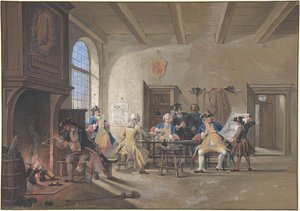
This 1727 oil painting captures a moment of dramatic tension from the comedy Beslikte Swaantje. The scene is set within a domestic interior, where a group of figures is gathered around a fireplace. A prominent character on the left, wearing a large, dark hat and a long cloak, gestures toward the assembly, driving the narrative forward. The composition relies on layered planes to create depth, with a smaller framed painting…

Schilderijen van Cornelis Troost, gerangschikt van 11 tot 81

11Triptych depicting the peasants' court from the comedy "Beslikte Swaantje" (right panel of triptych) (1727) door Cornelis TroostTriptych depicting the peasants' court from the comedy "Beslikte Swaantje" (right panel of triptych)1727 · Amsterdam Museum 12Triptych depicting the peasants' court from the comedy "Beslikte Swaantje" (left panel of triptych) (1727) door Cornelis TroostTriptych depicting the peasants' court from the comedy "Beslikte Swaantje" (left panel of triptych)1727 · Amsterdam Museum 13Portrait of two men in an interior (1727) door Cornelis TroostPortrait of two men in an interior1727 · Rijksmuseum Twenthe 14Portrait of Gerrit Sichterman ( -1730) (1726) door Cornelis TroostPortrait of Gerrit Sichterman ( -1730)1726 · Groninger Museum 15Portrait of an unknown man (1732) door Cornelis TroostPortrait of an unknown man1732 · Amsterdam Museum 16Portrait of een persoon genaamd Willem Roell (1700-1775) (1729) door Cornelis TroostPortrait of een persoon genaamd Willem Roell (1700-1775)1729 · Amsterdam Museum 17Portrait of een persoon genaamd Elisabeth de Famars (1715-1780) (1724) door Cornelis TroostPortrait of een persoon genaamd Elisabeth de Famars (1715-1780)1724 · Amsterdam Museum 18Inspectors of the Collegium Medicum in Amsterdam, 1724 (1724) door Cornelis TroostInspectors of the Collegium Medicum in Amsterdam, 17241724 · Rijksmuseum 19Portrait of Maria de Lange (1696-1744), wife of Cornelius Ascanius van Sypesteyn, with her three young children (1727) door Cornelis TroostPortrait of Maria de Lange (1696-1744), wife of Cornelius Ascanius van Sypesteyn, with her three young children1727 · Kasteel-Museum Sypesteyn 20Depart for hunting with monumental architecture (1731) door Cornelis TroostDepart for hunting with monumental architecture1731 21Portrait of the Inspectors of the Collegium Medicum, Cornelis Troost, 1724 (1724) door Cornelis TroostPortrait of the Inspectors of the Collegium Medicum, Cornelis Troost, 17241724 22Herman Boerhaave (1668-1738) (1740) door Cornelis TroostHerman Boerhaave (1668-1738)1740 · Amsterdam Museum 23Portrait of Jeronimus Tonneman and his Son Jeronimus (1736) door Cornelis TroostPortrait of Jeronimus Tonneman and his Son Jeronimus1736 · National Gallery of Ireland 24Anna Homout b. Horneman (1740) door Cornelis TroostAnna Homout b. Horneman1740 25Dutch delivery room (1741) door Cornelis TroostDutch delivery room1741 · Museum Boijmans Van Beuningen 26Het beslikte Zwaentje or the court house at Puyterveen (1741) door Cornelis TroostHet beslikte Zwaentje or the court house at Puyterveen1741 · Museum Boijmans Van Beuningen 27Portrait of Herman Boerhaave, teacher of medicine in Leiden (1736) door Cornelis TroostPortrait of Herman Boerhaave, teacher of medicine in Leiden1736 28Portrait of the Tolling Family (1742) door Cornelis TroostPortrait of the Tolling Family1742 · Museum de Fundatie 29Guardroom Scene (1744) door Cornelis TroostGuardroom Scene1744 30Portrait of a Man (1730) door Cornelis TroostPortrait of a Man1730 · Mauritshuis 31The Delivery Room (1748) door Cornelis TroostThe Delivery Room1748 · Rijksmuseum 32The Doctor's Visit (1750) door Cornelis TroostThe Doctor's Visit1750 33Nursery Visit (1750) door Cornelis TroostNursery Visit1750 34Portrait of Louise Christina Trip, Wife of Gerrit Sichterman (1725) door Cornelis TroostPortrait of Louise Christina Trip, Wife of Gerrit Sichterman1725 · Rijksmuseum 35Reinier Adriaansz (1737) door Cornelis TroostReinier Adriaansz1737 · Mauritshuis 36Lady with Cupid and a Songbook (1745) door Cornelis TroostLady with Cupid and a Songbook1745 · Mauritshuis 37Love Scene (1736) door Cornelis TroostLove Scene1736 · Rijksmuseum 38Rumor erat in casa (1740) door Cornelis TroostRumor erat in casa1740 · Mauritshuis 39Guardroom Scene;Allegory on the War with France in 1747 (1747) door Cornelis TroostGuardroom Scene;Allegory on the War with France in 17471747 · Mauritshuis 40False Virtue Discovered: The Discovery of Volkert in the Laundry Basket (1739) door Cornelis TroostFalse Virtue Discovered: The Discovery of Volkert in the Laundry Basket1739 · Mauritshuis 41The Mathematicians or the Young Lady Who Fled: The Dispute between Doctors Raasbollius and Urinaal (1741) door Cornelis TroostThe Mathematicians or the Young Lady Who Fled: The Dispute between Doctors Raasbollius and Urinaal1741 · Mauritshuis 42Nemo Loquebatur (1740) door Cornelis TroostNemo Loquebatur1740 · Mauritshuis 43Portrait of Maria Magdalena Stavenisse, Wife of Jacob de Witte of Elkerzee, Councilor of Zierikzee, Cornelis Troost, c. 1726 (1726) door Cornelis TroostPortrait of Maria Magdalena Stavenisse, Wife of Jacob de Witte of Elkerzee, Councilor of Zierikzee, Cornelis Troost, c. 17261726 · Rijksmuseum 44Regents of the Aalmoezeniersweeshuis Orphanage in Amsterdam, 1729, Cornelis Troost, 1729 (1729) door Cornelis TroostRegents of the Aalmoezeniersweeshuis Orphanage in Amsterdam, 1729, Cornelis Troost, 17291729 · Rijksmuseum 45Pefroen and the Sheep (1739) door Cornelis TroostPefroen and the Sheep1739 · Mauritshuis 46Erat Sermo inter Fratres (1740) door Cornelis TroostErat Sermo inter Fratres1740 · Mauritshuis 47Three Governors of the Surgeons Guild, Amsterdam (1731) door Cornelis TroostThree Governors of the Surgeons Guild, Amsterdam1731 · Rijksmuseum 48Self-Portrait (1745) door Cornelis TroostSelf-Portrait1745 · Mauritshuis 49Rumor erat in Casa (There was a Commotion in the House) (1740) door Cornelis TroostRumor erat in Casa (There was a Commotion in the House)1740 · Mauritshuis 50Captain Ulrich or Greed Thwarted: Disguised, Godefroy and his Servant Put Captain Ulrich to Flight (1738) door Cornelis TroostCaptain Ulrich or Greed Thwarted: Disguised, Godefroy and his Servant Put Captain Ulrich to Flight1738 · Mauritshuis 51Portrait of a Gentleman (1716) door Cornelis TroostPortrait of a Gentleman1716 52Portrait of a Man, Cornelis Troost, 1723 (1723) door Cornelis TroostPortrait of a Man, Cornelis Troost, 17231723 · Rijksmuseum 53Portrait of the Physician Herman Boerhaave, Professor at the University of Leiden, Cornelis Troost, 1735 (1735) door Cornelis TroostPortrait of the Physician Herman Boerhaave, Professor at the University of Leiden, Cornelis Troost, 17351735 · Rijksmuseum 54Alexander the Great at the Battle of the Granicus against the Persians, Cornelis Troost, 1737 (1737) door Cornelis TroostAlexander the Great at the Battle of the Granicus against the Persians, Cornelis Troost, 17371737 · Rijksmuseum 55Portrait of Isaac Sweers, Chief Officer of Amsterdam and Governor of the Dutch East India Company, Cornelis Troost, 1730 - 1740 (1740) door Cornelis TroostPortrait of Isaac Sweers, Chief Officer of Amsterdam and Governor of the Dutch East India Company, Cornelis Troost, 1730 - 17401740 · Rijksmuseum 56Jeronimus Tonneman and his Son (1736) door Cornelis TroostJeronimus Tonneman and his Son1736 57The Phoenix, Cornelis Troost, 1720 - 1750 (1750) door Cornelis TroostThe Phoenix, Cornelis Troost, 1720 - 17501750 · Rijksmuseum 58Portrait of Ludolf Backhuysen II, Painter and Dragoon, Grandson of the Marine Painter Ludolf Backhuysen I, Cornelis Troost, 1735 - 1750 (1750) door Cornelis TroostPortrait of Ludolf Backhuysen II, Painter and Dragoon, Grandson of the Marine Painter Ludolf Backhuysen I, Cornelis Troost, 1735 - 17501750 · Rijksmuseum 59An Amsterdam Canal House Garden, Cornelis Troost, c. 1740 - 1745 (1745) door Cornelis TroostAn Amsterdam Canal House Garden, Cornelis Troost, c. 1740 - 17451745 · Rijksmuseum 60The Discovery of Jan Claasz (1738) door Cornelis TroostThe Discovery of Jan Claasz1738 · Mauritshuis 61the consultation door Cornelis Troostthe consultation 62motherhood door Cornelis Troostmotherhood 63Saartje Jans is Asked for her Hand in Marriage (1738) door Cornelis TroostSaartje Jans is Asked for her Hand in Marriage1738 · Mauritshuis 64Ibant qui poterant, qui non potuere cadebant (1739) door Cornelis TroostIbant qui poterant, qui non potuere cadebant1739 · Mauritshuis 65Loquebantur Omnes (1740) door Cornelis TroostLoquebantur Omnes1740 · Mauritshuis 66Self-Portrait, Cornelis Troost, 1715 - 1730 (1730) door Cornelis TroostSelf-Portrait, Cornelis Troost, 1715 - 17301730 · Yale Center for British Art 67Regents of the Aalmoezeniersweeshuis Orphanage in Amsterdam, 1729, Cornelis Troost, 1729 (1729) door Cornelis TroostRegents of the Aalmoezeniersweeshuis Orphanage in Amsterdam, 1729, Cornelis Troost, 17291729 · Rijksmuseum 68Gerrit Sichterman (1688-1730). Quartermaster-General of the Cavalry, Colonel of the Oranje-Groningen Infantry Regiment, Commandant of Grave, Cornelis Troost, c. 1725 (1725) door Cornelis TroostGerrit Sichterman (1688-1730). Quartermaster-General of the Cavalry, Colonel of the Oranje-Groningen Infantry Regiment, Commandant of Grave, Cornelis Troost, c. 17251725 · Rijksmuseum 69Gerrit Sichterman (1688-1730). Quartermaster-General of the Cavalry, Colonel of the Oranje-Groningen Infantry Regiment, Commandant of Grave, Cornelis Troost, 1725 (1725) door Cornelis TroostGerrit Sichterman (1688-1730). Quartermaster-General of the Cavalry, Colonel of the Oranje-Groningen Infantry Regiment, Commandant of Grave, Cornelis Troost, 17251725 · Rijksmuseum 70Self-portrait, Cornelis Troost, 1739 (1739) door Cornelis TroostSelf-portrait, Cornelis Troost, 17391739 · Rijksmuseum 71Self portrait door Cornelis TroostSelf portrait 72Jan lepeltak door Cornelis TroostJan lepeltakRijksmuseum 73The Ambassador of the Rascals Exposes himself from the Window of 't Bokki Tavern in the Haarlemmerhout door Cornelis TroostThe Ambassador of the Rascals Exposes himself from the Window of 't Bokki Tavern in the HaarlemmerhoutRijksmuseum 74Family group at a harpsichord. door Cornelis TroostFamily group at a harpsichord.Rijksmuseum 75The feigned sadness first company, eleventh stage of the comedy The discovered apparent virtue door Cornelis TroostThe feigned sadness first company, eleventh stage of the comedy The discovered apparent virtue 76The Spendthrift or the Wasteful Woman, act III, scene V, from the Play by Thomas Asselijn (Joanna and the Polish Jewish Traders) door Cornelis TroostThe Spendthrift or the Wasteful Woman, act III, scene V, from the Play by Thomas Asselijn (Joanna and the Polish Jewish Traders)Rijksmuseum 77The Wedding of Kloris and Roosje door Cornelis TroostThe Wedding of Kloris and RoosjeMauritshuis 78Singing Round the Star on Twelfth Night door Cornelis TroostSinging Round the Star on Twelfth NightMauritshuis 79Blindman's buff (1740) door Cornelis TroostBlindman's buff1740 · Museum Boijmans Van Beuningen 80The anatomy of Dr Willem Roell door Cornelis TroostThe anatomy of Dr Willem RoellAmsterdam Museum 81Portrait of a Music Lover (1736) door Cornelis TroostPortrait of a Music Lover1736 · Rijksmuseum

De beroemde schilderijen van Cornelis Troost, periode voor periode

De onderwerpen die de aandacht van Cornelis Troost troffen

De vier onderwerpen die het meest voorkomen in deze originelen, elk met zijn mooiste voorbeeld.

De musea waar de originele werken van Cornelis Troost worden bewaard

De 8 musea met de meeste schilderijen op deze pagina.

Museum Stad Werken van Cornelis Troost Schilderijen uit deze lijst
Rijksmuseum, AmsterdamRijksmuseum Amsterdam 25 Inspection of a Cavalry Regiment, perhaps by William of Hesse-Homburg, A Couple Making Music, Cornelis Troost, 1743, Inspectors of the Collegium Medicum in Amsterdam, 1724
Mauritshuis, Den HaagMauritshuis Den Haag 21 The Organ Grinder, Harlequin, Magician and Barber: The Rivals Exposed, Portrait of a Man
Amsterdam Museum, AmsterdamAmsterdam Museum Amsterdam 10 The Regents of the Oudezijds Huiszittenhuis, Triptych depicting the peasants' court from the comedy "Beslikte Swaantje", Triptych depicting the peasants' court from the comedy "Beslikte Swaantje" (center panel of triptych)
Museum Boijmans Van Beuningen, RotterdamMuseum Boijmans Van Beuningen Rotterdam 3 Dutch delivery room, Het beslikte Zwaentje or the court house at Puyterveen, Blindman's buff
Rijksmuseum Twenthe, EnschedeRijksmuseum Twenthe Enschede 2 Double portrait of an unknown man and a boy, Portrait of two men in an interior
Hermitage Museum, Sint-PetersburgHermitage Museum Sint-Petersburg 1 Scene in a Coffee Shop
Bayerische Staatsgemäldesammlungen, MünchenBayerische Staatsgemäldesammlungen München 1 Aeneas and Dido Set Out for the Hunt
Groninger Museum, GroningenGroninger Museum Groningen 1 Portrait of Gerrit Sichterman ( -1730)

Cornelis Troost, één iconisch schilderij per decennium

Werken per decennium

Kies een decennium om het origineel te zien dat dit tijdperk definieert.

Schilderijen van Cornelis Troost: de galerie geeft antwoord

Welk schilderij van Cornelis Troost is het beroemdste van allemaal?Onthul het antwoord

Inspection of a Cavalry Regiment, perhaps by William of Hesse-Homburg (1742), Rijksmuseum, Amsterdam. The Regents of the Oudezijds Huiszittenhuis (1740) en A Couple Making Music, Cornelis Troost, 1743 (1743) volgen.

Hoe oud was Cornelis Troost bij de voltooiing van Inspection of a Cavalry Regiment, perhaps by William of Hesse-Homburg?Onthul het antwoord

46 jaar oud: Inspection of a Cavalry Regiment, perhaps by William of Hesse-Homburg dateert uit 1742, en Cornelis Troost werd geboren in 1696.

Wat zijn de top 10 schilderijen van Cornelis Troost?Onthul het antwoord

Inspection of a Cavalry Regiment, perhaps by William of Hesse-Homburg, The Regents of the Oudezijds Huiszittenhuis, A Couple Making Music, Cornelis Troost, 1743, Scene in a Coffee Shop, The Organ Grinder, Harlequin, Magician and Barber: The Rivals Exposed, Double portrait of an unknown man and a boy, Aeneas and Dido Set Out for the Hunt, Triptych depicting the peasants' court from the comedy "Beslikte Swaantje" en Triptych depicting the peasants' court from the comedy "Beslikte Swaantje" (center panel of triptych). De bovenstaande ranglijst vermeldt het jaar en het museum van elk werk.

Hoeveel werken heeft Cornelis Troost gemaakt?Onthul het antwoord

Onze catalogus bevat 82 werken van Cornelis Troost, daterend van 1716 tot 1750.

Waar hangen de beroemdste originele werken van Cornelis Troost?Onthul het antwoord

Voornamelijk in Rijksmuseum (Amsterdam), Mauritshuis (Den Haag) en Amsterdam Museum (Amsterdam). De bovenstaande museumtabel bevat een volledig overzicht.

Wanneer creëerde Cornelis Troost de beroemdste schilderijen?Onthul het antwoord

In 1740s: 23 van de 81 werken op deze pagina werden toen gemaakt, waaronder Inspection of a Cavalry Regiment, perhaps by William of Hesse-Homburg.

Wat zijn de vroegste en laatste beroemde werken van Cornelis Troost?Onthul het antwoord

Op deze pagina is het vroegste Portrait of a Gentleman (1716) en het laatste Scene in a Coffee Shop (1750).

Welke onderwerpen keerde Cornelis Troost het vaakst naar terug?Onthul het antwoord

Man (18), Woman (13) en 18th century (13), verspreid over de 81 werken op deze pagina.

In welk medium werkte Cornelis Troost het meest?Onthul het antwoord

Oil On Canvas, voor 29 van de 81 werken op deze pagina.

Bij welke stroming wordt Cornelis Troost gerekend?Onthul het antwoord

Rococo, te oordelen aan de originelen op deze pagina.

Welke originelen van Cornelis Troost zijn in de collectie van het Rijksmuseum?Onthul het antwoord

Inspection of a Cavalry Regiment, perhaps by William of Hesse-Homburg, A Couple Making Music, Cornelis Troost, 1743 en Inspectors of the Collegium Medicum in Amsterdam, 1724: het Rijksmuseum, Amsterdam herbergt 25 van de werken op deze pagina.

Cornelis Troost: de kunstenaar

Een venster op de Gouden Eeuw van Amsterdam

Cornelis Troost, een naam die onlosmakelijk verbonden is met het levendige weefsel van het achttiende-eeuwse Amsterdam, was meer dan slechts een kunstenaar; hij was een scherpzinnige observator en een meesterlijke chroniqueur van zijn tijd. Geboren in het hart van de Republiek der Zeven Verenigde Nederlanden op 8 oktober 1696 in Amsterdam, onthult Troosts reis van ambitieus acteur tot gevierd schilder een fascinerende samensmelting van artistieke passies en persoonlijke transformatie. Hoewel hij aanvankelijke werd opgeleid als toneelspeler, vond hij zijn ware roeping niet tussen het applaus en het drama, maar in de minutieuze details en subtiele nuances van de schilderkunst. De koers van zijn leven werd gekenmerkt door een bewuste verschuiving – een doelbewuste afwijzing van de schijnwerpers ten gunste van de verstilde contemplatie van penseelstreken, wat hem uiteindelijk tot een van de meest significante figuren in de Nederlandse Rococo-genreschilderkunst maakte.

De artistieke vorming van Troost begon onder de begeleiding van Arnold Boonen, een gerespecteerd portrettist die het aangeboren talent van zijn leerling herkende. Deze leertijd bood een cruciaal fundament, maar het waren Troosts vroege tekeningen die zijn eigenzinnige stijl werkelijk lieten zien – in het bijzonder een werk uit 1708 waarin prins Eugène van Savoye en de beruchte boekhandelaar en spion Louis Renard betrokken zijn bij clandestiene activiteiten in een luxueus Amsterdams bordeel. Dit werk, doordrenkt met humor en intrige, gaf al een voorbode van de thema's die hij later met zoveel betoverende vaardigheid zou verkennen: de complexiteit van het sociale leven, de verleiding van het genot, en de verborgen stromingen onder de vernislaag van fatsoen.

De elegantie van de Rococo en het sociale narratief

Naarmate zijn carrière volwassen werd, groeide Troost uit tot een meester in het vastleggen van de delicate balans tussen frivoliteit en verfijning. Zijn werk werd ongetwijfeld beïnvloed door de heersende artistieke trends van zijn tijd, waaronder de dramatische composities van William Hogarth, bekend om zijn satirische weergaven van de Londense samenleving, en de elegante gratie van Franse meesters zoals Watteau, Boucher en Lancret. Deze synthese van het Nederlands realisme en de Franse Rococo-elegantie stelde hem in staat werken te creëren die zowel diep geworteld waren in de lokale realiteit als voortreffelijk verfijnd.

Zijn repertoire was opmerkelijk divers, variërend van intieme portretten tot monumentale groepscomposities. Enkele van zijn meest blijvende bijdragen aan de kunstwereld omvatten:

  • Portret van de Inspecteurs van het Collegium Medicum (1724): Een schitterend Rococo-olieverfschilderwerk dat het hoogtepunt van de achttiende-eeuwse Nederlandse kunstzinnigheid en institutionele elegantie toont.
  • Portret van Maria Magdalena Stavenisse (ca. 1726): Een barok meesterwerk dat verfijnde details gebruikt om aristocratische rijkdom en status te etaleren.
  • Regenten van het Aalmoezeniersweeshuis (1729): Een monumentaal groepsportret dat dient als een venster op de sociale structuren van Amsterdam, waarbij dramatische belichting en een weelderige setting worden ingezet om een gevoel van burgerlijke belangrijkheid over te brengen.

De nalatenschap van een meester-observator

De betekenis van Cornelis Troost ligt in zijn vermogen om te fungeren als een visueel historicus voor een periode van transitie. Hoewel het tijdperk van de grote meesters uit de Nederlandse Gouden Eeuw was verstreken, blies Troost de Nederlandse traditie nieuw leven in door deze te doordrenken met de lichtvoetigheid en de decoratieve charme van de Rococo-beweging. Zijn schilderijen stellen niet enkel gezichten voor; ze vangen de geest van een tijdperk – het ritselen van zijde, het flakkeren van kaarslicht en de subtiele sociale hiërarchieën van de Amsterdamse bovenklasse.

Door zijn gevatte portretten en meeslepende genrescènes liet Troost een nalatenschap na die kijkers tot op de dag van vandaag blijft betoveren. Hij blijft een spilfiguur die de kloof overbrugde tussen de zware, dramatische tradities van de zeventiende eeuw en de luchtige, gracieuze esthetiek van de achttiende eeuw, waardoor hij ervoor zorgde dat de sociale nuances van zijn geliefde Amsterdam voor generaties lang in pigment zouden worden bewaard.