The Master of Clay: The Life and Art of Clodion
Born in Nancy, France, the sculptor known to history as Clodion—or Claude Michel—emerged as one of the most captivating figures of the late eighteenth century. His journey into the heart of the French art world began in 1755 when he arrived in Paris, entering the prestigious workshop of his maternal uncle, Lambert-Sigisbert Adam. This early immersion in a lineage of skilled sculptors provided him with a foundation of technical excellence that would later allow him to transcend the boundaries of traditional medium. While many of his contemporaries sought permanence in marble or bronze, Clodion found his true voice in the tactile, intimate world of terracotta.
His development was profoundly shaped by his travels and his encounters with the classical past. After winning the prestigious Prix de Rome, he moved to Italy, where he shared a studio with the renowned Jean-Antoine Houdon. It was during this period that Clodion deeply studied the nuances of antique, Renaissance, and Baroque sculpture. This exposure to the grace of antiquity infused his work with a sense of timelessness, even as he remained firmly rooted in the playful, light-hearted spirit of the Rococo style. He possessed an extraordinary gift for capturing fleeting emotions and dynamic movement within the soft, malleable confines of clay, creating works that felt alive even before they were fully realized.
A Legacy of Elegance and Emotion
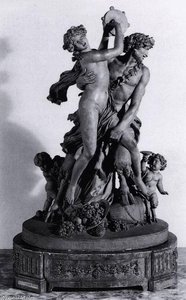
Clodion’s oeuvre is a testament to his ability to blend classical mythology with a palpable sense of human vitality. His sculptures often feature mythological figures—satyrs, nymphs, and bacchantes—engaged in scenes of Dionysian ecstasy or tender interaction. In works such as Satyr and Bacchante, one can observe the masterful interplay between earthly passion and idealized beauty. He had a unique talent for modeling musculature with anatomical precision while maintaining an ethereal grace that prevented his figures from feeling heavy or static. This mastery made his terracotta pieces highly sought after; indeed, it is noted that his works were often purchased by admirers even before they were completed.
As the artistic landscape shifted from the Rococo toward the more restrained Neoclassical movement, Clodion’s work evolved to reflect these changing sensibilities. His later pieces, such as the marble statue of Montesquieu, demonstrate a profound stillness and a capacity for intellectual gravity, capturing the contemplative power of Enlightenment thought. Yet, even amidst the rise of Neoclassicism, he never lost his ability to evoke the whimsical and the romantic. Whether decorating functional objects like clocks and vases or creating independent sculptural masterpieces, Clodion’s touch remained unmistakable—a delicate balance of technical rigor and poetic inspiration that continues to enchant viewers in collections around the world.
Vraag & Antwoord
In welke historische periode werkte Claude Michel (Clodion)?
Claude Michel (Clodion) werkte in de Vroegmoderne tijd-periode. Deze periode plaatst het oeuvre van de kunstenaar in een historisch kader.
Hoe kan ik het werk van Claude Michel (Clodion) jaar voor jaar volgen?
De kunstwerken van Claude Michel (Clodion) zijn in chronologische volgorde te bekijken op de Tijdlijn kunstwerken pagina van de kunstenaar.
Hoe populair zijn de kunstwerken van Claude Michel (Clodion)?
De Statistieken-pagina van Claude Michel (Clodion) bevat statistieken die zijn berekend op basis van de kunstwerken van de kunstenaar die op deze website staan vermeld.