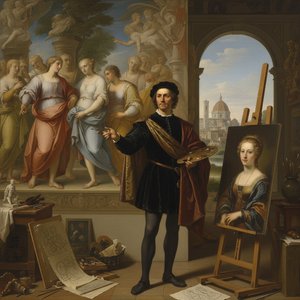
Early Life and Training
Andrea del Sarto, a name synonymous with understated elegance and masterful technique in the Florentine Renaissance, was born on July 16, 1486, in Gualfonda, a small village near Florence. His origins were humble; his father, Agnolo, was a tailor – a profession reflected in the “del Sarto” (tailor’s son) that became his surname. Early indications suggest he received an initial apprenticeship with a goldsmith, followed by training under the painter and wood sculptor Gian Barile. This foundational period instilled within him a solid understanding of materials and craftsmanship, setting the stage for his future artistic endeavors. Later, he honed his skills working alongside Piero di Cosimo and Raffaellino del Garbo, absorbing the stylistic nuances of these prominent figures and developing his own burgeoning artistic voice. It was during this time that he began to forge a distinctive approach, one characterized by an interest in color and atmosphere – a departure from the purely linear styles prevalent at the time.Artistic Career and Notable Works
Andrea’s career truly blossomed through a collaboration with Franciabigio, resulting in their joint creation of the *Baptism of Christ* for the Compagnia dello Scalzo in Florence around 1503-1504. This fresco marked a pivotal moment, establishing his reputation and initiating a long series of monochromatic (grisaille) frescoes – a technique he would master with remarkable skill. These works, often depicting religious scenes in shades of gray, showcased his ability to create depth and form through subtle variations in tone. A particularly significant achievement is the *Cenacolo di Andrea del Sarto* (The Last Supper), a monumental fresco spanning over 40 square meters at the Museo del Cenacolo di Andrea del Sarto in Florence. This masterpiece, completed around 1507-1508, demonstrates his exceptional command of composition and his innovative use of color to convey emotion and drama. Furthermore, he created the *Holy Family*, commissioned by Zanobi Strozzi for his villa at Rovezzano, now housed in the Pinacoteca delle Gallerie Nazionali d’Arte Antica in Rome – a testament to his versatility and ability to adapt his style to diverse patrons and settings. His early work also included frescoes depicting the *Stories of Miracles of San Filippo Benizzi* for the Loggia dei Servi di Maria, revealing his initial skill with monochromatic grisaille and foreshadowing his later mastery.Influence and Style
Despite being often overshadowed by the towering figures of Leonardo da Vinci, Michelangelo, and Raphael during his lifetime, Andrea del Sarto’s artistic legacy is profound. His work embodies a unique synthesis of High Renaissance ideals and nascent Mannerist tendencies. He skillfully blended the balanced compositions and harmonious colors of the Renaissance with a subtle sense of unease and ambiguity characteristic of Mannerism – a shift away from strict realism towards expressive distortion and psychological depth. His approach to color was particularly innovative, employing a rich and nuanced palette that created a captivating sense of atmosphere and luminosity. Andrea’s influence extended beyond his own creations; he mentored younger artists like Giorgio Vasari, shaping the artistic landscape of Florence for generations to come.Legacy and Historical Significance
Andrea del Sarto's contribution to art history is often underestimated, yet it remains undeniably significant. He was a master of his craft, capable of producing works that are both technically brilliant and emotionally resonant. His frescoes, in particular, stand as remarkable achievements, demonstrating his exceptional skill in creating depth, form, and atmosphere through the manipulation of light and shadow. While he may not have achieved the same level of fame as some of his contemporaries, Andrea del Sarto’s work continues to be admired for its quiet elegance, subtle complexity, and enduring beauty. His legacy lies not only in his individual masterpieces but also in his influence on subsequent generations of artists – a testament to his lasting impact on the course of art history.Vraag en antwoord
In welke stad en welk land is Andrea del Sarto geboren?
Andrea del Sarto werd geboren in Florence, in Italië.
In welke historische periode werkte Andrea del Sarto?
Andrea del Sarto werkte in de Renaissance-periode. Deze periode plaatst het oeuvre van de kunstenaar in een historisch kader.
Welke kunstwerken van Andrea del Sarto worden het meest bekeken?
Statistieken over de werken van Andrea del Sarto zijn te vinden op de Statistieken-pagina van de kunstenaar.