A Life of Connection
Alfonso Ossorio lived at the intersection of many worlds. Born in 1916, his early years were shaped by a tension between his Catholic faith and his own identity. Before he became a central figure in the art world, he worked as a medical illustrator during the Second World War. This period of service brought a certain precision to his hand, though his heart was often elsewhere.
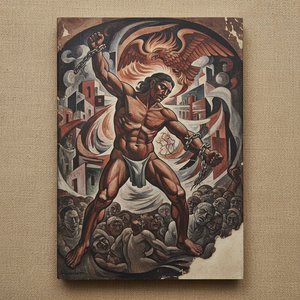
In his early thirties, a return to his childhood home in the Philippines changed his perspective. The landscapes and memories of this trip surfaced in his work through sharp, angular forms and bright colors. He used a wax-resist technique, where watercolor is washed over shapes that repel the pigment, to create images that felt both grounded and otherworldly. One of his most famous works from this era is the mural The Angry Christ, located in the Chapel of St. Joseph the Worker. This depiction of the Last Judgement was so striking that it initially unsettled many local worshippers, yet it has since become a place people visit with reverence.
The Art of Assemblage
As his career progressed, Ossorio moved away from traditional painting toward something more tactile and complex. He began creating what he called "Congregations." These were assemblages made by bringing together found objects that seemed unrelated at first glance. He gathered pieces of bark, feathers, mirrors, animal bones, and even scraps of plastic.
He believed that these ordinary, often discarded items could hold a spiritual weight when placed in unexpected ways. By grouping these materials, he sought to find the magic within the everyday. His work was not about looking toward a distant heaven, but about finding a sense of the divine in the material world around us. He saw the human being as the essential link between the physical earth and the concept of the spiritual.
A Role in the Art Community
While his own hands were busy creating, Ossorio also acted as a bridge for other artists. He was deeply involved in the Abstract Expressionist and Art Brut movements. Through his estate in East Hampton, he established the Signa Gallery. This space became a home for significant collections, including the Compagnie de l'Art Brut belonging to Jean Dubuffet.
He spent much of the 1950s organizing exhibitions in New York City that brought attention to the work of his contemporaries. His efforts helped introduce many viewers to artists such as:
Through these exhibitions and his role as a collector, he helped shape the way these movements were understood by the public. He remained a person who found meaning in the gathering of things, whether they were pieces of art or fragments of the natural world.
Vraag en antwoord
Hoe vind ik alle werken van Alfonso A. Ossorio per medium?
De werken van Alfonso A. Ossorio kunnen per medium worden bekeken op de Alle technieken pagina van de kunstenaar.
Hoe heeft de kunst van Alfonso A. Ossorio zich in de loop der tijd ontwikkeld?
Een chronologisch overzicht van het werk van Alfonso A. Ossorio is te vinden op de Loopbaanoverzicht pagina van de kunstenaar, waar de kunstwerken hoofdstuk voor hoofdstuk in volgorde van creatie worden gepresenteerd.
Waar kan ik de kunstwerken van Alfonso A. Ossorio ontdekken, ingedeeld op onderwerp?
De werken van Alfonso A. Ossorio kunnen per onderwerp worden verkend op de Onderwerpsindex pagina van de kunstenaar.