Olieverfversie
 Alles over Study for Kites







































 Voor kunstwerken of reproducties die aan één zijde groter zijn dan 105 cm (ongeveer 41 inch), wordt de lijst als een losse set verzonden. Deze methode garandeert een veilige levering en voorkomt schade tijdens het transport.


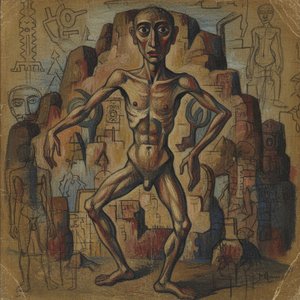
William Roberts is a British painter of figure compositions and portraits. He was a pioneer of abstract art before the First World War. Roberts worked outside the mainstream. Later in his career he would describe himself as an English Cubist. In 1914 Roberts joined the short-lived art movement the Vorticists, founded by the artist and writer Wyndam Lewis. The Vorticists believed that British art at this time was in a decayed state. Their aesthetic combined the geometrical fragmentation of Cubism with Futurist machine-like imagery. During the First World War, Roberts was a gunner on the Western Front. Later he became a war artist, a position he held in both world wars. He is best remembered for his large complex and colourful compositions.Roberts has marked this reference picture with a grid to help him to transfer it to canvas. The canvas is marked with a corresponding grid allowing the picture to be enlarged and transferred one square at a time.
Veelgestelde vragen
Is Study for Kites handgeschilderd of een print?
Met de hand geschilderd: een professioneel kunstenaar kopieert Study for Kites in olieverf op linnen canvas.
Welke maat moet ik kiezen voor Study for Kites?
De afmetingen variëren van 30.4 x 32.9 cm (€178) tot 230.3 x 249.3 cm (€1843); in de tabel op deze pagina vindt u de verschillende opties en de bijbehorende prijzen.
Hoe lang duurt de bezorging?
De levertijd bedraagt 4 tot 5 weken, inclusief gratis wereldwijde expressverzending; op deze pagina wordt een optie voor spoedproductie aangeboden. U kunt het binnen 100 dagen zonder voorwaarden retourneren voor een volledige terugbetaling.
Waar is het origineel van Study for Kites?
Het origineel maakt deel uit van de collectie van het Royal Albert Memorial Museum - Art Gallery, Exeter.
Welk medium heeft William Roberts gebruikt voor Study for Kites?
Watercolor
 Voorvertoning

 Verstuur
 Delen
 Details bekijken
 Informatieblad


 Download
 Vergelijkbare items
 Röntgenonderzoek
 Diavoorstelling
 Vraag & antwoord

 Statistieken