Bekijk op ware grootte
 Verstuur
 Delen
Delen
 Details bekijken
 Gids voor studentenkunstwerken

 Download
 Vergelijkbare items
 Röntgenonderzoek
 Diavoorstelling
 Statistieken
Mary Edwards

 Lees meer
Giclée / Kunstafdrukken
Giclée- of canvasafdruk van museumkwaliteit met een snelle productie en flexibele afwerkingsmogelijkheden. ( Koop handgeschilderd kunstwerk Schakel over naar digitale afbeeldingen)




P118B €10

P118H €10

P118W €10

P438Z €10

P508JH €12

P508YH €12

P805H €10

P805Z €10

P919BZ €10

P919G €10

P919XJ €10

P959ZH €10

P968JZ €12

W106C €8

W218G €10

W218JH €8

W218Y €10

W307PJ €10

W316G €10

W316PJ €8

W316Y €10

W398PJ €8

W4111J €10

W500HY €15

W500JH €15

W692G €12

W849H €8

W940BG €15

W953PJ €8




Kies uit onze vooraf ingestelde maten die overeenkomen met de originele verhoudingen van het kunstwerk.

Voer de breedte en de hoogte in die u nodig heeft, passend bij uw lijst of uw muur. Een afdruk kan alleen worden ingekort, nooit groter worden gemaakt dan het origineel, waardoor een formaat met een andere verhouding een deel van de afbeelding verliest. Wij sturen u een digitaal mockup ter goedkeuring voordat we iets drukken. De afbeelding op deze pagina toont niet de werkelijke uitsnede — dit is alleen te zien op het mockup.
Wereldwijde levering () binnen 2 weken in plaats van de standaard 4/5 weken. (21 oktober)

Gratis wereldwijde expressverzending

Hoogwaardig linnen canvas

Volledige verzendverzekering

Garantie op terugbetaling van invoerrechten

Garantie op exacte kleurweergave

Retourbeleid van 100 dagen (alleen bij defecten)

100% Geld-terug-garantie

Korting bij meerdere afnames
 De optie voor glas is alleen beschikbaar bij een formaat kleiner dan 110 cm.

Mary Edwards
Giclée / Kunstafdrukken
Formaat reproductie
-


Totaalprijs
€ 71
A Moment of Quiet Contemplation: William Hogarth’s “Mary Edwards”
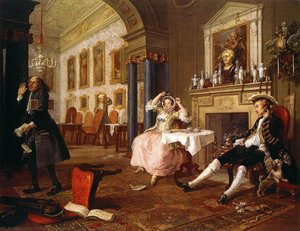
William Hogarth's "Mary Edwards," a captivating portrait rendered with his signature meticulous detail and sharp social observation, offers more than just a likeness; it presents a carefully constructed tableau of domesticity and quiet introspection. Painted around the mid-18th century, this work exemplifies Hogarth’s unique approach to genre painting – moving beyond mere representation to deliver a subtle commentary on the roles and expectations placed upon women within the burgeoning urban landscape of London. The scene unfolds within a modestly furnished interior, likely a parlor or study, bathed in soft light that suggests an afternoon repose. At the heart of the composition sits Mary Edwards, a woman of evident grace and intelligence, absorbed in a book. Her posture is relaxed yet dignified, her gaze directed inward, hinting at a world of thought and imagination contained within those pages.
Beside her rests her loyal dog, a creature of gentle demeanor that mirrors the serenity of the scene. The inclusion of the animal isn’t merely decorative; it speaks to the close bonds between humans and animals in 18th-century life – a shared space of companionship and mutual affection. The dining table behind them, adorned with simple tableware and a clock, anchors the composition within the realities of daily existence. The clock, a recurring motif in Hogarth’s work, serves as a subtle reminder of time's relentless passage, adding a layer of temporal awareness to the scene.
Hogarth’s Technique: A Masterclass in Detail and Observation
Hogarth was renowned for his painstaking technique, honed during his early apprenticeship as an engraver. This training instilled within him an unparalleled ability to render texture, light, and shadow with astonishing accuracy. In “Mary Edwards,” this skill is immediately apparent. Notice the subtle variations in the fabric of Mary’s dress – the delicate folds, the sheen of the material, all meticulously captured. The dog's fur is rendered with a remarkable level of detail, conveying its softness and warmth. Hogarth’s use of chiaroscuro—the dramatic contrast between light and dark—further enhances the sense of depth and realism within the painting. He masterfully employs this technique to draw the viewer’s eye towards Mary’s face, emphasizing her expression of quiet contemplation.
Furthermore, Hogarth's approach extended beyond mere technical proficiency; he was a keen observer of human behavior. He didn’t simply paint what he saw but sought to capture the essence of his subjects – their personalities, their social standing, and their place within the broader context of society. This is particularly evident in Mary Edwards’ posture and expression, which suggest a woman of independent thought and quiet dignity.
Symbolism and Social Commentary
While seemingly a simple portrait, “Mary Edwards” carries subtle layers of symbolic meaning. The book she reads likely represents her intellectual pursuits – a rare privilege for women of the era. It speaks to a desire for knowledge and self-improvement, hinting at a woman who transcends the traditional roles assigned to her by society. The dog, as mentioned earlier, symbolizes companionship and loyalty, but also perhaps a connection to the natural world—a grounding force amidst the complexities of urban life.
Considering this painting within the context of Hogarth’s broader oeuvre reveals a consistent thread of social commentary. He frequently used his art to critique the moral failings and societal injustices of his time. While “Mary Edwards” lacks the overt satire of works like *A Rake's Progress*, it subtly challenges conventional notions of female roles, suggesting that women possessed intellectual capabilities beyond mere domesticity. It’s a quiet assertion of agency within a restrictive social framework.
A Legacy of Insight: Mary Stella Edwards and Beyond
Interestingly, the subject of this painting bears a striking resemblance to Mary Stella Edwards (1893-1989), an English painter herself. While separated by over two centuries, both women shared a passion for art and a desire to capture moments of quiet beauty. Edwards’ own work often featured domestic scenes and portraits, reflecting a similar interest in the lives of ordinary people. The connection between Hogarth's "Mary Edwards" and Edwards highlights the enduring appeal of portraying intimate human experiences.
Today, OriginalUniqueArt offers meticulously crafted hand-painted reproductions of “Mary Edwards,” allowing you to bring this remarkable work into your home or office. Each reproduction is created by skilled artisans who replicate Hogarth’s technique with exceptional precision, ensuring that the painting's beauty and detail are faithfully preserved. Whether you are an art enthusiast, a collector, or simply seeking a piece of timeless elegance, a OriginalUniqueArt reproduction of “Mary Edwards” offers a unique opportunity to connect with one of Britain’s most influential artists.
Vragen & Antwoorden
Wat is de emotionele toon van "Mary Edwards" door William Hogarth?
De emotionele toon die is vastgelegd voor "Mary Edwards" door William Hogarth is Reflective. Het vat het gevoel samen dat het werk uitdrukt.
Zijn er werken die lijken op "Mary Edwards"?
Werken die lijken op "Mary Edwards" staan vermeld op de Vergelijkbare werken-pagina van het kunstwerk.
Welke onderwerpen komen voor in "Mary Edwards" door William Hogarth?
"Mary Edwards" door William Hogarth toont: portrait, domesticity, reading, dog, dining, london, satire, 18th century.
Biografie van de kunstenaar
William Hogarth: Een Londens Leven in Inkt en Verf
William Hogarth, geboren in het bruisende hart van 18e-eeuwse Londen in 1697, was meer dan een kunstenaar; hij was een visuele historicus, een scherp waarnemer van de menselijke natuur en een satirische commentator op de maatschappelijke stromingen van zijn tijd. Zijn levensverhaal is onlosmakelijk verbonden met het weefsel van Engeland tijdens een periode van significante transformatie – haar groeiende ambities, onderliggende angsten en doordringende hypocrisies die allemaal krachtig tot uiting kwamen in zijn opmerkelijk gedetailleerde en vaak bittere werken. De zoon van een worstelende latienschoolmeester, werd Hogarth’s vroege ervaringen hem zowel een liefde voor het leren als een scherp bewustzijn van sociale ongelijkheid bijgebracht – een fundament dat cruciaal bleek te zijn om zijn artistieke visie vorm te geven. In eerste instantie werd hij leerling van een houtsnijder, maar toonde snel een talent dat verder ging dan alleen technische vaardigheid; hij bezat een innate vermogen om de nuances van menselijk gedrag te observeren en deze over te brengen in boeiende visuele verhalen. Echter, hij vervetelde zich tegen de beperkingen van traditionele houtgravure, op zoek naar een expressievere uitlaatklep voor zijn groeiende creativiteit. Dit leidde tot studies aan zowel de St Martin’s Lane Academy als onder het toezicht van Sir James Thornhill, waar hij zijn vaardigheden in schilderkunst en compositie verfijnde, invloeden op zich nam die later zijn unieke stijl zouden beïnvloeden.De Geboorte van Moderne Morele Onderwerpen
Hogarth’s ware innovatie lag niet zozeer *wat* hij schilderde, maar *hoe*. Hij legde de basis voor wat hij zelf “moderne morele onderwerpen” noemde – een reeks beelden ontworpen om een verhaal te vertellen, vaak doordrenkt van een sterke satirische ondertoon. Dit waren geen geïsoleerde portretten of landschappen; het waren visuele romans die zich voor de blikvinder ontvouwden, met opmerkzame commentaar op hedendaagse samenleving. A Harlot’s Progress, gecreëerd in 1742, staat wellicht als zijn meest bekende voorbeeld. Deze reeks van zes schilderijen volgt de tragische ondergang van Mary, een jonge vrouw die in Londen arriveert vol hoop maar snel wordt meegesleurd door de verleidingen en gevaren van de stad. Elke scène is met zorgvuldig detail weergegeven, gevuld met symbolische elementen die de morele verval rondom haar onthullen. Op een vergelijkbare manier, A Rake’s Progress, begonnen in 1733, traceert het roekeloze neergang van Tom Rakewell, een man die zijn erfenis weggooit op gokken, debauchee en uiteindelijk waanzin. Deze waren niet alleen waarschuwende verhalen; ze waren onverbogen portretten van een samenleving die worstelde met kwesties van klasse, moraliteit en sociale mobiliteit. Hogarth’s genialiteit lag in zijn vermogen om alledaagse scènes – de drukke straten van Londen, de weelderige interieurs van de rijken, het arme leven van de armen – te transformeren tot kunstwerken die resoneren met een breed publiek. Hij schuwde niet om de harde realiteit van het leven te portretteren, en presenteerde deze met een combinatie van humor en pathos die kijkers dwong om kritisch na te denken over zichzelf en hun samenleving.Techniek en Invloeden: Een Synthese van Stijlen
Hogarth’s artistieke stijl was een unieke synthese van diverse invloeden. Hij bewonderde de realisme en narratieve detail die te vinden zijn in het werk van Nederlandse genre schilders zoals Pieter de Hooch, wat zichtbaar is in zijn zorgvuldige weergave van interieurs en alledaagse leven. Ook de satirische prints uit Frankrijk speelden een rol bij het vormen van zijn benadering van sociale commentaar. Echter, Hogarth was niet alleen imitator van deze bronnen; hij verwerkte ze tot iets geheel nieuws en uniek voor hemzelf. Zijn techniek kenmerkt zich door een meesterlijke beheersing van lijn en schaduw, wat duidelijk is in zijn gravures. Hij gebruikte een kenmerkende kruisgravuretechniek die diepte en textuur creëerde, waardoor zijn scènes tot leven kwamen met aanzienlijke helderheid. Ook bezat hij een uitzonderlijk oog voor compositie, waarbij hij figuren en objecten in de kader plaatste om dynamische en boeiende verhalen te creëren. Naast kunst was Hogarth beïnvloed door literaire werken, met name die van Jonathan Swift en Henry Fielding, wiens satirische humor zijn eigen sociale observaties vormgaven. Hij geloofde dat kunst niet alleen mooi maar ook een morele functie moest vervullen, kijkers uitdaagend om kritisch na te denken over de wereld om hen heen en hun plaats daarin. Hij streefde ernaar om een spiegel op te houden aan de natuur, zowel haar schoonheid als haar lelijkheid met onverbogen eerlijkheid.Erfgoed en Duurzaam Impact
Hogarth’s impact strekt zich ver buiten het domein van de kunst uit de 18e eeuw. Zijn werk werd enorm populair dankzij de massaproductie van gravures op basis van zijn schilderijen, waardoor zijn satirische commentaar toegankelijk werd voor een breder publiek dan ooit tevoren. Hij wordt algemeen beschouwd als een voorganger van politieke karikatuur en stripverhalen, waardoor de weg vrijkwam voor visuele storytelling in populaire cultuur. Kunstenaars zoals James Gillray en George Cruikshank werden direct beïnvloed door zijn stijl, waarbij hij zijn traditie van sociale satire voortzette. Zelfs Charles Lamb, de beroemde essayist, merkte op dat Hogarth’s beelden “zoals boeken waren om te lezen in plaats van alleen maar naar te kijken”.- Hogarth vestigde een unieke Britse artistieke identiteit.
- Zijn werk biedt onschatbare inzichten in de Engelse samenleving van de 18e eeuw.
- Hij heeft generaties kunstenaars en satirici beïnvloed.

William Hogarth
1697 - 1764 , Verenigd Koninkrijk
Snelle feiten
- Artistic Movement Or Style: Satire, Realisme
- Artists Or Movements Influenced By This Artist:
- James Gillray
- Franse satirische prints
- Artists Who Influenced This Artist:
- Pieter de Hooch
- Jonathan Swift
- Date Of Birth: 1697
- Date Of Death: 1764
- Full Name: William Hogarth
- Nationality: Britse kunstenaar
- Notable Artworks:
- A Harlot's Progress
- A Rake's Progress
- Marriage A-la-Mode
- Place Of Birth: Londen, Verenigd Koninkrijk
Gerelateerde artikelen
Jacob Henricus Maris: A Master of Dutch Atmospheric Realism & the Intimate Landscape
Explore the captivating world of Jacob Henricus Maris, a leading figure of the Dutch Hague School. Discover his atmospheric landscapes, signature brushstrokes & lasting influence on 19th-century art. Learn more at OriginalUniqueArt.
Edward Hopper's Top 25 Meesterwerken: Kunst, Verhalen & Sfeer voor je Interieur
Ontdek de top 25 meesterwerken van Edward Hopper! Duik in de wereld van Amerikaans realisme, iconische diners & verstilde hotelkamers. Kunst kopen? Vind hoogwaardige reproducties & interieurinspiratie op OriginalUniqueArt.com.
Mark Rothko's Top 25 Meesterwerken: Kleur, Emotie & Abstracte Kunst voor uw Interieur
Ontdek de top 25 meesterwerken van Mark Rothko! Duik diep in zijn emotionele kleurveldschilderijen en abstract expressionisme. Vind museumkwaliteit Rothko reproducties & interieurinspiratie op OriginalUniqueArt.com.

William Hogarth: Satire, Social Commentary & the Birth of Modern British Art
Explore the satirical world of William Hogarth, pioneering British painter & engraver. Discover his iconic works like *A Rake's Progress* and insightful social commentary on 18th-century London life.

Crimson Threads of Narrative: Exploring Symbolism & Representation in Artworks Featuring the Red Dress
Explore the rich symbolism of the red dress in art history! From ancient power displays to iconic portraits like Cézanne’s 'Madame Cezanne', discover the cultural and artistic significance behind this captivating color. Expert analysis & insights.