

 Voorvertoning
 Verstuur
 Delen
Delen
 Details bekijken

 Download
 Vergelijkbare items
 Röntgenonderzoek
 Diavoorstelling
 Statistieken
Coney Island
 1940
1940 26.0 x 35.0 cm
 Lees meer
Koop een digitale afbeelding in hoge resolutie met verbeterde kwaliteit, die veel superieur is aan de online voorvertoning.
Elk bestand wordt met uiterste precisie voorbereid door onze interne specialisten, met behulp van geavanceerde tools en deskundige handmatige retouche. Wij garanderen dat elke afbeelding een uitzonderlijke helderheid, nauwkeurige kleurweergave en verfijnde details bezit.
Het uiteindelijke bestand wordt binnen 72 uur per e-mail geleverd, geoptimaliseerd voor direct gebruik in professionele, redactionele en printomgevingen. Dit is dezelfde kwaliteit waarop vooraanstaande designstudio's, uitgevers en galerieën vertrouwen.
Digitale afbeeldingen
Download een bestand met hoge resolutie voor persoonlijke weergave, afdrukken en creatieve projecten. ( Schakel over naar print Bestel handgeschilderde reproductie)
Inbegrepen bij elke bestelling van een digitale afbeelding
Professionele digitale levering, gegarandeerd
Wanneer u kiest voor OriginalUniqueArt.com, ontvangt u niet alleen een afbeelding – u krijgt een professioneel verbeterd digitaal kunstwerk, met precisie vervaardigd en voorzien van een tevredenheidsgarantie. Dit is alles wat automatisch bij uw bestelling is inbegrepen:

Snelle levering per e-mail
Uw hoogwaardige digitale afbeeldingsbestand wordt binnen 72 uur na bestelling naar u gemaild – klaar voor direct gebruik.

AI-verbeterd digitaal bestand
Uw kunstwerk wordt professioneel geoptimaliseerd met behulp van geavanceerde AI-tools en handmatige bewerkingen, waardoor maximale details, helderheid en kleurnauwkeurigheid worden gegarandeerd.

Gratis levenslange herlevering van digitale afbeeldingen
Je bestand per ongeluk verwijderd of kwijtgeraakt? Geen zorgen – we sturen het u op elk gewenst moment gratis opnieuw toe.

Geen invoerkosten – nooit
Geniet direct van uw kunstwerk zonder invoerrechten, belastingen of verzendkosten – digitale downloads zijn altijd belastingvrij.

Garantie op kleurgetrouwheid
Met behulp van professionele hulpmiddelen en kleurbeheer zorgen wij ervoor dat uw digitale afbeelding de originele kleuren zo nauwkeurig mogelijk weergeeft.

100 dagen tevredenheidsgarantie
Als u niet tevreden bent met uw digitale afbeelding, passen wij deze aan of storten wij 100% terug binnen 100 dagen - zonder vragen te stellen.

100% Geld-terug-garantie
Niet tevreden? Ontvang een volledige terugbetaling binnen 100 dagen na ontvangst van uw digitale bestand - zonder vragen te stellen.

Korting bij grote bestellingen
Koop 3 afbeeldingen, bespaar 10% - Koop 5, bespaar 15% - Koop 10+, bespaar 20%. Ideaal voor creatieve projecten, galerieën en bureaus.
Kunstenaarsbiografie
The Shadow of the City: The Life and Lens of Weegee
In the frantic, neon-lit pulse of mid-century New York, one name emerged from the darkness to document the city's most visceral moments: Weegee. Born Arthur Melville Fellig in 1899, the man behind the pseudonym was far more than a mere observer; he was a phantom of the streets, a self-made pioneer who transformed the grim realities of urban decay into a profound form of visual journalism. His journey did not begin in the hallowed halls of an art academy, but rather in the grit and hardship of Brooklyn. After serving as a soldier in World War I—an experience that likely stripped away any lingering illusions of romanticism—Fellig turned his gaze toward the burgeoning chaos of Manhattan. He was a man who understood that the true heart of the metropolis beat most loudly in its darkest alleys, its crime scenes, and its moments of sudden, unvarnished tragedy.
Weegee’s rise to prominence was characterized by an unparalleled audacity. Eschewing the traditional path of seeking employment through official channels, he famously created his own vocation. For years, he operated without credentials, haunting Manhattan Police Headquarters and waiting for the police teletype to broadcast the next unfolding drama. This relentless pursuit allowed him to arrive at scenes of accidents, fires, and crimes often mere minutes after they occurred, capturing a raw immediacy that no other photographer could replicate. His work was not an attempt to beautify the struggle of the Great Depression or the tension of the post-war era; instead, it was a confrontation. Through his lens, the viewer was forced to witness the unflinching reality of poverty, injury, and death, presented without the comfort of artistic embellishment.
Technique and the Aesthetics of Flash
The visual language of Weegee was defined by a stark, high-contrast aesthetic that has since become iconic in the history of street photography. Utilizing a Rolleiflex camera equipped with a powerful flashbulb, he mastered the art of illuminating the shadows. This technique created a dramatic, almost theatrical lighting effect, where subjects were thrust into sharp relief against an impenetrable black background. This "flash-heavy" style did more than just provide visibility in the dead of night; it heightened the psychological tension of his compositions, isolating individuals and objects within a void of urban uncertainty. There was no room for retouching or manipulation in his process; he sought a brutal honesty that relied entirely on the spontaneous interplay of light and darkness.
His compositions, while appearing spontaneous, were deeply impactful due to their ability to frame the human condition. Whether capturing a captured burglar, the chaotic energy of Coney Island, or the sudden stillness of a street accident, Weegee possessed an innate sense of timing and framing. His black and white prints carried a weight that color could never achieve, emphasizing textures of wet pavement, weathered skin, and the cold steel of police sirens. This mastery of light allowed him to turn the mundane and the macabre into something hauntingly beautiful, bridging the gap between news photography and fine art.
Legacy and Historical Significance
The historical significance of Weegee lies in his role as a chronicler of an era that was rapidly disappearing. He captured the transition of New York from the desperate years of the Depression through the transformative period of World War II, providing a visual record of social realism that remains unparalleled. Beyond his solo photographic endeavors, his influence extended into the realm of cinema, where he collaborated with legendary directors like Stanley Kubrick, bringing his gritty, documentary-style eye to the silver screen.
Today, Weegee is remembered not just as a photojournalist, but as an artist who found meaning in the margins of society. His work serves as a testament to the power of the unmediated gaze, reminding us that there is profound truth to be found in the shadows. His legacy continues to inspire generations of street photographers who seek to capture the pulse of the world exactly as it is: raw, unfiltered, and undeniably human.
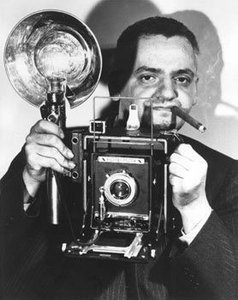
weegee (arthur fellig)
1899 - 1968
Belangrijkste feiten
- Artistic Movement Or Style: Street Photography
- Date Of Birth: 1899
- Full Name: Arthur Fellig
- Nationality: American
- Notable Artworks:
- Brooklyn School Children See Gambler Murdered in Street
- Street Accident
- Victory Celebration
- Place Of Birth: New York City, USA