Voorvertoning
 Verstuur
 Delen
Delen
 Details bekijken
 Gids
Gids

 Download
 Vergelijkbare items
 Röntgenonderzoek
 Diavoorstelling
 Vraag & antwoord
 Statistieken
Division -Unit


 Lees meer
Giclée / Kunstafdrukken
Giclée- of canvasafdruk van museumkwaliteit met een snelle productie en flexibele afwerkingsmogelijkheden. ( Bestel handgeschilderde reproductie Schakel over naar digitale afbeeldingen)




P118B €10

P118H €10

P118W €10

P438Z €10

P508JH €12

P508YH €12

P805H €10

P805Z €10

P919BZ €10

P919G €10

P919XJ €10

P959ZH €10

P968JZ €12

W106C €8

W218G €10

W218JH €8

W218Y €10

W307PJ €10

W316G €10

W316PJ €8

W316Y €10

W398PJ €8

W4111J €10

W500HY €15

W500JH €15

W692G €12

W849H €8

W940BG €15

W953PJ €8




Kies uit onze vooraf ingestelde maten die overeenkomen met de originele verhoudingen van het kunstwerk.

Voer de gewenste breedte en hoogte in, passend bij uw lijst of muur. Een afdruk kan alleen worden ingekort en nooit groter worden gemaakt dan het origineel; een formaat met andere verhoudingen zal daarom een deel van de afbeelding verliezen. Wij sturen u een digitaal mockup ter goedkeuring voordat we tot drukwerk overgaan. De afbeelding op deze pagina toont niet de werkelijke uitsnede — dit is alleen te zien op het mockup.
Wereldwijde levering () binnen 2 weken in plaats van de standaard 4/5 weken. (11 november)

Gratis wereldwijde expressverzending

Hoogwaardig linnen canvas

Volledige verzendverzekering

Garantie op terugbetaling van invoerrechten

Garantie op exacte kleurweergave

Retourbeleid van 100 dagen (alleen bij defecten)

100% Geld-terug-garantie

Korting bij meerdere afnames
 De optie voor glas is alleen beschikbaar bij een formaat kleiner dan 110 cm.

Division -Unit
Giclée / Kunstafdrukken
Afmetingen reproductie
-


Eindtotaal
€ 72
Division -Unit: A Symphony of Color and Spirit
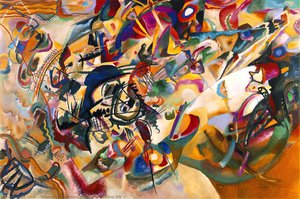
Wassily Kandinsky’s “Division - Unite,” created in 1934 during his formative Parisian period, stands as an emblem of abstract expressionism and a testament to the artist's relentless pursuit of spiritual resonance within visual art. Born in Moscow in 1866, Kandinsky embarked on a transformative artistic odyssey fueled by encounters with Impressionist painting—particularly Claude Monet’s “Haystacks”—and profoundly moved by Wagner’s opera "Lohengrin." These experiences instilled within him an unwavering conviction that art could transcend mere representation and communicate directly with the soul. This conviction would become the cornerstone of his groundbreaking approach to abstraction, forever altering the landscape of modern artistic endeavor. Early influences extended beyond purely visual stimuli; Kandinsky absorbed the vibrant hues and symbolic narratives of Russian folk art, gleaned from expeditions into the Vologda region. He meticulously documented these observations, recognizing their capacity to evoke emotional responses akin to musical harmonies—a concept he would champion throughout his career. This intellectual framework underpinned his artistic explorations, guiding him toward a deliberate rejection of conventional pictorial conventions in favor of forms that prioritized color and composition as primary expressive vehicles. The painting itself presents a striking visual experience: a square grid serves as the foundational structure for an astonishing array of organic shapes—circles, squares, triangles—interwoven with scattered letters. These elements are not uniformly distributed; rather, they cluster and overlap, generating a palpable sense of controlled chaos that belies Kandinsky’s meticulous planning. Diagonal lines intersect the grid, injecting dynamism into the composition and reinforcing the feeling of movement. The color palette is extraordinarily rich and diverse, encompassing reds, greens, blues, yellows, oranges, and purples—applied in both solid blocks and blended areas to create subtle gradations that heighten visual interest. Dominating the background is a pale grey or off-white hue, allowing the vibrant colors of the shapes to command attention and radiate luminosity. Kandinsky’s technique reflects his unwavering commitment to capturing inner experience. Executed primarily with oil paints on canvas—likely stretched taut—the application appears remarkably smooth, minimizing visible brushstrokes and prioritizing tonal harmony. This deliberate restraint underscores Kandinsky's belief that color alone could convey profound emotional significance. The resulting surface possesses a subtle textural quality, suggestive of the paper-like texture of his preparatory sketches, hinting at the artist’s ongoing engagement with traditional drawing methods alongside his pioneering explorations of abstraction. “Division - Unite” embodies Kandinsky’s mature abstract style—characterized by its rejection of representational imagery and its masterful manipulation of color relationships to evoke spiritual contemplation. It aligns seamlessly with the tenets of Abstract Expressionism, a movement that championed spontaneous gesture and emotional intensity as paramount considerations in artistic creation. More than just a visual spectacle, this artwork invites viewers into a realm where form and color coalesce to communicate unspoken truths—a legacy that continues to inspire artists and collectors alike.Composition & Structure
The square grid serves as the central organizing principle of “Division - Unite,” providing a framework for the arrangement of disparate elements while simultaneously fostering a sense of controlled dynamism. Unlike traditional perspectival representations, Kandinsky eschews depth illusion, opting instead for a flattened surface that emphasizes color and form as independent expressive forces. Diagonal lines intersect the grid, injecting movement into the composition and disrupting any potential static equilibrium. This deliberate disruption mirrors Kandinsky’s philosophical conviction that art should transcend rational thought and tap into primal instincts—a core tenet of his spiritual worldview.Color Palette & Harmony
Kandinsky's masterful use of color is arguably the painting's most striking feature. The palette encompasses a spectrum of hues—reds, greens, blues, yellows, oranges, and purples—each carefully positioned to create visual harmony and convey specific emotional resonances. Solid blocks of color coexist with blended areas, generating subtle gradations that enrich the overall tonal range. The dominant off-white background serves as a counterpoint to the vibrant shapes, maximizing their luminosity and enhancing their impact on the viewer’s eye. Kandinsky's meticulous attention to color theory—informed by Goethean aesthetics—demonstrates his profound understanding of how color can stimulate sensory perception and evoke psychological responses.Technique & Materials
The painting was crafted using oil paints on canvas, a medium favored by Kandinsky for its ability to achieve exceptional tonal fidelity and textural nuance. The application technique prioritizes smoothness and tonal consistency, minimizing visible brushstrokes and emphasizing the artist’s commitment to capturing inner experience through visual form. This deliberate restraint underscores Kandinsky's belief that color alone could convey profound emotional significance—a conviction that underpinned his entire artistic practice.Symbolic Significance & Emotional Impact
“Division - Unite” transcends mere aesthetic beauty; it embodies Kandinsky’s aspiration to communicate spiritual truths through abstraction. The scattered letters within the composition serve as visual anchors, grounding the organic shapes in a realm of intellectual contemplation—a reflection of Kandinsky's engagement with philosophical ideas and his belief that art could illuminate hidden dimensions of human consciousness. Ultimately, this painting invites viewers into a meditative state—a testament to Kandinsky’s enduring legacy as one of the foremost pioneers of abstract expressionism and a visionary artist who dared to explore the uncharted territories of visual perception.Historical Context
Created in 1934, “Division - Unite” emerged during Kandinsky's Parisian period—a time marked by profound intellectual ferment and artistic experimentation. The painting reflects the influence of Bauhaus, where Kandinsky taught from 1922 to 1933, and embodies the broader ethos of Abstract Expressionism—a movement that championed spontaneity and emotional intensity as paramount considerations in artistic creation. It stands as a pivotal work within Kandinsky’s oeuvre, solidifying his reputation as one of the most innovative and influential artists of the 20th century.Size & Dimensions
Unknown Date: 1934Veelgestelde vragen
Kan ik "Division -Unit" door Wassily Kandinsky op mijn eigen muur bekijken voordat ik het koop?
"Division -Unit" heeft een augmented reality-preview: de AR-weergave-pagina van het kunstwerk toont het in uw eigen ruimte op een compatibel apparaat.
Hoe oud was Wassily Kandinsky bij het creëren van "Division -Unit" in 1934?
Toen "Division -Unit" werd gemaakt in 1934, was Wassily Kandinsky - geboren in 1866 - 68 jaar oud.
Welke nationale herkomst ligt ten grondslag aan de Abstract Expressionism van "Division -Unit"?
"Division -Unit" werd gecreëerd door Wassily Kandinsky, geboren in Rusland, binnen de Abstract Expressionism-stroming. De herkomst van de kunstenaar verbindt het werk met Abstract Expressionism, zoals beoefend door kunstenaars uit Rusland.
Biografie kunstenaar
Het Vroege Leven en de Academische Vorming
Wassily Kandinsky werd geboren in Moskou, als zoon van Lidia Ticheeva en Vassily Silvestrovich Kandinsky. Zijn vroege jaren werden diepgaand gevormd door de klanken van muziek; hij wijdde zijn tijd aan het studeren van het piano en de cello. Deze vroege lessen in ritme en geluid zouden een blijvende resonantie in hem teweegbrengen, lang nadat hij zijn ouderlijk huis had verlaten.
Zijn pad leidde echter niet onmiddellijk naar het canvas. In plaats daarvan volgde hij een formele opleiding aan de Universiteit van Moskou, waar hij zich concentreerde op de disciplines rechten, economie en etnografie. Na zijn afstuderen nam hij uiteindelijk een positie in als docent. Pas toen hij de leeftijd van dertig jaar bereikte, begon hij aan zijn formele schildersopleiding, waarmee hij zijn focus verschoof van het bestuderen van sociale en juridische structuren naar de fysieke handeling van het tekenen en schetsen.
Deze cruciale verschuiving bracht hem naar München. Daar zocht hij naar een rigoureuze training aan de Anton Ažbe School en de Academie voor Beeldende Kunsten. Hij bracht zijn tijd daar door met het bestuderen van de mechanica van de vorm en de manier waarop licht met objecten interageert, waarbij hij zijn eerdere academische leven achter zich liet om zich volledig te wijden aan het leven van een kunststudent.
De Transitie naar een Artistiek Leven
De grote verschuiving begon in 1896 tijdens een tentoonstelling in Moskou. Het aanschouwen van Claude Monet’s “Haystacks” veranderde fundamenteel de manier waarop hij licht en kleur waarnam. Deze ontmoeting met het impressionisme ontketende een diepe, aanhoudende drang naar de schilderkunst. Het was een stille koerswijziging van een leven dat voorheen volledig was gericht op de gestructureerde wereld van de wet en de economie. De roep van het canvas bleek uiteindelijk sterker dan de stabiliteit van zijn academische pad.
Uiteindelijk verliet hij zijn positie als hoogleraar rechten aan de Universiteit van Dorpat om deze nieuwe impuls te volgen. Rond 1896 was hij naar München verhuisd om met een formele kunststudie te beginnen. Hij zocht de Anton Ažbe School en de Academie voor Beeldende Kunsten op om de mechanica van zijn gekozen ambacht te beheersen. Deze transitie was een beweging van de collegezaal naar het atelier, waarbij hij juridische theorieën inruilde voor de studie van vorm en pigment.
- De Blue Rider (1903)
De Murnau-periode en het Expressionisme
In 1901 ontmoette Wassily Kandinsky de kunstenares Gabriele Münter. Hun band groeide naarmate zij een gedeelde passie ontwikkelden voor de expressieve kracht van kleur. Tegen 1909 hadden zij een huis gekocht in Murnau, een omgeving die het perfecte decor vormde voor een reeks landschappen waarin de vormen van de natuurlijke wereld begonnen te transformeren. De werken uit deze periode dragen de essentie van zijn eerdere studies in zich, met name de diepe invloed van de Russische volkskunst. Hij hanteerde felle kleuren tegen donkere achtergronden, een stijl die getuigde van zijn wortels in de tradities van zijn jeugd.
De landschappen van Murnau waren geen loutere kopieën van de omgeving. Hij beschouwde de heuvels en de huizen door een lens die de voorkeur gaf aan emotionele intensiteit boven letterlijke nauwkeurigheid. De kleuren werden assertiever en bewogen weg van de verstilling van de traditionele representatie. Hij zocht naar een manier om het canvas te laten pulseren met een gevoel van leven, waarbij hij het landschap slechts als vertrekpunt gebruikte voor iets dat veel innerlijker was. De penseelstreken werden breder en de grenzen tussen de objecten begonnen te vervagen.
- Murnau. Landscape with Green House (1909)
De Blauwe Ruiter en Abstractie
In München verschoof de focus naar een geheel nieuwe manier van kijken. Wassily Kandinsky was medeoprichter van de groep Der Blaue Reiter (De Blauwe Ruiter), een kring van kunstenaars die streefde naar het doorbreken van de oppervlakkigheid van de zichtbare wereld. Tijdens deze periode raakte hij nauw verbonden met de expressionistische beweging, waarbij het hoofddoel het vinden van een visuele taal voor de innerlijke geest was. Hij begon zich steeds verder te verwijderen van de herkenbare vormen van het landschap, en koos in plaats daarvan voor een stijl waarin het emotionele gewicht van kleur en vorm centraal stond. Dit was een breuk met de letterlijke weergave van de werkelijkheid, een overgang naar het non-objectieve.
Zijn werk ontwikkelde zich tot een diepgaande studie van hoe een lijn of een specifieke tint kon fungeren als een muzikale noot. Als pionier van de abstracte kunst ontdeed hij het kunstwerk van de noodzaak dat een onderwerp een herkenbaar object moest zijn. In plaats daarvan richtte hij zich op het samenspel van vormen en de manier waarop zij konden communiceren zonder directe verwijzing naar de natuur. Deze ontwikkeling van de niet-representatieve schilderkunst was geen plotselinge breuk, maar een gestage beweging naar de essentie van het gevoel. Het canvas werd een ruimte voor pure compositie, waar de ordening van elementen rechtstreeks tot de intuïtie van de toeschouwer sprak.
- 1913: Color Study of Squares and Circles
- 1914: Im Kreis (In de Cirkel)
- 1923: Composition VIII
- 1926: Several Circles
Onderwijs en de Bauhaus-jaren
Na zijn verblijf in Rusland, waar hij diende als de eerste directeur van het Instituut voor Artistieke Cultuur in Moskou, bewoog Wassily Kandinsky zich richting de academische kringen van Duitsland. In 1921 ontving hij de uitnodiging om verbinding te maken met het Bauhaus in Weimar. Deze periode markeerde een cruciale verschuiving naar een meer gestructureerde verkenning van de interactie tussen kleur en vorm op het canvas. Hij bracht een groot deel van zijn tijd door in deze omgeving, waar hij van 1922 tot 1933 lesgaf aan de Bauhaus-school voor kunst en architectuur.
Zijn aanwezigheid in het klaslokaal werd gekenmerkt door een diepe focus op de mechanica van de visuele taal. Hij onderzocht hoe een cirkel of een lijn gewicht en betekenis kon dragen, zonder dat deze de noodzaak had om een fysiek object na te bootsen. Het was een tijdperk van experimenten met geometrie en de psychologische impact van specifieke tinten. Het werk uit deze jaren ademt vaak een gevoel van precisie uit, waarbij hij zich losmaakte van de vloeiende, organische vormen uit zijn eerdere jaren en bewoog naar een meer berekende ordening van elementen.
Het tijdperk van zijn onderwijs kwam abrupt tot een einde toen het nazi-regime in 1933 het Bauhaus sloot. Deze gebeurtenis dwong hem tot een vertrek uit de gestructureerde omgeving van de school en leidde hem naar een nieuw hoofdstuk in Frankrijk. Zijn tijd in Duitsland was een periode geweest van diepgaande theoretische ontwikkeling, waarin het abstracte een methode werd om het innerlijke landschap van de menselijke geest in kaart te brengen.
De laatste jaren en zijn laatste verblijfplaats
De sluiting van het Bauhaus in 1933 dwong hem tot een vertrek richting Frankrijk. Hij vestigde zich daar en bleef in het land verblijven van 1933/1934 tot aan zijn dood. Gedurende deze periode verdiepte zijn band met zijn nieuwe vaderland zich, en in 1939 werd hij zelfs het Franse staatsburgerschap verleend.
Zijn laatste levensjaren bracht hij door in dit Franse landschap, waar hij bleef experimenteren met gelaagde impasto-technieken die zijn doeken een fysieke, textuurrijke aanwezigheid gaven. Een dergelijk meesterwerk uit deze periode is An Intimate Party (1942). Wassily Kandinsky ging op 13 december 1944 onherroepelijk uit het leven.
Belangrijke Werken en Artistieke Mijlpalen
Wanneer men de vroege werken van Wassily Kandinsky nauwgezet bestudeert, ontdekt men de wortels van zijn transformatie naar abstractie. In 1903 schilderde hij The Blue Rider, een werk waarin een in donkerblauw gehuld figuur te paard door een schaars, groen landschap rijdt. Dit stuk vangt een moment van overgang, waarin de herkenbare vormen van de wereld beginnen te bezwijken onder de overweldigende kracht van kleur. Zijn penseelstreken uit deze periode waren vaak breed en expressief, een voorbode van de non-objectieve richtingen die zijn oeuvre uiteindelijk zou inslaan.
Naarmate zijn focus verschoof naar geometrische precisie en het samenspel van vormen, werden zijn composities steeds gestructureerder. In 1923 creëerde hij Composition VIII, een meesterwerk dat wordt gedefinieerd door de dynamische interactie tussen cirkels en lijnen. Tegen 1925 was zijn palet opnieuw getransformeerd in Yellow, Red, Blue, waarbij de kleuren zelf het primaire onderwerp werden. Deze jaren illustreren een gestage beweging weg van de landschappen uit zijn jeugd, richting een taal van pure vorm en tint. Zelfs in zijn latere jaren bleef de experimenteerdrift onverminderd groot; rond 1939 ontstond Composition X, wat de voortdurende evolutie van zijn visuele vocabulaire getuigt.
- Abschied (kleine versie) (1903)
- Improvisation. Gorge (1914)
- Im in the Circle (1914)
- Several Circles (1926)
Waar u zijn meesterwerken vandaag de dag kunt bewonderen
De canvassen van Wassily Kandinsky zijn verspreid over verschillende vooraanstaande instellingen, die elk een unieke blik werpen op de fascinerende evolutie van zijn kleurgebruik en vormtaal. In Parijs herbergt het Centre Pompidou vele van zijn schilderijen, wat de bezoeker de zeldzame kans biedt om de verschuiving naar zijn non-objectieve composities van dichtbij te ervaren. Ook het Solomon R. Guggenheim Museum in New York City beheert een indrukwekkende collectie van zijn werk, inclusief cruciale stukken uit zijn meer geometrische periodes.
In München vindt men in de Lenbachhaus een significante selectie van zijn schilderijen, die de essentie van zijn tijd met de Der Blaue Reiter-groep prachtig weerspiegelen. Voor wie de grootschalige, complexe arrangementen in hun volle glorie wil aanschouwen, biedt de Tretyakov Gallery in Moskou de monumentale "Composition VII". Deze locaties bieden elk een ander perspectief op zijn artistieke reis: van zijn vroege, expressieve landschappen tot zijn latere, meer gestructureerde abstracties.
- Composition VII
- Several Circles
- Yellow, Red, Blue
- An Intimate Party

Wassily Kandinsky
1866 - 1944 , Rusland
Belangrijkste feiten
- Artistic Movement Or Style:
- Expressionisme
- Abstracte schilderkunst
- Der Blaue Reiter
- Artists Or Movements Influenced By This Artist: ['Abstract expressionisme']
- Artists Who Influenced This Artist: ['Claude Monet']
- Date Of Birth: 1866
- Date Of Death: 1944
- Full Name: Wassily Wassilyevich Kandinsky
- Nationality: Russisch
- Notable Artworks:
- Papeln (Populi)
- Several Circles
- Composition VIII
- Composition VII
- An Intimate Party
- Place Of Birth: Moskou, Rusland
Gerelateerde artikelen

Kandinsky's Meesterwerken: 25 Abstracte Kunstparels voor uw Interieur | OriginalUniqueArt
Ontdek de 25 meest iconische werken van Wassily Kandinsky! Duik in zijn abstracte wereld vol kleur, expressionisme & spirituele diepgang. Vind museumkwaliteit reproducties en interieurinspiratie op OriginalUniqueArt.com.

Mastering Abstraction: The Top 25 Essential Works by Wassily Kandinsky
Explore 25 iconic Kandinsky masterpieces and the birth of abstraction. Discover the full collection online at OriginalUniqueArt.com.

Mastering Abstraction: The Top 25 Essential Works by Wassily Kandinsky
Embark on a journey through the soul of abstraction with our curated guide to Wassily Kandinsky's top 25 masterpieces. Explore the vibrant colors and spiritual forms that defined modern art. Find museum-quality reproductions for your decor. Discover all masterpieces on OriginalUniqueArt.com.

Mastering Abstraction: The Top 25 Essential Artworks by Wassily Kandinsky
Journey through the vibrant soul of abstraction with our curated guide to the top 25 Wassily Kandinsky masterpieces. Explore the stories behind his iconic colors and shapes. Find museum-quality reproductions and decor inspiration. Discover all masterpieces on OriginalUniqueArt.com.

Mastering Abstraction: The Top 25 Essential Works by Wassily Kandinsky
Journey through the soul of abstraction with our curated guide to the top 25 Wassily Kandinsky masterpieces. Explore the vibrant colors and spiritual forms that defined modern art. Find museum-quality reproductions and decor inspiration. Discover all masterpieces on OriginalUniqueArt.com.