Voorvertoning
 Verstuur
 Delen
Delen
 Details bekijken
 Gids
Gids

 Download
 Vergelijkbare items
 Röntgenonderzoek
 Diavoorstelling
 Q&A
Q&A Statistieken
Black Relationship
 Black strokes I
 1924
1924 37.0 x 36.0 cm
 Solomon R. Guggenheim Museum
 Lees meer
Giclée / Kunstafdrukken
Giclée- of canvasafdruk van museumkwaliteit met een snelle productie en flexibele afwerkingsmogelijkheden. ( Bestel handgeschilderde reproductie Schakel over naar digitale afbeeldingen)




P118B €10

P118H €10

P118W €10

P438Z €10

P508JH €12

P508YH €12

P805H €10

P805Z €10

P919BZ €10

P919G €10

P919XJ €10

P959ZH €10

P968JZ €12

W106C €8

W218G €10

W218JH €8

W218Y €10

W307PJ €10

W316G €10

W316PJ €8

W316Y €10

W398PJ €8

W4111J €10

W500HY €15

W500JH €15

W692G €12

W849H €8

W940BG €15

W953PJ €8




Kies uit onze vooraf ingestelde maten die overeenkomen met de originele verhoudingen van het kunstwerk.

Voer de gewenste breedte en hoogte in, passend bij uw lijst of muur. Een afdruk kan alleen worden ingekort en nooit groter worden gemaakt dan het origineel; een formaat met andere verhoudingen zal daarom een deel van de afbeelding verliezen. Wij sturen u een digitaal mockup ter goedkeuring voordat we tot drukwerk overgaan. De afbeelding op deze pagina toont niet de werkelijke uitsnede — dit is alleen te zien op het mockup.
Wereldwijde levering () binnen 2 weken in plaats van de standaard 4/5 weken. (30 oktober)

Gratis wereldwijde expressverzending

Hoogwaardig linnen canvas

Volledige verzendverzekering

Garantie op terugbetaling van invoerrechten

Garantie op exacte kleurweergave

Retourbeleid van 100 dagen (alleen bij defecten)

100% Geld-terug-garantie

Korting bij meerdere afnames
 De optie voor glas is alleen beschikbaar bij een formaat kleiner dan 110 cm.

Black Relationship
Giclée / Kunstafdrukken
Afmetingen reproductie
-


Eindtotaal
€ 71
A Universe Within: Decoding Kandinsky’s ‘Black Relationship’
Wassily Kandinsky's ‘Black Relationship,’ painted in 1924, is not merely an artwork; it’s a visual poem, a distillation of spiritual inquiry rendered in the language of abstract form. Measuring a modest 37 x 36 cm, this watercolor and ink on paper possesses an expansive quality, drawing the viewer into a cosmos of color and shape that feels both intimate and infinite. Created during Kandinsky's tenure at the Bauhaus school, ‘Black Relationship’ exemplifies his mature style – a harmonious balance between analytical geometry and intuitive expression. The painting isn’t about *representing* something; it is about *being* something—a manifestation of inner necessity, as Kandinsky himself termed the driving force behind his art. The composition centers around a dominant black circle punctuated by a vibrant red dot, an arrangement that immediately evokes a sense of mystery and focused energy. This central motif isn’t isolated but exists within a dynamic field of other circles, varying in size and hue—yellows, blues, and further shades of black—that seem to orbit and interact with one another. These aren't haphazardly placed; they are carefully considered elements contributing to a complex visual rhythm. Kandinsky wasn’t interested in replicating the external world but rather in expressing the internal resonances of color and form. He believed that each color possessed its own spiritual vibration, capable of evoking specific emotions and sensations within the viewer. The black, often associated with the unknown or the infinite, acts as a grounding force, while the red—a color of passion and vitality—injects a spark of life into the composition.The Bauhaus Influence & Beyond
To understand ‘Black Relationship’ fully, it's crucial to consider its historical context. Kandinsky joined the faculty of the Bauhaus in 1922, a revolutionary school of art and design that sought to unify all artistic disciplines—painting, sculpture, architecture, typography—under a common philosophy. The Bauhaus emphasized functionalism, geometric abstraction, and the exploration of materials. While Kandinsky’s work predates the Bauhaus aesthetic, his time there undoubtedly influenced his approach. He began to refine his abstract vocabulary, focusing on precise forms and carefully calibrated color relationships. However, unlike some of his Bauhaus colleagues who embraced a purely rational approach, Kandinsky never abandoned the spiritual dimension of his art. ‘Black Relationship’ is evidence of this synthesis—a work that is both intellectually rigorous and emotionally resonant. Kandinsky's artistic journey was profoundly shaped by his synesthetic experiences – a neurological phenomenon where stimulation of one sense triggers an experience in another. He often described “hearing” colors and “seeing” music, which deeply informed his belief that art should transcend mere representation and tap into the universal language of feeling. This is why his paintings don’t depict objects; they *are* expressions of emotion, spiritual states, and inner landscapes. The circles within ‘Black Relationship’ can be interpreted as representing cosmic bodies, cellular structures, or simply pure forms existing in a state of dynamic equilibrium.A Timeless Resonance for Modern Interiors
‘Black Relationship’ is more than just a historical artifact; it's a work that continues to speak powerfully to contemporary audiences. Its abstract nature makes it incredibly versatile, lending itself beautifully to a wide range of interior design schemes. The painting’s predominantly dark palette, punctuated by bursts of color, can add depth and sophistication to modern living spaces. It would be particularly striking in a minimalist setting, where its complex composition provides a focal point without overwhelming the room. Alternatively, it could complement more eclectic interiors, adding a touch of intellectual intrigue and artistic flair. A high-quality reproduction of ‘Black Relationship’ allows art lovers to experience Kandinsky's visionary world firsthand, bringing a sense of calm contemplation and aesthetic beauty into their homes. It is an invitation to pause, reflect, and connect with the profound mysteries that lie within the realm of abstract art.Veelgestelde vragen
Wat zijn de afmetingen van het originele "Black Relationship"?
De afmetingen van "Black Relationship" door Wassily Wassilyevich Kandinsky zijn 37 x 36 cm. Reproducties kunnen in andere formaten worden besteld met behoud van dezelfde verhoudingen.
In welk jaar werd "Black Relationship" gemaakt?
"Black Relationship" door Wassily Wassilyevich Kandinsky werd gecreëerd in 1924.
Hoe kan ik "Black Relationship" door Wassily Wassilyevich Kandinsky bekijken als een diavoorstelling?
"Black Relationship" door Wassily Wassilyevich Kandinsky is te bekijken als een diavoorstelling op de Diavoorstelling-pagina van het kunstwerk.
Biografie kunstenaar
A Life Immersed in Color and Spirit
Wassily Wassilyevich Kandinsky, geboren in Moskou in 1866, was een revolutionaire figuur die de koers van moderne kunst onherstelbaar heeft veranderd. Zijn reis was geen directe artistieke roeping; aanvankelijk was hij bestemd voor een carrière in de rechten en economie aan de Universiteit van Moskou, maar het was een diepgaande ontmoeting met impressionistische schilderkunst – specifiek Claude Monet’s “Haystacks” – en een aangrijpend ervaring tijdens het bijwonen van Wagners opera "Lohengrin" die in hem een onweerstaanbare drang ontstond om kunst te beoefenen. Dit cruciale moment, rond de leeftijd van dertig, markeerde niet alleen een carrièreverandering, maar ook een complete verschuiving in perspectief, waardoor hij op weg werd gesteld naar het pionierswerk van abstractie. Kort daarna verhuisde hij naar München en meldde zich aan bij de prestigieuze Academie voor Beeldende Kunsten en studeerde daar onder Franz von Stuck, hoewel zelfs binnen formele training Kandinsky’s geest hunkerde naar exploratie buiten conventionele grenzen.
Vroege invloeden omvatten Russische volkskunst, verkregen tijdens een etnografische expeditie naar de Vologda-regio in 1889, wat een fascinatie wekte voor levendige kleurenpaletten en symbolische beelden. Deze basis zou cruciaal blijken te zijn terwijl hij begon zijn unieke artistieke taal te ontwikkelen. Deze vroege verkenningsreizen waren niet alleen gebaseerd op esthetische voorkeuren; ze waren geworteld in een diepe culturele verbinding en een groeiend begrip van hoe kunst kan communiceren buiten de letterlijke betekenis. De invloed van Wagner’s opera's was bijzonder belangrijk, omdat het Kandinsky’s verlangen naar expressie en spiritualiteit stimuleerde.
The Dawn of Abstraction: From Expressionism to Inner Necessity
Kandinsky’s vroege werken tonen een sterke expressionistische neiging, gekenmerkt door felle kleuren en emotionele intensiteit – schilderijen zoals “Papeln (Poplars)” uit 1902 illustreren deze periode. Echter, hij was niet tevreden om de buitenwereld te representeren; hij zocht naar het uiten van innerlijke realiteiten, spirituele waarheden die verder gingen dan eenvoudige visuele weergave. Deze zoektocht leidde hem geleidelijk weg van representatiekunst en richting een revolutionaire verkenning van kleur, vorm en hun emotionele resonans. Hij geloofde dat kleuren inherent psychologische effecten hadden, in staat om specifieke gevoelens en zintuiglijke ervaringen bij de kijker op te roepen.
Hij begon te geloven dat kleuren een intrinsieke betekenis hadden, die verband hield met zijn toenemende interesse in de Theosophie, een spirituele beweging die esoterische kennis en universele broederschap benadrukte. Door zich verder te verdiepen in deze ideeën, werden Kandinsky’s schilderijen steeds meer niet-objectief, waarbij herkenbare vormen werden losgelaten ten gunste van abstracte composities gedreven door een “innerlijke noodzaak”. Dit was niet alleen het opgeven van representatie; het was het ontdekken van een nieuwe visuele taal die in staat was om de ongrijpbare rijkdommen van emotie en spiritualiteit uit te drukken. Hij streefde ernaar om een visueel equivalent te creëren voor muziek, waarbij kleur en vorm harmonieerden om diepgaande emotionele reacties op te wekken.
Geometric Harmony and Spiritual Resonance
De periode na zijn betrokkenheid bij de invloedrijke kunstenaarsgroep Der Blaue Reiter (De Blauwe Reiter), die hij in 1911 in München mede-stigde, zag een verdere evolutie in Kandinsky’s stijl. Hoewel eerdere werken vaak vloeiende, organische vormen vertoonden, begon hij te experimenteren met abstracte geometrie, waarbij de nadruk lag op het samenspel van cirkels, driehoeken en vierkanten. “Several Circles” (140 x 140 cm) is een voorbeeld van deze fase – een dynamische compositie waarin kleur en vorm in een harmonieus maar energiek dansje interageren. De kleuren werden zorgvuldig gekozen om specifieke emoties en ideeën te oproepen, wat de essentie van Kandinsky’s artistieke visie weerspiegelt.
Deze geometrie was niet koud of steril; het was doordrenkt met spirituele betekenis. Kandinsky geloofde dat geometrische vormen inherente symbolische betekenissen hadden, en hun arrangement binnen de doek kon specifieke emotionele reacties oproepen. Zijn theoretische geschriften, waaronder “Concerning the Spiritual in Art” (1911), legden deze overtuigingen vast, waardoor een nieuwe benadering van abstracte kunst als een middel tot expressie van diepgaande spirituele waarheden werd gecreëerd. Hij betoogde dat kunst niet de bedoeling had om de natuur na te bootsen, maar eerder om de innerlijke wereld van de kunstenaar te onthullen en verbinding te maken met de kijker op een dieper, intuïtiever niveau.
Bauhaus Influence and Lasting Legacy
De uitbraak van de Eerste Wereldoorlog dwingde Kandinsky in 1914 terug naar Rusland, maar na de Russische Revolutie bevond hij zich steeds meer op tegenstrijdige wijze met het heersende artistieke klimaat. In 1920 accepteerde hij een lespost aan de Bauhaus school in Duitsland, waar hij generaties kunstenaars beïnvloedde met zijn theorieën over kleur, vorm en abstractie. De Bauhaus bood een ideale omgeving voor Kandinsky om zijn ideeën verder te ontwikkelen en nieuwe creatieve paden te verkennen.
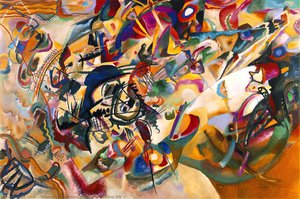
Hij bleef experimenteren met geometrische vormen en levendige kleuren, waarbij hij vaak ingewikkelde impasto-technieken gebruikte om texturen te creëren die de diepte en complexiteit van zijn composities verhoogden – zoals blijkt uit latere werken zoals “An Intimate Party” (1942). Na het sluiten van de Bauhaus door het Nazi-regime in 1933, verhuisde Kandinsky naar Frankrijk, waar hij zijn leven beëindigde. Zijn impact op moderne kunst is onmiskenbaar; hij wordt algemeen beschouwd als een pionier van abstract expressionisme en een sleutelfiguur in de ontwikkeling van niet-representatieve schilderkunst. Zijn werken worden in belangrijke musea over de hele wereld tentoongesteld, waaronder de Tretyakov Gallery in Moskou, die zijn monumentale “Composition VII” herbergt – een getuigenis van zijn artistieke visie en blijvende nalatenschap.
Kandinsky’s verkenning van kleur, vorm en spiritualiteit inspireert kunstenaars tot op de dag van vandaag, waardoor hij zijn plaats als een van de meest belangrijke figuren in de 20e-eeuwse kunstgeschiedenis wordt bevestigd. Hij schilderde niet alleen plaatjes; hij schilderde emoties, ideeën en de essentie van het menselijk spirituele.

Wassily Wassilyevich Kandinsky
1866 - 1944 , Rusland
Belangrijkste feiten
- Artistic Movement Or Style: Abstract kunst, Expressionisme
- Artists Or Movements Influenced By This Artist:
- Expressionisme
- Der Blaue Reiter
- Artists Who Influenced This Artist:
- Claude Monet
- Richard Wagner
- Date Of Birth: 1866
- Full Name: Wassily Wassilyevich Kandinsky
- Nationality: Russisch, Frans
- Notable Artworks:
- Murnau met Regenboog
- Tempered Elan
- An Intieme Party
- Meerdere Cirkels
- Place Of Birth: Moskou, Rusland
Gerelateerde artikelen

Top 10 Legendarische Aquarellen die de Kunst voor Altijd Veranderden | OriginalUniqueArt
Ontdek de 10 legendarische aquarellen die kunstgeschiedenis schreven! Van Turner tot Monet, leer over techniek, emotie & impact. Vind museumkwaliteit reproducties en interieurinspiratie op OriginalUniqueArt.com.

Kandinsky's Meesterwerken: 25 Abstracte Kunstparels voor uw Interieur | OriginalUniqueArt
Ontdek de 25 meest iconische werken van Wassily Kandinsky! Duik in zijn abstracte wereld vol kleur, expressionisme & spirituele diepgang. Vind museumkwaliteit reproducties en interieurinspiratie op OriginalUniqueArt.com.

Top 10 Meesterwerken van de Geometrische Abstractie | OriginalUniqueArt.nl
Ontdek de 10 meest invloedrijke meesterwerken van de geometrische abstractie! Van Mondriaan tot Malevich, leer over kunstenaars, technieken & kleuren. Museumkwaliteit reproducties op OriginalUniqueArt.com – voor een unieke interieurstijl.

Ephemeral Visions: Exploring the History & Emotional Resonance of Watercolor Painting
Explore the captivating history of watercolor painting, from ancient techniques to modern masters like Kandinsky & Blake. Discover essential artists, collecting tips & the emotional power of this luminous medium. Expert insights for art enthusiasts.

Ephemeral Visions: Exploring the Artistic Legacy & Contemporary Practice of Watercolor Painting
Explore the captivating world of watercolor painting! Discover its rich history, essential techniques, influential artists & collecting tips. A comprehensive guide for art enthusiasts from OriginalUniqueArt.