
 Voorvertoning
 Verstuur
 Delen
Delen
 Details bekijken
 Gids
Gids

 Download
 Vergelijkbare items
 Röntgenonderzoek
 Diavoorstelling
 Q&A
Q&A Statistieken
T. G. Arthur


 Lees meer
Giclée / Kunstafdrukken
Giclée- of canvasafdruk van museumkwaliteit met een snelle productie en flexibele afwerkingsmogelijkheden. ( Bestel handgeschilderde reproductie Schakel over naar digitale afbeeldingen)




P118B €10

P118H €10

P118W €10

P438Z €10

P508JH €12

P508YH €12

P805H €10

P805Z €10

P919BZ €10

P919G €10

P919XJ €10

P959ZH €10

P968JZ €12

W106C €8

W218G €10

W218JH €8

W218Y €10

W307PJ €10

W316G €10

W316PJ €8

W316Y €10

W398PJ €8

W4111J €10

W500HY €15

W500JH €15

W692G €12

W849H €8

W940BG €15

W953PJ €8




Kies uit onze vooraf ingestelde maten die overeenkomen met de originele verhoudingen van het kunstwerk.

Voer de gewenste breedte en hoogte in, passend bij uw lijst of muur. Een afdruk kan alleen worden ingekort en nooit groter worden gemaakt dan het origineel; een formaat met andere verhoudingen zal daarom een deel van de afbeelding verliezen. Wij sturen u een digitaal mockup ter goedkeuring voordat we tot drukwerk overgaan. De afbeelding op deze pagina toont niet de werkelijke uitsnede — dit is alleen te zien op het mockup.
Wereldwijde levering () binnen 2 weken in plaats van de standaard 4/5 weken. (31 oktober)

Gratis wereldwijde expressverzending

Hoogwaardig linnen canvas

Volledige verzendverzekering

Garantie op terugbetaling van invoerrechten

Garantie op exacte kleurweergave

Retourbeleid van 100 dagen (alleen bij defecten)

100% Geld-terug-garantie

Korting bij meerdere afnames
 De optie voor glas is alleen beschikbaar bij een formaat kleiner dan 110 cm.

T. G. Arthur
Giclée / Kunstafdrukken
Afmetingen reproductie
-


Eindtotaal
€ 72
The Commanding Presence: Sir John Lavery’s T.G. Arthur
Sir John Lavery's 1890 portrait of Thomas George Arthur, a prominent figure in British military and colonial administration, is more than just a likeness; it’s a carefully constructed tableau of authority, confidence, and the subtle complexities of Victorian society. Painted during a period of significant imperial expansion and burgeoning social reform, the painting captures Arthur not merely as a man, but as an embodiment of the power and responsibility held within the British Empire. Lavery, deeply embedded in the Glasgow School movement yet increasingly influenced by Parisian Impressionism, masterfully blends realistic detail with a loose, evocative brushstroke – a technique that breathes life into the subject while simultaneously hinting at the artist’s own evolving style.
- Subject and Context: T.G. Arthur (1840-1907) served as Chief Secretary for Ireland from 1886 to 1888, a role marked by considerable political tension and ultimately unsuccessful attempts at reconciliation with Irish nationalists. His position demanded both strategic acumen and a measured approach, qualities subtly conveyed in the portrait’s composition. The backdrop, deliberately blurred and indistinct, suggests a vastness of responsibility – mirroring the expansive reach of the British Empire under his stewardship.
- Lavery's Technique: Notice the interplay of light and shadow, characteristic of Lavery’s approach. He employs broken brushstrokes to create a sense of movement within Arthur’s uniform, suggesting both military precision and underlying energy. The muted palette – dominated by browns, blues, and greys – reinforces the seriousness of the subject while preventing the portrait from becoming overly formal or static.
Decoding the Symbolism: Uniform, Gesture, and Gaze
Beyond mere representation, Lavery imbues the painting with layers of symbolic meaning. Arthur’s military uniform, meticulously rendered, is not simply a garment; it's a visual shorthand for his role as a soldier and administrator – a symbol of order, discipline, and control. The gold stripe on his sleeve, a clear indicator of rank, subtly elevates him within the social hierarchy. However, Lavery doesn’t present Arthur as an unapproachable figure of absolute power. Instead, he captures a moment of relaxed contemplation, with Arthur’s hand resting casually on his hip and his gaze directed directly at the viewer. This direct engagement invites a connection, suggesting a willingness to engage in dialogue – a surprisingly human element within this portrait of authority.
The subtle tilt of Arthur's head adds an air of intelligence and perhaps even a hint of weariness, reflecting the burdens of his position.A Window into Victorian Society
To understand Lavery’s portrait fully, it’s crucial to consider the broader social context of 1890. The Victorian era was characterized by rapid industrialization, imperial expansion, and a complex interplay of social classes. Portraits like this were not merely commissioned; they served as powerful statements of status and influence within a society obsessed with appearances. Lavery's skill lies in his ability to capture the essence of this era – its formality, its ambition, and its underlying anxieties – all within the confines of a single canvas.
- The Glasgow School Influence: While rooted in the realism of the Glasgow School, Lavery’s work increasingly embraced Impressionistic techniques, particularly his use of light and color. This fusion reflects the artistic currents of the time – a blending of traditional academic training with modern experimentation.
- Social Commentary: The portrait can be interpreted as a subtle commentary on the role of the British Empire in Ireland. Arthur’s position as Chief Secretary highlights the complexities of colonial administration and the ongoing tensions between Britain and its Irish subjects.
Collecting a Legacy: Reproduction and Appreciation
OriginalUniqueArt offers meticulously crafted hand-painted reproductions of Sir John Lavery's “T.G. Arthur,” ensuring that this significant work of art is accessible to collectors and enthusiasts worldwide. Each reproduction captures the nuances of Lavery’s original technique, faithfully recreating the painting’s evocative atmosphere and symbolic depth. Whether adorning a study or a grand salon, this portrait remains a compelling testament to Victorian power, diplomacy, and the enduring legacy of Sir John Lavery.
Veelgestelde vragen
Wat is de luminantie van "T. G. Arthur" door Sir John Lavery?
De kleuren van "T. G. Arthur" hebben een luminantie van Dark.
Waar kan ik een voorproefje van "T. G. Arthur" bekijken?
Om een reproductie van "T. G. Arthur" door Sir John Lavery te bekijken, opent u de Voorvertoning pagina van het kunstwerk.
Wie heeft "T. G. Arthur" gemaakt en in welk jaar?
"T. G. Arthur" werd in 1890 gecreëerd door Sir John Lavery.
Biografie kunstenaar
A Life Immersed in Portraiture and Society
Sir John Lavery, geboren in Belfast in 1856, was een schilder die de geest van zijn tijd moeiteloos vastlegde – een tijd gekenmerkt door zowel uitbundige Edwardiaanse maatschappij als de sombere realiteit van oorlogstijd. Zijn reis van bescheiden begin tot het worden van een van Groot-Brittannië’s meest gevraagde portretkunstenaars is een getuigenis van zijn talent, ambitie en vermogen om zich te bewegen door de complexe sociale stromingen van zijn tijd. Orfan geworden in een vroege leeftijd, werd Lavery overgebracht naar Schotland, waar hij tijdens de jaren 70 fundamentele training ontving aan de Haldane Academy in Glasgow. Deze initiële blootstelling ontstondde een passie die zou leiden tot verdere studies aan de Académie Julian in Parijs in de vroege jaren 80, waardoor hij zich midden in het hart van Europese artistieke innovatie bewaakte.Na zijn terugkeer naar Glasgow werd Lavery snel geassocieerd met de invloedrijke Glasgow School beweging, waarbij hij haar esthetische principes opnam en connecties sloot die zijn vroege ontwikkeling vormden. Een cruciale gebeurtenis was in 1888 toen hij een prestigieuze opdracht kreeg: het schilderen van het staatsbezoek van Koningin Victoria aan de Glasgow International Exhibition. Dit markeerde een keerpunt, waardoor hij werd opgeroepen tot de kring van de hogere wereld en kort daarna verhuisd naar Londen. De opdracht was niet alleen een professionele triomf; het signaliseerde Lavery’s aankomst als een kunstenaar in staat om niet alleen gelijkenis maar ook de grandeur en autoriteit van zijn onderwerpen vast te leggen.
Invloeden en Artistieke Ontwikkeling
Lavery’s artistieke zintuigen werden diep beïnvloed door verschillende sleutelinvloeden, met name James McNeill Whistler. Hij bewonderde Whistler’s nadruk op tonale harmonie, atmosferische effecten en een verfijnde esthetische gevoeligheid – kwaliteiten die kenmerken van zijn eigen stijl zouden worden. De invloed is zichtbaar in de delicate penseelstreken en subtiele kleurenpaletten die door zijn oeuvre lopen. Naast Whistler absorbeerde Lavery lessen uit het Franse Impressionisme, waarbij hij elementen van het gebroken kleurgebruik en de nadruk op het vastleggen van flitsende momenten van licht integreerde. Echter, hij omarmde volledig de radicale afwijking van traditionele vorm die Impressionisme kenmerkte; in plaats daarvan synthetiseerde hij deze invloeden tot een uniek persoonlijk stijl die elegantie combineerde met moderniteit.
Zijn vroege werk toonde vaak scènes uit het dagelijks leven en landschappen, maar zijn meesterschap in portrettering was de sleutel tot zijn reputatie. Lavery bezat een buitengewone vaardigheid om de essentie van zijn onderwerpen – hun persoonlijkheid, sociale status en innerlijke levens – op doek vast te leggen. Hij combineerde op een bekwame manier Impressionistische technieken met een scherp oog voor detail, waardoor portretten ontstonden die zowel esthetisch aantrekkelijk als psychologisch inzichtelijk waren. Hij registreerde niet alleen verschijningsbeelden; hij interpreteerde karakter.
Oorlogsdokumentatie en Nationale Erkendheid
De uitbraak van de Eerste Wereldoorlog bracht een nieuwe dimensie aan Lavery’s artistieke praktijk. Net als William Orpen werd hij benoemd tot officiële oorlogskunstenaar, belast met het documenteren van het conflict. Ondanks voortdurende gezondheidsproblemen en een traumatische auto-ongeluk – een gevolg van een Zeppelin-aanval – kon hij niet dienen aan de Westelijke Fronten. Onverstoord richtte Lavery zijn aandacht op scènes in Groot-Brittannië, waarbij hij de sfeer van oorlogstijd vastlegde door middel van beelden van schepen, vliegtuigen en luchtschepen. Deze werken bieden een uniek perspectief op het oorlogsproces, met de focus op technologische ontwikkelingen en logistieke uitdagingen die kenmerkend waren voor de oorlog thuisfront.
Na de oorlog werd Lavery’s bijdragen formeel erkend met een eretitel en benoeming tot de Royal Academy. Zijn leven werd steeds meer verweven met de sociale en politieke elite, in het bijzonder de Asquith-familie. Hij bracht veel tijd door in hun Thames-kant woning, waarbij hij portretten creëerde en idyllische scènes vastlegde die een glimp gaven van hun bevoorrechte wereld. Hij werd ook betrokken bij de turbulente gebeurtenissen rondom de Ierse onafhankelijkheid, waardoor zijn Londense huis een neutrale plek werd voor cruciale verdragsonderhandelingen.
Erfgoed en Duurzaam Impact
Sir John Lavery’s nalatenschap strekt zich uit verder dan zijn indrukwekkende oeuvre. Hij was een charismatische figuur die moeiteloos tussen artistieke kringen en de hogere wereld heen ging, waardoor hij een symbool werd van de dynamiek van die tijd. Zijn portretten worden nog steeds hoog aangeschreven om hun elegantie, technische vaardigheid en inzichtelijke karakterisaties. Opmerkelijk genoeg verscheen zijn allegorische figuur van Ierland op Ierse bankbiljetten van 1928 tot 1975 – een getuigenis van zijn blijvende nationale betekenis.
Lavery’s artistieke stijl, gekenmerkt door een combinatie van Impressionistische technieken en nauwkeurig detail, inspireert kunstenaars nog steeds. Zijn vermogen om de essentie van zijn onderwerpen vast te leggen, in combinatie met zijn meesterschap in licht en kleur, zorgt ervoor dat zijn werk voor generaties naar voren zal worden gekeken. Hij was een kunstenaar die niet alleen zijn tijd documenteerde maar ook een deel ervan vormde, waardoor hij een onuitwisbare stempel op de Britse kunstgeschiedenis heeft nagelaten.
Belangrijkste Kenmerken van Zijn Kunst
- Impressionistische Technieken: Integreerde elementen van het Impressionisme in zijn werk, met name in het gebruik van licht en kleur.
- Portrettering Expertise: Bekend om zowel fysieke gelijkenis als psychologische diepgang vast te leggen in zijn portretten.
- Belangrijke thema’s: Portretten, maatschappelijke scènes, oorlogsdokumentatie, landschappen.
- Elegante stijl: Zijn schilderijen worden vaak gekenmerkt door hun elegantie, levendigheid en verfijnde esthetische gevoeligheid.

Sir John Lavery
1856 - 1941 , Ierland
Belangrijkste feiten
- Artistic Movement Or Style: Impressionisme, Portretkunst
- Artists Who Influenced This Artist: ['James McNeill Whistler']
- Date Of Birth: 1856
- Date Of Death: 1941
- Full Name: Sir John Lavery
- Nationality: Iers
- Notable Artworks:
- Mrs Lavery
- Michael Collins
- Sommer op de rivier
- Place Of Birth: Belfast, Ierland
Gerelateerde artikelen

John Singer Sargent's Top 25 Meesterwerken: Portretten & Schilderijen voor uw Interieur | OriginalUniqueArt
Ontdek de 25 mooiste meesterwerken van John Singer Sargent! Van elegante portretten tot impressionistische schilderijen – leer over zijn leven, techniek & impact. Museumkwaliteit reproducties voor uw interieur op OriginalUniqueArt.com.

Sir Alfred James Munnings: Top 25 Meesterwerken voor Kunstliefhebbers | OriginalUniqueArt.nl
Ontdek de top 25 schilderijen van Sir Alfred James Munnings, meester van paardenkunst & Engelse impressionisme. Leer over zijn leven, techniek en iconische werken. Museumkwaliteit reproducties op OriginalUniqueArt.com! Ontdek alle meesterwerken online.

John Constable's Top 25 Meesterwerken: Landschappen die de Ziel Raaken | OriginalUniqueArt
Ontdek de 25 mooiste schilderijen van John Constable, meester van de Engelse Romantiek. Van idyllische landschappen tot iconische Hay Wain – bewonder zijn techniek en emotie. Museumkwaliteit reproducties & decoratie op OriginalUniqueArt.com.
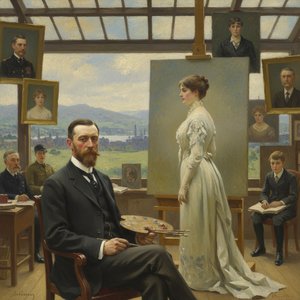
Sir John Lavery: A Study in Scottish Impressionism & the Portraiture of a Generation
Explore the life & art of Sir John Lavery, a master of Scottish Impressionism and renowned portraitist. Discover his captivating works, Irish heritage, and lasting legacy with OriginalUniqueArt.
Sir Joshua Reynolds' Meesterwerken: 25 Portretten van Elegantie & Status | OriginalUniqueArt
Ontdek de 25 meesterwerken van Sir Joshua Reynolds! Duik in de wereld van elegante portretten uit de 18e eeuw en bewonder zijn Grand Style. Vind museumkwaliteit reproducties & interieurinspiratie op OriginalUniqueArt.com.


