Schakel over naar print
 Lees meer







































 Voor kunstwerken of reproducties die aan één zijde groter zijn dan 105 cm (ongeveer 41 inch), wordt de lijst als een losse set verzonden. Deze methode garandeert een veilige levering en voorkomt schade tijdens het transport.


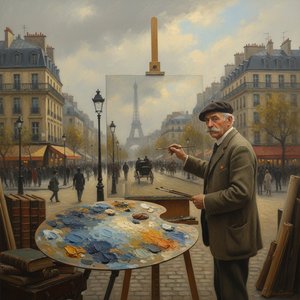
Cais da Farinha, carry us on the banks of the Seine, in Paris, the capital where the artist meets for the second time, now for a period of five years (1921-1926), and already with a path marked by the influence of his master of the School of Fine Arts of Lisbon and a naturalistic tradition, incorporated by Malhoa and Columbano. Technically, ready to develop new paths and to emancipate himself from the academic demands, Dórdio Gomes has joined the pictorial movement which will mark the history of European painting and open himself to the new constructive and formal concerns developed by Paul Cézanne, the postmodernist. This painting is an exercise of landscaping, in which the author paints outdoors, like the Impressionists did, in front of the motif, providing the chromatic changes of nature, at the precise moment of a day of charged atmospheric environment, in a scenario of distant perspective, making the outline of the horizon stand out, the silhouette of Notre-Dame. The right bank of the river, on rolling, winding earth, occupies the foreground of the observer, in search of the objects present, such as the car and boats moored in the waters of the Seine.
Veelgestelde vragen
Wat zijn de techniek en de datum van "Cais da Farinha, Paris" door Simão César Dordio Gomes?
"Cais da Farinha, Paris" werd in 1923 vervaardigd met de Oil-techniek. Materiaal en datum beschrijven hoe en wanneer het origineel is gemaakt.
Hoeveel mensen bekijken "Cais da Farinha, Paris"?
Er bestaat een Statistieken-pagina voor "Cais da Farinha, Paris". Deze brengt de maandelijkse bezoeken aan het kunstwerk en andere werken van de kunstenaar in kaart, met uitsplitsingen naar land en taal.
In welke stroming en in welk tijdperk kan "Cais da Farinha, Paris" door Simão César Dordio Gomes worden geplaatst?
"Cais da Farinha, Paris" door Simão César Dordio Gomes behoort tot de Modernism-stroming, uit de Moderne tijd-periode van de maker.
 Voorvertoning
 Verstuur
 Delen
Delen
 Details bekijken
 Gids
Gids

 Download
 Vergelijkbare items
 Röntgenonderzoek
 Diavoorstelling
 Q&A
Q&A Statistieken