Schakel over naar print
 Lees meer







































 Voor kunstwerken of reproducties die aan één zijde groter zijn dan 105 cm (ongeveer 41 inch), wordt de lijst als een losse set verzonden. Deze methode garandeert een veilige levering en voorkomt schade tijdens het transport.


A Symphony of Form and Color
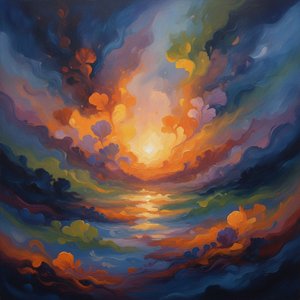
In the vast landscape of mid-century abstraction, few works capture the rhythmic tension between structure and spontaneity as masterfully as Serge Poliakoff’s Abstract Composition. Created in 1954, this piece serves as a profound testament to the artist's ability to translate complex human emotions into a visual language of pure geometry and vibrant pigment. At first glance, the eye is immediately arrested by a commanding red square that anchors the center of the canvas, acting as a heartbeat for the entire arrangement. This central weight is balanced by a delicate dance of smaller rectangles, blue triangles, and golden circles, creating a composition that feels both meticulously planned and organically alive. It is not merely a collection of shapes, but a carefully orchestrated movement where each element breathes alongside its neighbor.
The technique employed in this work reflects the essence of the Tachisme movement and the 'New' École de Paris, where the texture of the paint itself becomes a character in the narrative. Poliakoff’s approach to color is nothing short of symphonic; he utilizes a palette that ranges from deep, somber blacks and earthy greens to brilliant yellows and piercing blues. The interplay between these hues creates a sense of depth that invites the viewer to linger. As light seems to shift across the different planes of the canvas, one perceives a layered complexity—a mosaic of color where the boundaries between geometric precision and fluid, organic forms blur into a singular, captivating experience.
Historical Resonance and Emotional Depth
To understand this masterpiece, one must look toward the soul of its creator. Born in Moscow amidst the grandeur of Russian tradition and the spiritual gravity of Orthodox iconography, Poliakoff brought a unique duality to his work. This 1954 composition embodies that very tension: the struggle between order and chaos, between the rigid lines of modernism and the fluid, unpredictable nature of human feeling. The painting does not seek to represent the physical world, but rather to evoke the internal landscapes of the psyche. The way the blue triangle pierces the upper corner or how the yellow circle provides a moment of warmth amidst more structured elements suggests a cosmic balance, much like the celestial movements Poliakoff often sought to capture through abstraction.
For the discerning collector or the interior designer, this artwork offers more than just aesthetic beauty; it provides a focal point of intellectual and emotional intrigue. Its large-scale presence (81 x 100 cm) allows it to command a room, transforming a contemporary space into a gallery of contemplative thought. Whether placed in a minimalist setting to provide a burst of energetic color or integrated into a classic study to add historical weight, this reproduction of Poliakoff’s vision brings a sense of timeless sophistication. It is an invitation to rediscover the joy of pure abstraction—a piece that continues to resonate with the same vigor and mystery it possessed decades ago.
Veelgestelde vragen
In welk jaar werd "Abstract Composition" gemaakt?
"Abstract Composition" dateert uit 1954. Deze datum plaatst het werk binnen de carrière van Serge Poliakoff en het betreffende tijdperk.
In welke fase van de carrière van Serge Poliakoff valt "Abstract Composition", gezien de datum?
"Abstract Composition", vervaardigd in 1954, behoort tot de Mature Period van de carrière van Serge Poliakoff.
Hoe wordt de stemming van "Abstract Composition" door Serge Poliakoff beschreven?
"Abstract Composition" door Serge Poliakoff wordt qua stemming beschreven als Bold. Deze classificatie kan helpen om het werk te laten aansluiten bij een bepaalde omgeving.
 Voorvertoning
 Verstuur
 Delen
Delen
 Details bekijken
 Gids
Gids

 Download
 Vergelijkbare items
 Röntgenonderzoek
 Diavoorstelling
 Q&A
Q&A Statistieken