Schakel over naar print
 Lees meer







































 Voor kunstwerken of reproducties die aan één zijde groter zijn dan 105 cm (ongeveer 41 inch), wordt de lijst als een losse set verzonden. Deze methode garandeert een veilige levering en voorkomt schade tijdens het transport.


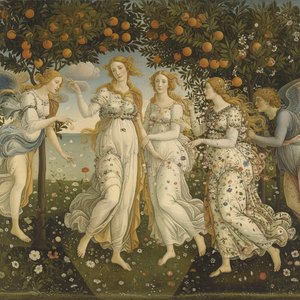
Primavera (detail) – A Renaissance Reverie
Sandro Botticelli’s “Primavera,” housed in the Uffizi Gallery of Florence, isn't merely a painting; it’s an invitation into a meticulously crafted dreamscape—a visual embodiment of rebirth and fecundity that continues to captivate audiences centuries later. Completed around 1482 during the height of Florentine artistic fervor under Lorenzo de’ Medici, this monumental panel depicts a vibrant celebration of spring, drawing heavily on classical mythology and humanist ideals.
Composition & Perspective: Orchestrating Beauty
The painting's genius lies in its masterful composition. Botticelli eschews traditional linear perspective, opting instead for a shallow depth that draws the viewer into the scene’s intimate embrace. Dominating the canvas are two figures—a woman adorned with flowers and surrounded by attendants—and a male nude embracing her. These central characters command attention, their intertwined hands symbolizing connection and perhaps hinting at the complexities of love. The surrounding foliage is rendered in dense detail, creating an illusion of lushness and movement that guides the eye across the expanse of the canvas.
Style & Technique: Delicate Flourishes of Color
Botticelli’s style is instantly recognizable—characterized by graceful lines, idealized forms, and a remarkable sensitivity to color. He employs sfumato techniques—a subtle blending of tones—to soften contours and create an ethereal atmosphere. Layers upon layers of thin glazes of oil paint achieve luminous effects, particularly noticeable on the skin tones and drapery fabrics. The artist’s meticulous brushwork contributes to a velvety texture that conveys both delicacy and grandeur.
Symbolism: Echoes of Classical Mythology & Renaissance Philosophy
"Primavera" is steeped in symbolism rooted in classical mythology and humanist philosophy. The figures represent Venus, Flora, Zephyr, Chloris, Mercury, and Cupid—each embodying virtues associated with springtime and fertility. Venus embodies beauty and love, while Flora represents the blossoming season. Zephyr, god of the west wind, brings warmth and vitality to the grove, and Chloris transforms into Flora, symbolizing regeneration. The inclusion of Cupid underscores the theme of desire and passion. Beyond these individual symbols, the painting speaks to broader concepts of harmony, balance, and the triumph of life over death—themes central to Renaissance thought.
Emotional Impact: Capturing a Moment of Transcendence
More than just aesthetically pleasing, “Primavera” evokes a profound emotional response. Its serene beauty and harmonious arrangement convey a sense of tranquility and wonder, transporting viewers back to the artistic milieu of Florence during its golden age. Botticelli’s masterful depiction of human form—particularly Venus—celebrates idealized femininity and embodies the humanist aspiration for perfection. The painting continues to inspire artists and collectors alike, serving as a testament to Botticelli's enduring legacy as one of the most influential painters of the Renaissance.
Veelgestelde vragen
Wat is de reden voor de auteursrechtelijke status van "Primavera (detail) (18)" door Sandro Botticelli?
"Primavera (detail) (18)" van Sandro Botticelli is bevindt zich in het publiek domein - de auteursrechten zijn verlopen. De auteursrechten worden berekend vanaf het jaar van overlijden van de kunstenaar; Sandro Botticelli is overleden in 1510.
Waarvoor wordt een afdruk van "Primavera (detail) (18)" aanbevolen?
De aanbevolen toepassing voor "Primavera (detail) (18)" door Sandro Botticelli is Accent. Het kan echter ook voor andere doeleinden worden gebruikt.
Kan ik "Primavera (detail) (18)" bekijken als een diavoorstelling op volledig scherm?
De diaporama van "Primavera (detail) (18)" is te bekijken op de Diavoorstelling-pagina van het kunstwerk.
 Voorvertoning
 Verstuur
 Delen
Delen
 Details bekijken
 Gids
Gids

 Download
 Vergelijkbare items
 Röntgenonderzoek
 Diavoorstelling
 Q&A
Q&A Statistieken