

 Voorvertoning
 Verstuur
 Delen
Delen
 Details bekijken

 Download
 Vergelijkbare items
 Röntgenonderzoek
 Diavoorstelling
Taking the Veil


 Lees meer
Giclée / Kunstafdrukken
Giclée- of canvasafdruk van museumkwaliteit met een snelle productie en flexibele afwerkingsmogelijkheden. ( Bestel handgeschilderde reproductie Koop afbeelding)




P118B $10

P118H $10

P118W $10

P438Z $10

P508JH $12

P508YH $12

P805H $10

P805Z $10

P919BZ $10

P919G $10

P919XJ $10

P959ZH $10

P968JZ $12

W106C $8

W218G $10

W218JH $8

W218Y $10

W307PJ $10

W316G $10

W316PJ $8

W316Y $10

W398PJ $8

W4111J $10

W500HY $15

W500JH $15

W692G $12

W849H $8

W940BG $15

W953PJ $8




Kies uit onze vooraf ingestelde maten die overeenkomen met de originele verhoudingen van het kunstwerk.

U kunt uw eigen afmetingen opgeven om in een specifieke lijst of ruimte te passen. Als de door u gekozen maat niet overeenkomt met de proporties van het originele kunstwerk, zullen wij de afbeelding bijsnijden of uitbreiden met een gespiegelde of effen rand. Een digitaal mockup wordt ter goedkeuring naar u verzonden voordat de productie begint.
Houd er rekening mee dat de preview op het scherm de werkelijke bijsneding of uitbreiding niet weergeeft. Alleen de mockup toont de uiteindelijke compositie nauwkeurig.
Hoewel aangepaste maten beschikbaar zijn, raden wij aan een afmeting uit de vooraf bepaalde lijst te kiezen om de originele proporties te behouden.
Wereldwijde levering () binnen 2 weken in plaats van de standaard 4/5 weken. (26 augustus)

Gratis wereldwijde expressverzending

Hoogwaardig linnen canvas

Volledige verzendverzekering

Garantie op terugbetaling van invoerrechten

Garantie op exacte kleurweergave

Retourbeleid van 60 dagen (alleen bij defecten)

100% Geld-terug-garantie

Korting bij meerdere afnames
 De optie voor glas is alleen beschikbaar bij een formaat kleiner dan 110 cm.

Taking the Veil
Giclée / Kunstafdrukken
Afmetingen reproductie
-


Eindtotaal
$ 81
Beschrijving verzamelobject
A Moment of Reflection: Robert Walter Weir’s “Taking the Veil”
Robert Walter Weir's "Taking the Veil," painted in 1863, is more than just a depiction of a religious ceremony; it’s a poignant tableau of faith, vulnerability, and societal expectations within mid-19th century America. This masterful work, housed today in the Yale University Art Gallery, offers a captivating glimpse into a specific historical moment while simultaneously resonating with universal themes of transformation and spiritual seeking. Weir, a prominent figure in the Hudson River School movement, skillfully blends realism with an almost ethereal quality, creating an image that is both grounded in observation and imbued with symbolic depth.
The scene unfolds within a richly detailed church interior – a red curtain dramatically framing the altar suggests a sense of solemnity and ritual. At the heart of the composition stands a young woman, poised on her knees before a priest. Her hands are raised, seemingly offering a veil she’s carefully removing from her head. This gesture is not merely one of modesty; it's an act of profound personal choice, a visible shedding of societal constraints and perhaps even a symbolic rejection of the rigid structures imposed upon women in that era. The figures surrounding her – the priest, other congregants – are rendered with careful attention to detail, each contributing to the overall atmosphere of reverence and quiet contemplation.
The Historical Context: Religion and Society in 1863
To fully appreciate “Taking the Veil,” it’s crucial to understand the social and religious landscape of America in 1863. The United States was grappling with profound changes – the Civil War raged, challenging established notions of identity and nationhood. Simultaneously, there was a growing tension between traditional Protestant values and the burgeoning Catholic community. While often viewed with suspicion and even hostility by some segments of American society, Catholicism was experiencing a period of significant growth, particularly in urban centers. Weir’s painting reflects this dynamic, capturing a moment of interaction – albeit one tinged with potential unease – between these two distinct religious groups.
The choice of depicting a nun taking her veil is itself significant. In the mid-19th century, convents were often viewed as places of refuge for women seeking an alternative to marriage and societal expectations. However, they also faced scrutiny and accusations of secrecy and undue influence. Weir’s portrayal humanizes this figure, presenting her not as a mysterious or potentially subversive element, but as a woman making a deliberate choice within the context of her faith.
Weir's Technique: Realism Infused with Romanticism
Weir was a master of capturing light and atmosphere, a hallmark of the Hudson River School. In “Taking the Veil,” he employs a carefully orchestrated use of chiaroscuro – dramatic contrasts between light and shadow – to draw the viewer’s eye to the central figure. The muted tones of the church interior create a sense of depth and intimacy, while the soft glow illuminating the woman's face emphasizes her vulnerability and resolve. His brushwork is precise yet expressive, conveying both meticulous observation and emotional resonance.
Notably, Weir’s training in Italy profoundly influenced his style. He studied the works of masters like Raphael and Michelangelo, absorbing their techniques for rendering human form and creating a sense of grandeur. This influence is evident in the painting's balanced composition, idealized figures, and attention to classical architectural details. However, unlike the purely academic approach favored by some of his contemporaries, Weir infused his work with a distinctly American sensibility – a focus on everyday life and the beauty of the natural world.
Symbolism and Emotional Impact
Beyond its historical context and technical merits, “Taking the Veil” is rich in symbolism. The veil itself represents both modesty and concealment, while its removal signifies liberation and self-discovery. The act of kneeling before the altar suggests a seeking of spiritual guidance and a connection to something larger than oneself. The painting evokes a sense of quiet contemplation, inviting viewers to reflect on themes of faith, choice, and the complexities of human experience.
More than just a historical record, “Taking the Veil” is a powerful meditation on the individual’s relationship with religion and society. It remains a compelling work of art, offering a poignant glimpse into a pivotal moment in American history and a timeless exploration of the human spirit.
Biografie van de kunstenaar
Robert Walter Weir: A Pioneer of Romantic Landscape Painting and Artistic Education
Robert Walter Weir (1803 – 1889) stands as a pivotal figure in the history of American art, recognized primarily for his contribution to the Hudson River School movement and his transformative role as an educator at the United States Military Academy. More than just a painter, Weir embodied a dedication to classical ideals blended with a profound appreciation for the natural world—a synthesis that profoundly impacted generations of artists and officers alike.- Early Life & Artistic Beginnings: Born in New Rochelle, NY, Weir’s formative years were marked by exposure to influential artistic mentors like Robert Cox (or Cook), who instilled foundational drawing skills. His self-directed study combined with brief instruction from Pietro Benvenuti in Florence solidified his commitment to mastering the techniques of Renaissance art.
- Italian Influence & Artistic Style: Weir’s journey to Italy between 1824 and 1827 proved decisive, immersing him in the masterpieces of Michelangelo and Raphael—artists whose compositional principles he diligently absorbed. This experience profoundly shaped his artistic style, characterized by meticulous detail, balanced compositions, and dramatic use of light and shadow, reflecting the grandeur and solemn beauty championed by the Hudson River School.
- Teaching at West Point: Weir’s appointment as Teacher of Drawing (1834–1846) and Professor of Drawing (1846–1876) at West Point represents arguably his most enduring legacy. He revolutionized art instruction, fostering a critical eye and cultivating creative problem-solving abilities within a cohort of future military leaders—including Ulysses S. Grant, Robert E. Lee, Jefferson Davis, and James Abbott McNeill Whistler—whose careers benefited immensely from his guidance.
- Iconic Landscapes & Historical Narratives: Weir’s artistic output is distinguished by monumental canvases that capture pivotal moments in American history with evocative symbolism and masterful execution. *The Embarkation of the Pilgrims*, commissioned for the U.S. Capitol rotunda, exemplifies this ambition—a powerful allegory of courage and faith that cemented his place as one of America's foremost landscape painters. Other notable works include *Landing of Hendrik Hudson,* *Evening of the Crucifixion,* and *Columbus before the Council of Salamanca*.
- Family Legacy & Artistic Influence: Weir’s artistic lineage extended beyond himself, with two sons pursuing careers in art—Julian Alden Weir and John Ferguson Weir—further amplifying the family's contribution to American art history. His dedication to fostering creativity and shaping young minds ensured that his influence would endure for decades to come.

Robert Walter Weir
1803 - 1889 , Verenigde Staten
Belangrijkste feiten
- Artistic Movement Or Style: Hudson River School
- Artists Or Movements Influenced By This Artist: ['Renaissance']
- Artists Who Influenced This Artist:
- Michelangelo
- Raphael
- Date Of Birth: 18 juni 1803
- Full Name: Robert Walter Weir
- Nationality: Amerikaans
- Notable Artworks:
- Embarkation of the Pilgrims
- Landing of Hendrik Hudson
- Evening of the Crucifixion
- Place Of Birth: New York City, Verenigde Staten
Gerelateerde artikelen

David Roberts: A Scottish Pioneer of Topographical Art & Orientalist Vision
Explore the captivating world of David Roberts, a pioneering Scottish painter renowned for his detailed Orientalist scenes & stunning Egyptian landscapes. Discover his legacy and find museum-quality reproductions at OriginalUniqueArt.
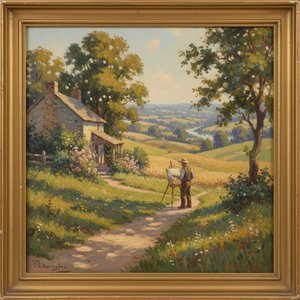
Julian Alden Weir: A Quiet Master of American Impressionism & Rural Life
Discover Julian Alden Weir, a leading American Impressionist painter celebrated for his serene landscapes & depictions of rural life. Explore his artistic evolution, influence on 'The Ten', and legacy at Weir Farm.

Robert Lillie: A Study in Victorian Genre Painting and Domestic Narrative
Explore the captivating Victorian genre paintings of Robert Lillie (1867-1949). Discover his serene Scottish landscapes and intimate domestic scenes, reflecting a unique artistic vision. Learn about his life, style & legacy.

Hubert Robert: Picturing Ruins, Preserving Memory – A Study of Romantic Antiquarianism & Artistic Innovation
Explore the captivating world of Hubert Robert, master of Romantic landscape painting & 'capriccio' ruins. Discover his historical context, artistic innovations, and collecting insights with OriginalUniqueArt.

The Refined Aesthetic of Victorian Illustration: A Study in Narrative & Technique
Explore the captivating world of Victorian illustration! Discover Pre-Raphaelite influences, key artists like Rossetti & Stephens, and the era's rich narrative detail. A deep dive for art enthusiasts.

