Minimalism · 1968
Untitled (Robert Morris, 1968)
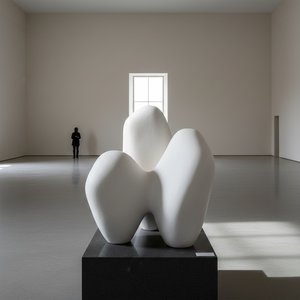
Robert Morris (1931–2018) maakte Untitled. Het dateert uit 1968. Het behoort tot de Minimalism-stroming. Het is gemaakt van Acrylic. Het is te vinden in Tate Modern in Londen, Verenigd Koninkrijk.
- 1968
- Acrylic
- Tate Modern, Londen

 Voorvertoning

 Met de hand geschilderd olieverfwerk
 Verstuur
 Delen
 Gids


 Download
 Vergelijkbare items
 Röntgenonderzoek
 Diavoorstelling
 Vraag & antwoord

 Statistieken
Untitled: de essentie
- Titel
- Untitled
- Kunstenaar
- Robert Morris (1931–2018)
- Geboren in [jaar]
- Kansas City, United States
- Datum
- 1968
- Medium
- Acrylic
- Te zien in
- Tate Modern, Londen, Verenigd Koninkrijk
- Beweging
- Minimalism
- Onderwerp
- sculpture, minimalism, organic, form, space, suspension
Wat stelt Untitled voor?
Robert Morris’s “Untitled”: A Meditation on Absence and Form
Robert Morris’s “Untitled,” created in 1968, stands as a cornerstone of Minimalism and a profound exploration into the very nature of perception within art. More than simply a sculpture, it's an invitation to contemplate the space between object and viewer, a deliberate rejection of representational imagery in favor of pure form and process. The piece, often realized in cast concrete or resin – though variations exist – presents a single, elongated form suspended from the ceiling, seemingly adrift within a stark white void. This simplicity is deceptive; it’s precisely this lack of overt narrative that generates such a powerful emotional response.
The sculpture's design deliberately avoids any immediately recognizable reference. It’s an organic curve, reminiscent perhaps of a fossilized stone or the attenuated form of a stretched root system – a subtle nod to the natural world without resorting to direct depiction. The surface is rarely smooth; instead, it bears the marks of its creation: subtle undulations, slight variations in tone, and even traces of the casting process itself. These imperfections aren’t flaws but integral elements of the work's philosophy, emphasizing the inherent materiality of the object and rejecting the illusionistic qualities of traditional sculpture. The deliberate roughness invites a tactile engagement, prompting us to consider the physicality of the piece and its relationship to our own bodies within the space.
The Philosophical Undercurrents of Minimalism
“Untitled” is deeply rooted in the burgeoning philosophical currents of the late 1960s. Minimalist artists like Morris were reacting against the perceived excesses of Abstract Expressionism, rejecting subjective emotion and personal expression in favor of a more objective approach to art-making. They sought to strip away all unnecessary elements – color, texture, narrative – leaving only the essential form and its relationship to space. Morris’s work directly engages with questions of perception: how do we see? How does our mind construct meaning from visual information? The sculpture's stark simplicity forces us to confront our own assumptions about art and representation.
Crucially, Morris wasn’t simply creating a visually pleasing object. He was interested in the *experience* of seeing – the way the form interacts with the surrounding space, the effect it has on the viewer’s perception of reality. The work's placement within a white room is deliberate; it isolates the sculpture and forces us to focus entirely on its shape and presence. This creates a sense of quiet contemplation, inviting viewers to slow down and engage with the artwork in a more mindful way.
Materiality and Process: A Key to Understanding
The choice of materials – typically cast concrete or resin – is significant. These durable, industrial substances lend an air of solidity and permanence to the sculpture, yet their inherent imperfections subtly undermine this sense of stability. The casting process itself becomes part of the artwork’s narrative; the marks left by the mold are not concealed but deliberately revealed, emphasizing the labor involved in its creation. This transparency – a key characteristic of Minimalism – invites us to consider the artist's hand and the physical processes that shaped the final form.
Morris often experimented with different casting techniques, manipulating the pour to create variations in texture and surface quality. These subtle differences contribute to the sculpture’s overall sense of ambiguity and complexity. The work is not about achieving a perfect, idealized form; it's about exploring the possibilities inherent within the materials and processes themselves.
Symbolism and Emotional Resonance
While “Untitled” resists easy interpretation, it evokes a powerful sense of stillness and contemplation. The elongated form suggests a reaching gesture – perhaps towards an unknown horizon or a deeper understanding – while its suspended position conveys a feeling of vulnerability and precariousness. The work’s simplicity can be surprisingly unsettling, prompting us to confront our own anxieties about the world and our place within it.
Ultimately, “Untitled” is not a statement but an experience. It's a reminder that art doesn't always need to tell a story; sometimes, its power lies in its ability to simply *be* – a quiet meditation on form, space, and the mysteries of perception. It remains a profoundly influential work, continuing to challenge our assumptions about what constitutes art and how we engage with it.
In welk museum bevindt Untitled zich?
Tate Modern
Londen, Verenigd Koninkrijk
De geschiedenis en de oorsprong van Tate Modern De aanwezigheid van Tate Modern in Londen, Verenigd Koninkrijk, is diep geworteld in de industriële geschiedenis van de skyline van Southwark. De locatie werd oorspronkelijk ingenomen door de Bankside Power Station, een imposante structuur die drie decennia lang in bedrijf was voordat deze uiteindelijk werd buitenbedrijf gesteld. Economische verschuivingen, in het bijzonder de stijgende olieprijzen, leidden ertoe dat de centrale op 31 oktober 1981 de deuren moest sluiten.


Untitled in hoge resolutie

Beschermd door auteursrecht: de afbeelding is uitsluitend ter referentie getoond.
Meer formaten, uitsneden & citatiegegevens →Robert Morris, Untitled (1968), Tate Modern.
Vragen over Untitled
Is "Untitled" vrij van auteursrecht?
Wat betreft het auteursrecht valt "Untitled" onder nog steeds auteursrechtelijk beschermd.
Hoe kan ik een reproductie van "Untitled" door Robert Morris bekijken?
Op de Voorvertoning-pagina van "Untitled" kunt u het kunstwerk bekijken voordat u bestelt.
Is "Untitled" door Robert Morris eerder licht of donker van kleur?
Wat betreft de waargenomen helderheid is "Untitled" door Robert Morris brilliant.
Hoe kan ik "Untitled" door Robert Morris bekijken als een diavoorstelling?
De diaporama van "Untitled" is te bekijken op de Diavoorstelling-pagina van het kunstwerk.
Welk gevoel roept "Untitled" bij u op?
De emotionele toon die is vastgelegd voor "Untitled" door Robert Morris is Reflective. Het vat het gevoel samen dat het werk uitdrukt.
Welke afmeting en oriëntatie worden aanbevolen voor een print van "Untitled" door Robert Morris?
Voor "Untitled" is de aanbevolen afdrukinstelling een formaat van Medium en een Portrait oriëntatie.
Wat is de reden voor de auteursrechtelijke status van "Untitled" door Robert Morris?
De auteursrechtstatus van "Untitled" - nog steeds auteursrechtelijk beschermd - is gebaseerd op het overlijden van de kunstenaar in 2018.
Hoe past "Untitled" binnen de thema's en stijl van Robert Morris?
"Untitled" deelt met andere werken van Robert Morris de Minimalism-stijl en de terugkerende thema's: minimalist abstraction, process-oriented, conceptual space, perceptual inquiry, deconstructed form, reduced elements, systematic approach, formal exploration.
In welke fase van de carrière van Robert Morris valt "Untitled", gezien de datum?
De datum uit 1968 plaatst "Untitled" in de Late Period van de ontwikkeling van Robert Morris.
Over de kunstenaar, Robert Morris

1931–2018, United States
Robert Morris
The Architect of Perception: The Life and Legacy of Robert Morris In the vast, often turbulent landscape of twentieth-century American art, few figures cast as long or as intellectually profound a shadow as Robert Morris. Born in 1931 in Kansas City, Missouri, Morris did not merely participate in the movements of his time; he provided the theoretical and physical scaffolding upon which much of contemporary art was built. His journey began with a rigorous multidisciplinary foundation, blending the precision of engineering with the expressive potential of fine art. This unique duality—the ability to dissect a form through a technical lens while simultaneously questioning its philosophical essence—became the hallmark of his career.
Ook van Robert Morris
 Document
 Bull Wall
Essays over Untitled
 The Subtlety of Form: Exploring Minimalism’s Evolution & Enduring InfluenceExplore the evolution of Minimalism with OriginalUniqueArt. Discover key artists like Judd & Martin, core principles, collecting insights, …
 The Subtlety of Form: Exploring Emotional Resonance in Minimalist ArtExplore the emotional depth of minimalist art with OriginalUniqueArt. Discover key artists like Agnes Martin & Donald Judd, investment pote…
 Drie Perspectieven, Één Ziel: De Emotionele Impact van Keuze in KunstreproductiesOntdek de emotionele impact van kunst! Lees over de psychologie achter reproducties en hoe kleur onze gevoelens beïnvloedt. Hoogwaardige ku…