Voorvertoning
 Verstuur
 Delen
Delen
 Details bekijken
 Gids
Gids

 Download
 Vergelijkbare items
 Röntgenonderzoek
 Diavoorstelling
 Statistieken
Les Amoureux de l


 Lees meer
De kunstwerken die op deze pagina worden weergegeven, zijn beschermd door de auteursrechtwetgeving, wat betekent dat het ons wettelijk niet is toegestaan om identieke reproducties te maken of te verkopen. Deze bescherming wordt gehandhaafd onder internationale overeenkomsten zoals de Conventie van Bern en door nationale wetgeving, waaronder de bepalingen van de Amerikaanse auteurswet - Titel 17. Alle rechten voorbehouden. Reproduceren of distribueren van afbeeldingen is niet toegestaan zonder uitdrukkelijke schriftelijke toestemming van WahooArt.com en de rechthebbenden.
Deze methode voldoet volledig aan de auteursrechtwetgeving, omdat het niet gaat om het kopiëren of dupliceren van het beschermde kunstwerk. In plaats daarvan is er sprake van een creatieve herinterpretatie — een nieuw schilderij dat door het origineel wordt geïnspireerd, maar er niet identiek aan is.
Giclée / Kunstafdrukken
Giclée- of canvasafdruk van museumkwaliteit met een snelle productie en flexibele afwerkingsmogelijkheden. ( Bestel handgeschilderde reproductie Schakel over naar digitale afbeeldingen)




P118B €10

P118H €10

P118W €10

P438Z €10

P508JH €12

P508YH €12

P805H €10

P805Z €10

P919BZ €10

P919G €10

P919XJ €10

P959ZH €10

P968JZ €12

W106C €8

W218G €10

W218JH €8

W218Y €10

W307PJ €10

W316G €10

W316PJ €8

W316Y €10

W398PJ €8

W4111J €10

W500HY €15

W500JH €15

W692G €12

W849H €8

W940BG €15

W953PJ €8




Kies uit onze vooraf ingestelde maten die overeenkomen met de originele verhoudingen van het kunstwerk.

Voer de gewenste breedte en hoogte in, passend bij uw lijst of muur. Een afdruk kan alleen worden ingekort en nooit groter worden gemaakt dan het origineel; een formaat met andere verhoudingen zal daarom een deel van de afbeelding verliezen. Wij sturen u een digitaal mockup ter goedkeuring voordat we tot drukwerk overgaan. De afbeelding op deze pagina toont niet de werkelijke uitsnede — dit is alleen te zien op het mockup.
Wereldwijde levering () binnen 2 weken in plaats van de standaard 4/5 weken. (27 oktober)

Gratis wereldwijde expressverzending

Hoogwaardig linnen canvas

Volledige verzendverzekering

Garantie op terugbetaling van invoerrechten

Garantie op exacte kleurweergave

Retourbeleid van 100 dagen (alleen bij defecten)

100% Geld-terug-garantie

Korting bij meerdere afnames
 De optie voor glas is alleen beschikbaar bij een formaat kleiner dan 110 cm.

Les Amoureux de l
Giclée / Kunstafdrukken
Afmetingen reproductie
-


Eindtotaal
€ 71
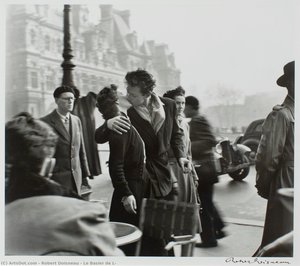
Les Amoureux de l'Opera: Een Parijse Moment Gefrozen in Tijd
Robert Doisneau’s “Les Amoureux de l’Opera” overstijgt simpelweg fotografische documentatie; het belichaamt de geest van het naoorlogse Parijs—een stad die worstelt met optimisme en melancholie, reikend naar verbinding tussen anonimiteit in de stad. Gefotografeerd in 1950, deze iconische afbeelding toont een jong stel dat omhelst op de traptreden van Hôtel de Ville (Gemeentelijk Gebouw), ondergedompeld in gedimde daglicht die een etherische kwaliteit geeft aan het beeld.
- Compositie & Perspectief: Doisneau gebruikt een licht gebogen perspectief, waardoor hij de grandeur van Hôtel de Ville benadrukt en de kijker naar boven trekt richting zijn imposante façade. Diagonaal lijnen die worden gemaakt door de trap snijden zich door horizontale lijnen gevormd door de muren van het gebouw, waardoor een dynamische visuele ritme wordt gecreëerd en een prachtige balans wordt bereikt.
- Technische Meesterschap: De briljantie van het beeld ligt in Doisneau’s meesterlijke gebruik van langzame sluitertijd—een techniek bekend als ‘bewegingsonscherpte.’ Deze bewuste manipulatie vangt vluchtige beweging op, waardoor de onscherpe figuren op de achtergrond worden omgezet in lichtstrepen die het beeld een gevoel van directe betrokkenheid geven en prachtige schoonheid verhoogt.
- Kleurenpalet & Textuur: Het geheel monochrome beeld maakt gebruik van een subtiele tonaliteit—variërend van diepe zwarttinten tot heldere witte tinten—om stemming en atmosfeer weer te geven. De gladde oppervlakte van de natuursteen traptreden contrasteert met de zachtere textuur die wordt gecreëerd door de onscherpte figuren, waardoor diepte en tactiele interesse aan de compositie worden toegevoegd.
Historische Context & Artistieke Stijl
Doisneau’s werk ontstond tijdens een periode gekenmerkt door significante sociale veranderingen in Frankrijk na de Tweede Wereldoorlog. Hij behoorde tot een generatie die documentaire fotografie omarmde als middel om het dagelijks leven weer te geven en emotionele resonans vast te leggen van gewone ervaringen. Doisneau’s stijl komt overeen met de principes van humanistisch realisme—een beweging gekarakteriseerd door zijn toegewijdheid aan het eerlijk en sympathiek weergeven van menselijke onderwerpen, vaak gericht op gemarginaliseerde gemeenschappen.
Symbolisme & Emotionele Impact
"Les Amoureux de l’Opera" spreekt krachtig over thema's liefde, intimiteit en kwetsbaarheid. Het omhelzen van het stel symboliseert verbinding tussen de drukke stad—een aangenaam herinnering dat zelfs in momenten van isolatie menselijke relaties blijven bestaan. Doisneau’s bewuste gebruik van bewegingsonscherpte onderstreept de vluchtige aard van tijd en ervaring, waardoor kijkers worden uitgenodigd om na te denken over schoonheid gevonden binnen voorbijgaande instanties.
Invloed & Erfenis
Doisneau’s afbeelding is geworden een symbool van Parijse charme en romantische idealisme. Het inspireert kunstenaars en ontwerpers nog steeds—een bewijs van Doisneau’s vermogen om gewone scènes te transformeren in onvergetelijke beelden die het essentieel gevoel voor emotie en artistieke visie vastleggen.
Veelgestelde vragen
Welke afmeting moet ik kiezen voor de print van "Les Amoureux de l" in mijn kamer?
De aanbevolen combinatie voor "Les Amoureux de l" door Robert Doisneau: een afdruk van Groot formaat in een Woonkamer.
Is "Les Amoureux de l" door Robert Doisneau eerder licht of donker van kleur?
Over het algemeen wordt "Les Amoureux de l" geregistreerd als gebalanceerd. De waargenomen helderheid beschrijft hoe licht of donker het werk oogt.
In welke stroming en in welk tijdperk kan "Les Amoureux de l" door Robert Doisneau worden geplaatst?
"Les Amoureux de l" behoort tot de Documentary Photography-stroming en de maker ervan was werkzaam in het Modern-tijdperk.
Biografie kunstenaar
A Parisian Chronicler: The Life and Legacy of Robert Doisneau
Robert Doisneau, born in Gentilly, France, in 1912, wasn’t merely a photographer; he was a visual poet of the streets, a chronicler of everyday life who captured the heart and soul of post-war Paris with an unparalleled blend of humanism, irony, and playful observation. His journey began amidst personal hardship – orphaned at a young age, raised by an unloving aunt – yet it blossomed into a career that celebrated the resilience and charm of the human spirit. Initially drawn to the technical arts, Doisneau trained in engraving and lithography at the École Estienne, skills that would later inform his compositional eye. However, it was the allure of the streets, the spontaneous narratives unfolding before him, that truly ignited his artistic passion. He began tentatively, reportedly photographing cobblestones to overcome initial shyness, gradually building confidence to capture the lives of children and adults in their natural environment.From Advertising to Artistic Vision
Doisneau’s early career was a pragmatic blend of necessity and opportunity. He navigated the world of advertising, working first as a draughtsman at Atelier Ullmann and later as a photographer for Renault. While these roles provided financial stability, they also fueled his growing interest in people and their interactions. His time at Renault, though ultimately cut short by his habitual tardiness, proved formative, exposing him to the possibilities of photography beyond mere commercial application. The late 1930s saw him join the Rapho photographic agency, a pivotal moment that allowed him to pursue street photography more seriously. This period coincided with the looming shadow of World War II, and Doisneau’s life took on another layer of complexity as he served in the French army and actively participated in the Resistance, utilizing his skills to forge documents for those fleeing persecution. It was a time of immense risk and moral responsibility, shaping his commitment to documenting the lives of ordinary people with dignity and respect.The Humanist Lens: Style and Influences
Doisneau’s photographic style is instantly recognizable – a masterful blend of candid observation, carefully composed framing, and a gentle, often ironic, perspective. He wasn't interested in grand narratives or dramatic events; instead, he found beauty and meaning in the mundane, the fleeting moments of everyday life. Influenced by masters like André Kertész, Eugène Atget, and Henri Cartier-Bresson, Doisneau developed his own unique voice, one that prioritized human connection over technical perfection. He possessed an extraordinary ability to anticipate and capture decisive moments, often with a touch of humor or whimsy. His work frequently features amusing juxtapositions, contrasting social classes, and eccentric characters, all set against the backdrop of bustling Parisian streets and cafes. Le Baiser de l'Hôtel de Ville (The Kiss by the Town Hall), his most iconic image from 1950, perfectly encapsulates this approach – a spontaneous moment of intimacy amidst the chaos of city life, an enduring symbol of love and freedom. He famously stated, “The marvels of daily life are so exciting; no movie director can arrange the unexpected that you find in the street.”A Legacy of Empathy and Observation
Throughout his career, Doisneau consistently championed the overlooked and marginalized. He had a particular fondness for children, portraying their play with seriousness and respect, recognizing their inherent dignity and freedom from adult constraints. His photographs offer a poignant glimpse into a post-war Paris rebuilding itself, grappling with social change, yet retaining its unique charm and spirit. While he briefly experimented with fashion photography for Vogue, his heart remained on the streets, capturing the authentic pulse of Parisian life. Despite receiving an invitation to join Magnum Photos from Henri Cartier-Bresson, Doisneau chose to remain with Rapho, valuing the agency’s independence and allowing him greater creative freedom. He was appointed a Chevalier (Knight) of the Legion of Honour in 1984, a testament to his significant contribution to French culture. Robert Doisneau passed away in 1994, leaving behind a vast body of work that continues to inspire and captivate audiences worldwide. His photographs are not simply records of a time and place; they are enduring celebrations of the human condition, reminding us to find beauty and meaning in the everyday moments that shape our lives.
Robert Doisneau
1922 - 1994 , France
Belangrijkste feiten
- Full Name: Robert Doisneau
- Nationality: French
- Date Of Birth: 1922
- Date Of Death: 1994
- Place Of Birth: Gennevilliers, France
- Notable Artworks: ["Le Baiser de l'hôtel de ville"]
- Artistic Movement Or Style: Humanist photography
- Artists Who Influenced This Artist:
- André Kertész
- Eugène Atget
- Henri Cartier-Bresson
Gerelateerde artikelen
Shadow & Soul: Why Black & White Photography Remains the Ultimate Power Move in Modern Art
Discover why black & white photography remains a powerful force in contemporary art. Explore the impact of light, shadow, and texture through a visual journey of monochrome mastery and learn how to elevate your space with timeless grayscale aesthetics.
Timeless Shadows: The Artistry, History, and Emotional Resonance of Black and White Photography
Explore the profound artistry of black and white photography. From historical mastery to the interplay of light and shadow, discover how monochrome captures timeless emotion and form through a sophisticated lens of art history.

Monochrome Visions: Exploring the Aesthetic & Historical Significance of Black & White Photography
Explore the rich history & artistic power of black and white photography. From early techniques to iconic masters like Ansel Adams, discover why monochrome continues to captivate art lovers today. Expert insights for collectors.
Beyond Color: The Timeless Power and Artistry of Black and White Photography
Explore the profound artistry of black and white photography. From the chemistry of gelatin silver to the chiaroscuro of the Old Masters, discover how monochrome captures the eternal essence of light, form, and emotion for the discerning art collector.

Top 10 Witte Meesterwerken: Kunstgeschiedenis & Interieurinspiratie
Ontdek de top 10 witte meesterwerken uit de kunstgeschiedenis! Van Monet tot Mondriaan, bewonder abstracte vormen & serene kleuren. Vind museumkwaliteit reproducties en interieurinspiratie op OriginalUniqueArt.com.