
 Voorvertoning
 Verstuur
 Delen
Delen
 Details bekijken
 Gids
Gids

 Download
 Vergelijkbare items
 Röntgenonderzoek
 Diavoorstelling
 Vraag & antwoord
 Statistieken
The Three Graces

- 207.0 x 173.0 cm


 Lees meer
Giclée / Kunstafdrukken
Giclée- of canvasafdruk van museumkwaliteit met een snelle productie en flexibele afwerkingsmogelijkheden. ( Bestel handgeschilderde reproductie Schakel over naar digitale afbeeldingen)




P118B €10

P118H €10

P118W €10

P438Z €10

P508JH €12

P508YH €12

P805H €10

P805Z €10

P919BZ €10

P919G €10

P919XJ €10

P959ZH €10

P968JZ €12

W106C €8

W218G €10

W218JH €8

W218Y €10

W307PJ €10

W316G €10

W316PJ €8

W316Y €10

W398PJ €8

W4111J €10

W500HY €15

W500JH €15

W692G €12

W849H €8

W940BG €15

W953PJ €8




Kies uit onze vooraf ingestelde maten die overeenkomen met de originele verhoudingen van het kunstwerk.

Voer de gewenste breedte en hoogte in, passend bij uw lijst of muur. Een afdruk kan alleen worden ingekort en nooit groter worden gemaakt dan het origineel; een formaat met andere verhoudingen zal daarom een deel van de afbeelding verliezen. Wij sturen u een digitaal mockup ter goedkeuring voordat we tot drukwerk overgaan. De afbeelding op deze pagina toont niet de werkelijke uitsnede — dit is alleen te zien op het mockup.
Wereldwijde levering () binnen 2 weken in plaats van de standaard 4/5 weken. (11 november)

Gratis wereldwijde expressverzending

Hoogwaardig linnen canvas

Volledige verzendverzekering

Garantie op terugbetaling van invoerrechten

Garantie op exacte kleurweergave

Retourbeleid van 100 dagen (alleen bij defecten)

100% Geld-terug-garantie

Korting bij meerdere afnames
 De optie voor glas is alleen beschikbaar bij een formaat kleiner dan 110 cm.

The Three Graces
Giclée / Kunstafdrukken
Afmetingen reproductie
-


Eindtotaal
€ 72
A Symphony in Pastel Hues – Exploring Robert Delaunay’s “The Three Graces”
Robert Delaunay's "The Three Graces," completed in 1912, stands as a cornerstone of Orphism and a testament to the transformative power of abstract color theory. Painted during a period of intense artistic experimentation—the Belle Époque giving way to the burgeoning avant-garde—this monumental canvas transcends mere representation, immersing viewers in a realm where form and pigment converge to evoke profound emotion.
- Subject Matter: The painting depicts three nude women – representing Grace, Fertility, and Charity – poised gracefully amidst a dynamic landscape populated by two horses. This classical allusion is deliberately disrupted by Delaunay’s radical approach to visual language.
- Style: Orphism, spearheaded by Delaunay alongside Sonia Delaunay, rejected traditional perspective and realism in favor of fragmented geometric shapes overlaid with vibrant pastel colors. The resulting aesthetic prioritizes sensation over intellect, aiming to stimulate the viewer's subconscious mind.
Technique – Embracing Simultaneity
Delaunay’s masterful technique exemplifies the core principles of Orphism. He employed a layering process—often applying paint in multiple stages—to achieve what he termed “simultaneity.” This meant that different areas of the canvas appeared to glow with independent color sources, creating an illusion of depth and movement without adhering to conventional spatial conventions.
- Color Palette: The painting’s palette is dominated by delicate shades of pink, peach, lavender, and turquoise—colors chosen not for their descriptive accuracy but for their expressive qualities. Delaunay meticulously calibrated hues to generate a harmonious visual experience that resonated with the emotional core of the artwork.
- Brushwork: Loose, gestural brushstrokes contribute to the painting’s dynamism, conveying a sense of energy and spontaneity. These marks are deliberately imprecise, rejecting meticulous detail in favor of capturing the fleeting beauty of light and color.
Historical Context – The Dawn of Abstract Expression
"The Three Graces" emerged from the crucible of artistic innovation that characterized early twentieth-century Europe. Influenced by Cézanne’s exploration of geometric simplification and Picasso’s groundbreaking Cubist experiments, Delaunay pushed boundaries further, anticipating developments in abstract expressionism decades later.
- Belle Époque Legacy: Despite its departure from academic traditions, the painting retains echoes of the Belle Époque aesthetic—particularly in its idealized depiction of feminine beauty. However, this classical reference is swiftly subsumed by Delaunay’s embrace of abstraction.
- Symbolism: The figures themselves embody universal themes of grace, fertility, and charity – concepts central to Christian iconography. Yet, Delaunay transforms these symbols into purely visual elements, prioritizing their emotive impact over doctrinal significance.
Emotional Resonance – Capturing the Essence of Beauty
Ultimately, “The Three Graces” succeeds in conveying a profound sense of serenity and wonder. The luminous colors and dynamic brushwork evoke feelings of tranquility and contemplation, inviting viewers to immerse themselves in a visual experience that transcends rational comprehension.
This remarkable artwork continues to inspire artists and collectors alike, serving as a poignant reminder of the transformative potential of color and form—a legacy firmly rooted in Delaunay’s pioneering vision of abstract art.
Veelgestelde vragen
In welk jaar werd "The Three Graces" gemaakt?
"The Three Graces" door Robert Delaunay werd gecreëerd in 1912.
Wat is het aanbevolen formaat en de oriëntatie voor de afdruk van "The Three Graces"?
Voor een afdruk van "The Three Graces" door Robert Delaunay wordt een formaat van Large aanbevolen in Portrait oriëntatie.
Hoe intens zijn de kleuren van "The Three Graces" door Robert Delaunay?
"The Three Graces" door Robert Delaunay heeft een Balanced kleurintensiteit.
Biografie kunstenaar
Robert Delaunay (1885-1941): A Pioneer of Abstract Color
Robert Victor Félix Delaunay, born in Paris on April 12, 1885, emerged as a pivotal figure in the radical artistic shifts of the early twentieth century. Though initially drawn to more traditional forms of painting—primarily decorative arts—his journey swiftly propelled him toward an exploration of color and light that would ultimately define his legacy and contribute significantly to the birth of abstract art. Delaunay wasn’t merely interested in *representing* the world; he sought to capture its very essence through a vibrant language of geometric shapes and luminous hues, co-founding the Orphism movement with his wife, Sonia Delaunay, and others who shared their vision. His early life was marked by instability—his parents divorced when he was young, and he was raised by relatives—but this perhaps fostered an independent spirit that would serve him well in challenging artistic conventions. He initially pursued decorative arts, but quickly gravitated towards painting, exhibiting at the Salon des Indépendants as early as 1904, demonstrating a burgeoning talent and ambition.Early Influences and Impressionistic Beginnings
Delaunay’s formative years were steeped in the aesthetic currents of his time. Like many artists of his generation, he absorbed the influence of Impressionism—particularly Georges Seurat—recognizing its groundbreaking use of color to capture fleeting moments of light and atmosphere. The shimmering effect achieved through the application of small, distinct dots of pigment—a technique known as Divisionism—became a cornerstone of his early artistic practice. This fascination with optical phenomena wasn’t merely stylistic; it reflected a deeper intellectual engagement with scientific theories about perception and color. He meticulously studied the work of Seurat and Cézanne, absorbing their compositional innovations and striving to emulate their mastery of tonal harmony. His initial paintings often depicted landscapes bathed in sunlight, capturing the beauty of nature through a delicate interplay of hues.Cubism: A Departure from Representation
A crucial turning point in Delaunay’s artistic development arrived with his encounter with Jean Metzinger and the burgeoning movement of Cubism. While he didn't fully embrace Léger’s analytical approach—which aimed to dissect objects into geometric components—Delaunay recognized the potential for abstraction within Cubist principles. He skillfully combined fragmented forms with bold color palettes, creating canvases that defied conventional notions of perspective and spatial illusion. Unlike Cézanne, who sought to depict the underlying structure of nature, Delaunay prioritized visual sensation above all else. This shift represented a decisive break from Impressionism’s preoccupation with capturing optical reality—a move toward an entirely new expressive language.The Birth of Orphism: Simultaneous Contrasts and Emotional Resonance
Delaunay's most distinctive contribution to modern art was undoubtedly the creation of Orphism, a term coined by Guillaume Apollinaire and which signaled a radical departure from established artistic traditions. Inspired by Nietzsche’s concept of “eternal recurrence”—the idea that life repeats itself infinitely—Orphism sought to evoke emotional responses through pure chromatic intensity. Delaunay championed the notion of *simultanéité*, arguing that colors interact with each other, generating new sensations and perceptions beyond what could be achieved through individual hues alone. This theoretical underpinning informed his artistic practice, resulting in paintings like “Simultaneous Contrasts: Sun and Moon,” where intersecting planes of color—often juxtaposed against complementary hues—created a dynamic visual experience. The Eiffel Tower series exemplifies this approach, demonstrating Delaunay’s ability to transform an iconic architectural symbol into a canvas brimming with energy and movement.Later Years and Enduring Legacy
The Second World War forced Delaunay and Sonia to relocate to Spain and Portugal, where they continued to produce artwork despite the hardships of exile. Upon returning to Paris in the 1920s, he explored diverse subjects—portraits, landscapes, and still lifes—but consistently upheld his core artistic convictions: color as a primary expressive force and abstraction as a pathway to profound emotional resonance. He undertook ambitious projects such as designing large-scale colored reliefs for the 1937 Paris International Exposition, showcasing his versatility as an artist and architect. Robert Delaunay’s untimely death in October 1941 marked a significant loss for the art world—however, his influence persists today. His pioneering work laid the foundation for subsequent developments in abstract art, establishing him as one of the foremost innovators of the modernist movement. He wasn't merely creating paintings; he was formulating a groundbreaking theoretical framework for understanding how color, light, and perception interact to shape our experience of reality—a legacy that continues to inspire artists across disciplines.
Robert Delaunay
1885 - 1941 , Frankrijk
Belangrijkste feiten
- Artistic Movement Or Style: Orphism, Cubisme
- Artists Or Movements Influenced By This Artist: ['Der Blaue Reiter']
- Artists Who Influenced This Artist: ['Paul Klee']
- Date Of Birth: April 12, 1885
- Full Name: Robert Victor Félix Delaunay
- Nationality: Frans
- Notable Artworks:
- Eiffel Tower
- Simultaneous Contrasts
- Windows Open Simultaneously
- Place Of Birth: Paris, France
Gerelateerde artikelen

From Cézanne to Cubism: The Revolutionary Evolution of Modern Art's Structural Vision
Explore the profound transition from Cézanne’s structural Post-Impressionism to the revolutionary fractured forms of Cubism. A sophisticated journey through the evolution of modern art for the discerning collector and connoisseur of fine art history.
Drie Perspectieven, Één Ziel: De Emotionele Impact van Keuze in Kunstreproducties
Ontdek de emotionele impact van kunst! Lees over de psychologie achter reproducties en hoe kleur onze gevoelens beïnvloedt. Hoogwaardige kunst voor uw interieur – met expert advies.
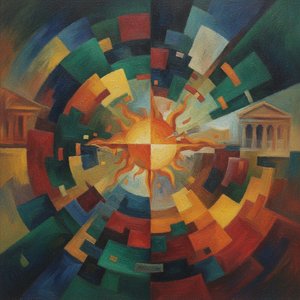
Orphism Unveiled: The Radiant Dance of Color and Light in the Evolution of Abstract Art
Discover the luminous world of Orphism. Explore how masters like Robert and Sonia Delaunay revolutionized art through a radiant dance of color, light, and geometric abstraction in this deep dive into modern art history.

Mastering Cubism: The Top 25 Georges Braque Artworks to Know
Journey through the revolutionary world of Georges Braque. From Analytical Cubism to iconic still lifes, explore 25 timeless masterpieces and find museum-quality art reproductions for your collection. Discover all masterpieces on OriginalUniqueArt.com.

Orphism: Decoding the Radiant Revolution of Color and Light in Modern Abstraction
Master the science of Orphism through our expert analysis of color and light. Explore the radiant revolution of modern abstraction now.

