Schakel over naar print
 Lees meer







































 Voor kunstwerken of reproducties die aan één zijde groter zijn dan 105 cm (ongeveer 41 inch), wordt de lijst als een losse set verzonden. Deze methode garandeert een veilige levering en voorkomt schade tijdens het transport.


A Poetic Tapestry of Script and Spirit
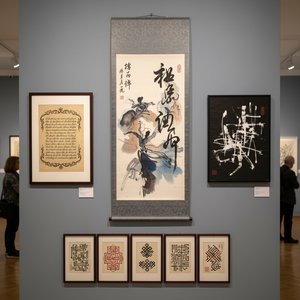
In the delicate interplay of ink and emerald, Geetāshtak emerges as more than a mere visual artifact; it is a profound meditation on the written word and its rhythmic soul. Created in 1926 by the legendary Bengali polymath Rabindranath Tagore, this piece serves as a bridge between the literary and the visual, where the boundaries of poetry and painting dissolve into one another. The artwork presents an intricate oriental script, flowing across the surface with a grace that suggests the very cadence of a song. Set against a lush, deep green background, the composition achieves a striking balance, allowing the fine details of the calligraphy to breathe while enveloping the viewer in a sense of tranquil, verdant depth.
The technique employed here reflects Tagore’s unique position as a pioneer of contextual modernism. Rather than focusing on representational imagery, the artist utilizes the aesthetic power of the script itself to evoke emotion. The meticulous attention to detail in each stroke suggests a rhythmic, almost musical quality—fitting for a work titled Geetāshtak, which hints at a collection of songs or verses. This approach invites the observer to look beyond the literal meaning of the characters and instead feel the movement, the weight, and the spiritual resonance of the ink as it dances upon the page.
Historical Resonance and Modern Elegance
To understand Geetāshtak is to understand the cultural renaissance of early 20th-century India. During a period when artists were seeking to reclaim their heritage while embracing modern sensibilities, Tagore stood at the forefront, blending traditional Indian aesthetics with a global, modernist vision. This piece captures that precise historical tension—the reverence for ancient script and spiritual tradition paired with a minimalist, almost abstract focus on form and color. It is a testament to an era where art was used to express a profound sense of identity and cosmic connection.
For the discerning collector or interior designer, this reproduction offers a sophisticated focal point that transcends mere decoration. The emerald tones provide a calming, organic energy, making it an ideal addition to spaces designed for contemplation, such as libraries, study alcoves, or serene living areas. Because the work relies on the evocative power of texture and tone rather than overt subject matter, it integrates seamlessly into both classical and contemporary interiors. It serves as a conversation piece that whispers of ancient wisdom and poetic beauty, bringing a touch of timeless, scholarly elegance to any curated environment.
Veelgestelde vragen
Op welke fase in de carrière van Rabindranath Thakur komt de datum uit 1926 van "Geetāshtak\n\n" overeen?
De datum uit 1926 plaatst "Geetāshtak\n\n" in de Late Period van de ontwikkeling van Rabindranath Thakur.
Is "Geetāshtak\n\n" door Rabindranath Thakur een licht of een donker kunstwerk?
De waargenomen helderheid van "Geetāshtak\n\n" door Rabindranath Thakur is brilliant. Deze kan worden afgestemd op de lichtinval in de beoogde ruimte.
Kan ik "Geetāshtak\n\n" door Rabindranath Thakur bekijken voordat ik bestel?
Een voorproefje van "Geetāshtak\n\n" door Rabindranath Thakur is beschikbaar op de Voorvertoning-pagina van het kunstwerk.
 Voorvertoning
 Verstuur
 Delen
Delen
 Details bekijken
 Gids
Gids

 Download
 Vergelijkbare items
 Röntgenonderzoek
 Diavoorstelling
 Q&A
Q&A Statistieken