
 Bekijk op ware grootte
 Verstuur
 Delen
Delen
 Details bekijken
 Gids voor studentenkunstwerken

 Download
 Vergelijkbare items
 Röntgenonderzoek
 Diavoorstelling
 Statistieken
George Weimer


 Lees meer
Handgemaakte olieverfreproductie
Met de hand geschilderd in olieverf op canvas in uw gewenste maat en lijst, op bestelling gemaakt door onze kunstenaars. ( Schakel over naar print Schakel over naar digitale afbeeldingen)




P118B €10

P118H €10

P118W €10

P438Z €10

P508JH €12

P508YH €12

P805H €10

P805Z €10

P919BZ €10

P919G €10

P919XJ €10

P959ZH €10

P968JZ €12

W106C €8

W218G €10

W218JH €8

W218Y €10

W307PJ €10

W316G €10

W316PJ €8

W316Y €10

W398PJ €8

W4111J €10

W500HY €15

W500JH €15

W692G €12

W849H €8

W940BG €15

W953PJ €8




Kies uit onze vooraf ingestelde maten die overeenkomen met de originele verhoudingen van het kunstwerk.

Voer de breedte en de hoogte in die u nodig heeft, passend bij uw lijst of uw muur. Dit is handgeschilderd, dus bij een afmeting met een andere vormverhouding kan de kunstenaar iets meer rondom het schilderij schilderen of juist iets meer weglaten — u kiest zelf. Wij sturen u een digitaal mockup ter goedkeuring voordat het schilderwerk begint. De afbeelding die op deze pagina wordt getoond, is niet het uiteindelijke resultaat — alleen de mockup geeft dit weer.
Na de bestelling zal het team van OriginalUniqueArt.com per e-mail contact opnemen met de klant voor instructies en een mockup-voorbeeld sturen.
Wereldwijde levering () binnen 3 tot 4 weken in plaats van de standaard 5 weken. (25 oktober). Zonder concessies aan de kwaliteit.

Gratis wereldwijde expressverzending

Hoogwaardig linnen canvas

Volledige verzendverzekering

Garantie op terugbetaling van invoerrechten

Garantie op exacte kleurweergave

Retourbeleid van 100 dagen (alleen bij defecten)

100% Geld-terug-garantie

Korting bij meerdere afnames
 De optie voor glas is alleen beschikbaar bij een formaat kleiner dan 110 cm.

George Weimer
Reproductiemethode
Formaat reproductie
-


Totaalprijs
€ 263
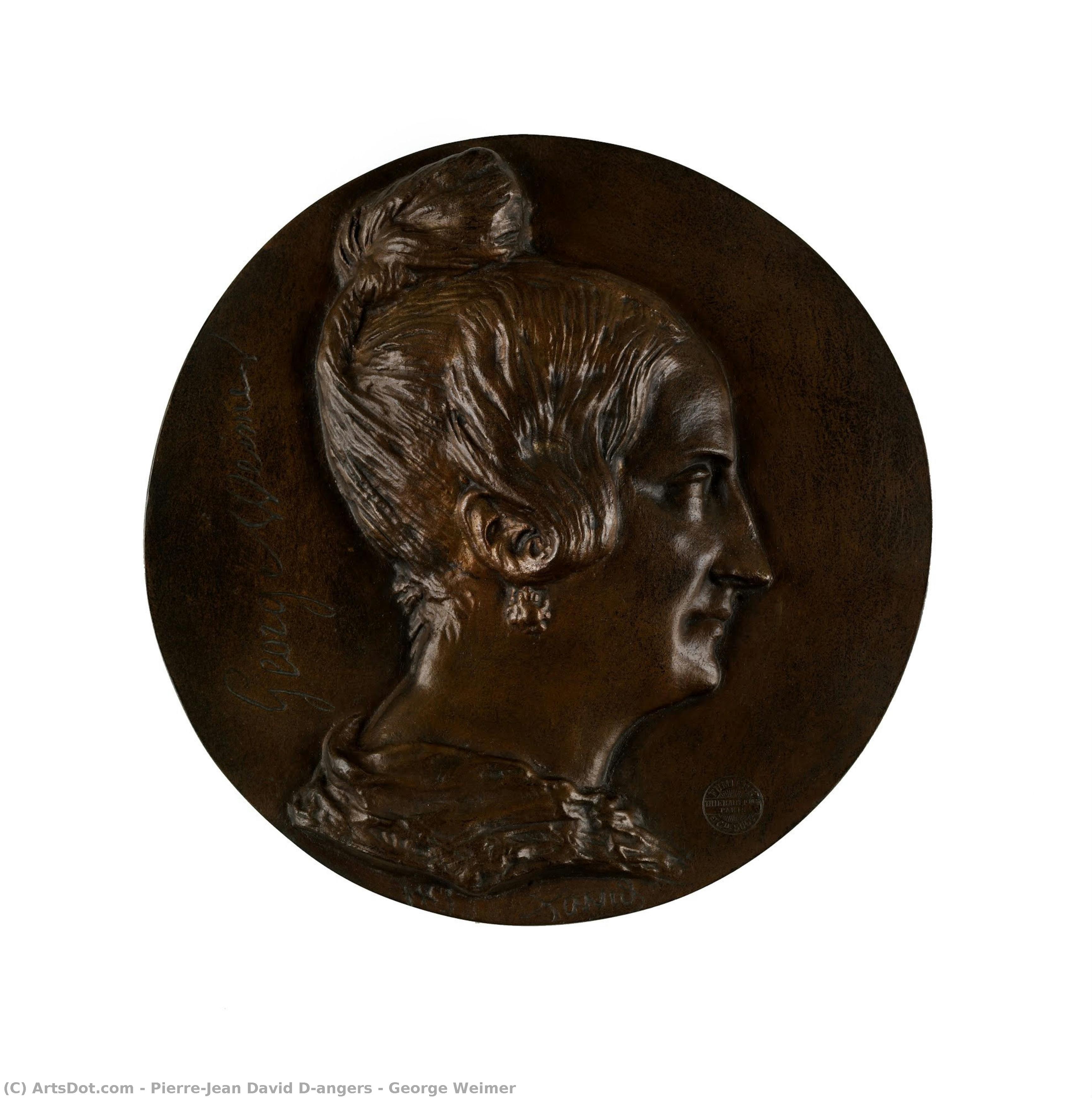
A Portrait of Romanticism: George Weimer by Pierre-Jean David d'Angers
The image before you isn’t merely a depiction of a man; it’s a window into the heart of 19th-century France, a poignant study in melancholy and quiet dignity. This captivating portrait of Marguerite-Josephine Weimer, known as Mademoiselle George, is a masterful work by Pierre-Jean David d'Angers, executed around 1833, and now meticulously reproduced for discerning collectors and admirers of Romantic art. David’s skill lies not just in capturing likeness, but in imbuing his subject with an almost palpable sense of introspection – a quiet sorrow that resonates deeply even across the centuries.
The composition itself is deceptively simple. A close-up view focuses on Weimer's face, rendered with exquisite detail. The bronze coin serves as a compelling backdrop, its smooth surface and intricate design offering a subtle contrast to the softness of her features. Her gaze, directed downward, speaks volumes – it’s not a look of defiance or anger, but rather one of quiet resignation, perhaps reflecting the challenges faced by a woman navigating the demanding world of Parisian theatre in an era where female performers often struggled for recognition and respect. The pearl necklace, a symbol of elegance and status, hints at her past successes, while the hat adds a touch of formality, suggesting a life lived within the constraints of societal expectations.
The Artist and His Time
Pierre-Jean David d'Angers (1788-1856) was a pivotal figure in French art during a period of dramatic social and political change. Born in Angers, he initially trained as a woodcarver before being drawn to the burgeoning world of sculpture. His early apprenticeship with Jacques-Louis David, the celebrated neoclassical painter, provided him with a rigorous foundation in artistic technique and a deep understanding of classical ideals. However, David d’Angers quickly developed his own distinctive style, embracing the emotional intensity and dramatic narratives characteristic of the Romantic movement. His work frequently explored themes of heroism, tragedy, and the human condition – subjects that mirrored the turbulent times he inhabited.
The portrait itself was created during a period of intense artistic experimentation and social upheaval. The Napoleonic era had left France profoundly changed, and artists were grappling with questions of identity, national pride, and the role of art in shaping public opinion. David d’Angers's decision to adopt the name “David d’Angers” – a deliberate homage to his master while asserting his own artistic lineage – reflects this complex interplay between tradition and innovation.
Symbolism and Emotional Resonance
Beyond its technical brilliance, the portrait is rich in symbolic meaning. The downward gaze of Weimer suggests introspection and perhaps a sense of isolation—a common theme within Romantic art. The coin, with its intricate details, could represent fleeting beauty or the ephemeral nature of fame. It’s a subtle reminder that even the most celebrated figures are ultimately subject to time and decay. The choice of bronze as the medium further enhances this sense of permanence and timelessness – a material chosen for its durability and ability to capture both form and texture with remarkable fidelity.
The portrait's emotional impact is undeniable. It’s not a celebratory depiction of beauty, but rather a poignant exploration of human vulnerability. Weimer’s expression invites the viewer to contemplate her story – her struggles, her triumphs, and ultimately, her enduring legacy as a captivating performer in a world that often failed to recognize her worth.
A Legacy Reimagined
This meticulously crafted reproduction captures not only the visual details of David d’Angers's original masterpiece but also its profound emotional resonance. Whether adorning a grand salon or a more intimate space, this artwork offers a captivating glimpse into the heart of Romanticism – a testament to the enduring power of art to illuminate the human experience. The quality of the reproduction ensures that every nuance of the original is faithfully preserved, allowing you to appreciate the artist’s skill and the subject's story with unparalleled clarity.
Consider this piece as more than just decoration; it’s an investment in a timeless work of art—a conversation starter, a source of inspiration, and a beautiful addition to any collection.
Vragen & Antwoorden
Welk onderwerp en welke sfeer combineert "George Weimer" door Pierre-Jean David D’Angers?
"George Weimer" door Pierre-Jean David D’Angers combineert french actress, romanticism, bronze coin, portrait, historical figure, 19th century, weimer met een Romantic atmosfeer.
Voor welke ruimte wordt "George Weimer" door Pierre-Jean David D’Angers aanbevolen?
Een reproductie van "George Weimer" past uitstekend in een Living Room.
Kan de afbeelding van "George Weimer" door Pierre-Jean David D’Angers vrij worden gereproduceerd?
"George Weimer" door Pierre-Jean David D’Angers is bevindt zich in het publiek domein - de auteursrechten zijn verlopen. Deze status bepaalt hoe de afbeelding van het werk mag worden gereproduceerd.
Biografie van de kunstenaar
A Legacy Forged in Stone: The Life and Art of Pierre-Jean David d’Angers
Born in Angers, France, in 1788, Pierre-Jean David began his artistic journey steeped in the republican fervor that would define much of his life and work. Initially apprenticed to a local wood carver – his father – young David quickly demonstrated an aptitude for sculpting that propelled him towards greater ambitions. He arrived in Paris in 1808, a city brimming with both classical tradition and revolutionary spirit, seeking tutelage under Philippe-Laurent Roland at the École des Beaux-Arts. This period was formative, grounding him in neoclassical principles while simultaneously exposing him to the burgeoning Romantic movement. A pivotal moment came in 1809 when he entered the studio of Jacques-Louis David, adopting the name “David d’Angers” not merely as a professional designation but as a conscious assertion of lineage and artistic ambition – a distinction from his celebrated master. This adoption signaled a desire to forge his own path while acknowledging the profound influence of the era's leading painter. Early struggles marked his Parisian years, yet he persevered, winning recognition with works like “Othryades” in 1810 and ultimately securing the prestigious Prix de Rome in 1811 for his sculpture "Epaminondas."Early Influences and Artistic Formation
David’s formative years were shaped by a confluence of artistic currents. His father, a skilled wood carver, instilled in him an appreciation for craftsmanship and meticulous detail – qualities that would permeate his sculptural practice throughout his career. Simultaneously, Roland at the École des Beaux-Arts imparted foundational knowledge of classical sculpture, emphasizing idealized form, harmonious proportions, and rational composition. These influences established a bedrock upon which David’s subsequent explorations of Romanticism could flourish. The arrival in Paris coincided with an explosion of artistic innovation fueled by revolutionary ideals. He absorbed the energy of this transformative period, recognizing its potential to inspire new forms of expression. His encounter with Jacques-Louis David proved particularly significant; David d’Angers consciously sought to emulate his master's stylistic prowess and intellectual rigor—a deliberate effort to transcend mere imitation and cultivate a distinctive artistic voice.The Roman Years: Classical Inspiration and Political Awakening
From 1811 to 1816, David embarked on a crucial pilgrimage to Rome – a city revered as the cradle of Western civilization and a bastion of classical learning. Under the tutelage of Antonio Canova, he honed his sculptural technique, mastering the subtleties of marble carving and embracing the aesthetic principles championed by the Neoclassical movement. However, Rome was more than just an academic destination; it served as a crucible for political awareness. The Bourbon Restoration shattered the illusions of republican idealism that had gripped France following Napoleon’s downfall—a disillusionment that fueled David’s conviction in the importance of portraying heroic figures who embodied moral virtue and civic responsibility. He diligently studied the sculptures of antiquity, absorbing their grandeur and restraint – qualities he would strive to recapture in his own works. This period solidified his commitment to classical ideals while simultaneously nurturing a burgeoning sensitivity to social and political issues.Rediscovering France: Engagement with Romanticism
David’s return to Paris in 1816 marked the beginning of a new chapter—one characterized by prolific artistic activity and engagement with the Romantic movement. He quickly established himself as a leading sculptor, securing commissions for monumental sculptures that celebrated national pride and commemorated historical events. His work on the Arc de Triomphe exemplifies his mastery of large-scale projects, demonstrating an ability to convey power and dynamism through sculpted form—a hallmark of Romantic artistic ambition. Simultaneously, he pursued portraiture with unwavering dedication, producing exquisitely detailed medallions that captured not only physical likeness but also psychological nuance—reflecting a shift toward emotional expression and subjective interpretation. His collaborations with writers like Victor Hugo and Goethe underscored his intellectual curiosity and his belief in the transformative potential of art to engage with profound philosophical questions. He championed republican ideals and actively opposed autocratic rule, aligning himself with progressive forces shaping French society during this turbulent era.A Monumental Legacy: Sculpture Beyond Neoclassicism
David’s artistic output spanned a remarkable range—from intimate portrait medallions to ambitious public monuments—establishing him as one of the most influential sculptors of his time. His sculptures—including “Wounded Philopoemen,” “La Douleur,” and “Epaminondas”—demonstrated an unparalleled ability to convey emotion and heroism through idealized form—a departure from the rigid conventions of Neoclassicism yet rooted in its foundational principles. The Pantheon frieze, commissioned for the bicentennial celebration of Voltaire’s birth, stands as a testament to his vision of civic grandeur—a monumental undertaking that embodies the spirit of Enlightenment ideals. His equestrian statue of Marshal Ney, erected in Paris during Napoleon III's reign, exemplifies his mastery of dynamic composition and sculptural technique—capturing the energy and momentum of military triumph. David’s enduring influence can be seen in countless subsequent sculptures—inspiring artists across generations to explore new expressive possibilities while upholding the legacy of classical tradition. He remains a sculptor whose work continues to resonate with audiences today—a figure who transformed the visual landscape of France and cemented his place as one of the nation's most revered artistic icons.
Pierre-Jean David D’Angers
1788 - 1856 , Frankrijk
Snelle feiten
- Artistic Movement Or Style: Neoclassicisme
- Artists Or Movements Influenced By This Artist: ['Romantiek']
- Artists Who Influenced This Artist:
- Jacques-Louis David
- Philippe-Laurent Roland
- Date Of Birth: 1788
- Date Of Death: 1856
- Full Name: Pierre Jean David d’Angers
- Nationality: Frans
- Notable Artworks:
- Wounded Philopoemen
- La Douleur
- Epaminondas
- Place Of Birth: Angers, France
Gerelateerde artikelen
Top 25 Meesterwerken Musée d'Orsay: Kunst, Geschiedenis & Decor Inspiratie
Ontdek de top 25 meesterwerken van het Musée d'Orsay! Van Monet’s impressionisme tot Van Gogh’s emotionele kracht. Leer over kunst, geschiedenis & vind perfecte reproducties voor uw interieur op OriginalUniqueArt.com.

Jacques-Louis David: Neoclassical Ideals & Revolutionary Witness
Explore the life & art of Jacques-Louis David, leading Neoclassical painter of the French Revolution. Discover iconic works like 'The Death of Marat' and his lasting impact on art history. Expert analysis & high-quality reproductions at OriginalUniqueArt.

Georges Braque's Top 25 Meesterwerken: Cubisme & Kunst voor uw Interieur
Ontdek de 25 meest iconische meesterwerken van Georges Braque, pionier van het Cubisme. Lees over zijn techniek, inspiratie & de impact op moderne kunst. Vind museumkwaliteit reproducties en verrijk uw interieur met OriginalUniqueArt.com!
Gerard David: Bridging Late Medieval Tradition with Early Renaissance Humanism
Explore the captivating world of Gerard David, a pivotal figure bridging late medieval artistry with the Early Renaissance. Discover his innovative techniques, religious masterpieces, and enduring legacy – a must-read for discerning art collectors.

Georges Seurat's Meesterwerken: 25 Iconische Schilderijen voor Kunstliefhebbers | OriginalUniqueArt
Ontdek de 25 meesterwerken van Georges Seurat! Duik in Pointillisme, Impressionisme & chromoluminarism. Bewonder 'A Sunday on La Grande Jatte' en meer. Museumkwaliteit kunst reproducties op OriginalUniqueArt.com.
