Olieverfversie
 Alles over The Boulevards







































 Voor kunstwerken of reproducties die aan één zijde groter zijn dan 105 cm (ongeveer 41 inch), wordt de lijst als een losse set verzonden. Deze methode garandeert een veilige levering en voorkomt schade tijdens het transport.


A Parisian Whisper: The Soul of The Boulevards
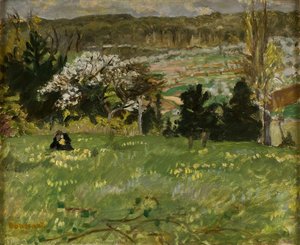
To step into Pierre Bonnard’s “The Boulevards” is to wander through a dream of fin de siècle Paris, where the bustling energy of the city is softened by a veil of poetic nostalgia. Created in 1900, this exquisite lithograph does not merely document a street scene; it captures the very breath of the Belle Époque. As a master of the Intimist movement, Bonnard moves away from the grand, sweeping gestures of traditional landscape painting to focus on the quiet, fleeting moments that define urban existence. The viewer is not an outsider looking in, but a silent participant, drifting alongside the figures strolling through a world rendered in a palette of muted greens, soft violets, and delicate pinks.
The composition possesses a deceptive simplicity that masks a profound emotional depth. Bonnard utilizes a subtly flattened perspective, compressing the space of the boulevard to draw the eye inward toward a towering architectural presence. This technique creates an intimate atmosphere, as if the city itself is leaning in to share a secret. The way the light filters through the scene—not with the harsh brilliance of the Impressionists, but with a diffused, ethereal glow—imbued the lithograph with a sense of timelessness. For the collector or interior designer, this piece offers a sophisticated balance of structure and softness, making it an ideal focal point for spaces that require a touch of historical elegance and contemplative calm.
Technique and the Art of Impressionistic Nuance
The technical mastery behind “The Boulevards” lies in Bonnard’s ability to use color as a vehicle for emotion rather than mere description. Executed as a lithograph on fine paper, the work showcases a remarkable command of tonal layering. By eschewing heavy outlines and traditional shading, Bonnard relies on overlapping planes of color to suggest depth and movement. The interplay between the cool greens and the warm, fleshy pinks creates a rhythmic vibration across the surface, mimicking the flickering movement of pedestrians and bicycles passing through the street. This approach reflects his roots in the Nabis group, where the decorative quality of the medium was just as vital as the subject matter itself.
Every stroke and color choice serves to evoke the atmosphere of a city in transition. There is a certain melancholy present in the muted tones, a reflection of the shifting social tides at the turn of the century. Yet, beneath this layer of nostalgia, there is an undeniable vibrancy—a pulse of life that remains even in the most subdued hues. For those seeking to adorn a home with art that tells a story, this reproduction provides more than just visual beauty; it offers a window into a vanished era of Parisian splendor, inviting a sense of romanticism and intellectual curiosity into any curated collection.
Veelgestelde vragen
Is The Boulevards handgeschilderd of een print?
Met de hand geschilderd: een professioneel kunstenaar kopieert The Boulevards in olieverf op linnen canvas.
Welke maat moet ik kiezen voor The Boulevards?
De afmetingen variëren van 28.0 x 35.7 cm (€179) tot 194.7 x 248.2 cm (€1589); in de tabel op deze pagina vindt u de verschillende opties en de bijbehorende prijzen.
Hoe lang duurt de bezorging?
De levertijd bedraagt 4 tot 5 weken, inclusief gratis wereldwijde expressverzending; op deze pagina wordt een optie voor spoedproductie aangeboden. U kunt het binnen 100 dagen zonder voorwaarden retourneren voor een volledige terugbetaling.
Waar is het origineel van The Boulevards?
Het origineel maakt deel uit van de collectie van het Detroit Institute of Arts, Detroit.
Welk medium heeft Pierre Bonnard gebruikt voor The Boulevards?
Lithograph
 Voorvertoning

 Verstuur
 Delen
 Details bekijken
 Informatieblad


 Download
 Vergelijkbare items
 Röntgenonderzoek
 Diavoorstelling
 Vraag & antwoord

 Statistieken