Schakel over naar print
 Lees meer







































 Voor kunstwerken of reproducties die aan één zijde groter zijn dan 105 cm (ongeveer 41 inch), wordt de lijst als een losse set verzonden. Deze methode garandeert een veilige levering en voorkomt schade tijdens het transport.


A Moment of Tranquility Captured by Bonnard
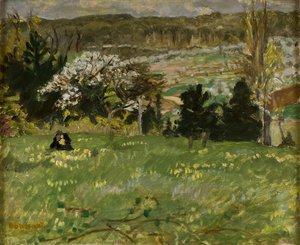
Pierre Bonnard’s “Summer in Normandy,” painted in 1912, isn't merely a depiction of a landscape; it’s an embodiment of Impressionism’s lingering influence and Bonnard’s distinctive approach to capturing the essence of domestic serenity. Currently residing at the Pushkin State Museum in Moscow, Russia, this oil on panel masterpiece transcends its physical dimensions, inviting viewers into a realm of muted hues and subtle textures that speak volumes about the artist's vision.
Composition and Style: Flattened Planes & Harmonious Color
The painting’s composition is deceptively simple yet profoundly effective. Bonnard skillfully arranges elements—a woman seated beneath an umbrella, a bench, a bed, and two chairs—to create a space that feels both inviting and contemplative. Characteristic of Bonnard's style, particularly aligned with the Nabis group, are flattened planes of color and a deliberate rejection of traditional perspective. This technique prioritizes tonal harmony and emotional resonance over precise realism, mirroring the stylistic sensibilities of artists like Édouard Vuillard.
Artist & Influences: Japanese Prints & The Poetics of Intimacy
Pierre Bonnard’s artistic journey was deeply impacted by Japonisme—the fascination with Japanese prints that gripped European art circles at the time. Like many Impressionists and Post-Impressionists, Bonnard sought to distill emotion and atmosphere into visual form, eschewing academic conventions for a more subjective experience. His exploration of interior spaces and quiet moments resonated with his contemporaries and continues to captivate audiences today. Notably, Bonnard’s work shares stylistic similarities with “Woman at Her Window,” another iconic piece showcasing Bonnard's masterful use of color and flattened planes.
Technical Detail: Mastering Color & Texture
Bonnard achieved his remarkable effects through meticulous brushwork and a careful consideration of pigment mixing. He employed a palette dominated by soft greens, yellows, and browns—colors that evoke the dappled shade of Normandy’s trees. Bonnard's technique involved layering thin glazes of color to build up tonal depth and create luminous surfaces. This painstaking process resulted in textures that are both tactile and visually stimulating, conveying a sense of warmth and stillness.
Symbolism & Emotional Impact: A Reflection of Inner Peace
"Summer in Normandy" transcends its visual description; it embodies the spirit of Intimism—a movement focused on portraying intimate scenes and capturing fleeting emotions. The woman’s posture beneath the umbrella symbolizes refuge from the outside world, while the surrounding greenery represents renewal and tranquility. Bonnard's ability to convey profound emotion through subtle color choices and understated composition underscores his enduring legacy as one of France’s most beloved painters.
Veelgestelde vragen
Hoe intens zijn de kleuren in "Summer in Normandy" door Pierre Bonnard?
"Summer in Normandy" door Pierre Bonnard heeft een Vivid kleurintensiteit.
Waar kan ik statistieken vinden over "Summer in Normandy" door Pierre Bonnard?
Er bestaat een Statistieken-pagina voor "Summer in Normandy". Deze brengt de maandelijkse bezoeken aan het kunstwerk en andere werken van de kunstenaar in kaart, met uitsplitsingen naar land en taal.
Hoe harmonieus is het kleurgebruik in "Summer in Normandy" door Pierre Bonnard?
De kleuren van "Summer in Normandy" door Pierre Bonnard vertonen een Softly Mixed Palette harmonie. Harmonie beschrijft de onderlinge relatie tussen de kleuren.
 Voorvertoning
 Verstuur
 Delen
Delen
 Details bekijken
 Gids
Gids

 Download
 Vergelijkbare items
 Röntgenonderzoek
 Diavoorstelling
 Vraag & antwoord
 Statistieken