Expressionism
Self-portrait (Paula Modersohn-Becker)
Paula Modersohn-Becker (1876–1907) maakte Self-portrait. Het behoort tot de Expressionism-stroming. Het is gemaakt van Oil On Canvas.
- Oil On Canvas

 Voorvertoning

 Met de hand geschilderd olieverfwerk
 Verstuur
 Delen
 Informatieblad


 Download
 Vergelijkbare items
 Röntgenonderzoek
 Diavoorstelling
 Vraag & antwoord

 Statistieken
Self-portrait, in het kort
- Titel
- Self-portrait
- Kunstenaar
- Paula Modersohn-Becker (1876–1907)
- Geboren in [jaar]
- Dresden, Duitsland
- Medium
- Oil On Canvas
- Beweging
- Expressionism
- Periode
- Modern
- Onderwerp
- woman, red hair, green shirt, face, eyes, wall
Wat stelt Self-portrait voor?
Identification of the Self-portrait
Self-portrait is a creation by the German Expressionist painter and draftswoman Paula Modersohn-Becker. This specific piece belongs to a vast body of work produced during her active life. The artist was born on 8 February 1876 in Dresden, Germany, and passed away on 30 November 1907 in Worpswede.
In this work, Paula Modersohn-Becker turns her gaze toward the viewer. The image captures a moment of quiet intensity through the artist's own likeness. It remains a direct encounter with her presence.
The Composition and Visual Details
The subject is positioned in front of a plain wall, seated in a manner that brings her face into sharp prominence. She wears a green shirt that contrasts with her red hair. Her hair is styled in an unconventional manner, contributing to the singular presence of the figure. The composition focuses heavily on the facial features, emphasizing a directness of gaze. Her eyes are open wide, looking straight ahead to meet the viewer's eyes with quiet intensity.
The arrangement of the figure against the background creates a sense of immediate, unmediated encounter. There is a notable focus on the psychological weight of the stare. The simplicity of the setting ensures that the viewer's attention remains fixed on the subject's expression and the specific arrangement of her features. This directness removes any sense of artifice from the encounter.
Technique and Artistic Medium
Executed in oil on canvas, this work exemplifies the principles of Expressionism. The medium allows for a directness of form that prioritizes the psychological state over mere physical likeness. Through the application of pigment, the artist achieves a sense of quiet intensity, focusing on the essential features of the face and the gaze to facilitate a moment of introspection.
The application of paint emphasizes a recognizable simplicity of form. This approach moves away from the atmospheric concerns of Impressionism, opting instead for a more structured and subjective visual language. The surface carries the weight of the artist's presence, using color and composition to explore the nuances of identity.
Where to See This Artwork Today
This work is held at the Paula Modersohn-Becker Museum in Bremen, Germany. The institution serves as a primary repository for the artist's output, housing a significant portion of her creative legacy.
Founded in 1927, the museum holds a unique position in art history as the first museum in the world devoted solely to a female artist. Its collection provides a comprehensive view of her development from her early training to her final years in Paris.
Related Works by the Artist
The artist's exploration of the self continued through several distinct phases of her career. In 1906, she produced Self-Portrait Looking Slightly Left, a work that shares a similar searching quality with her other studies of identity. During that same year, she completed Self-Portrait at 6th Wedding Anniversary, a piece that captures a specific moment of transition. This work is also known as Self-portrait on the sixth anniversary of marriage.
Earlier compositions reveal a different focus on objects and the female form. Around 1904, she created Self-Portrait with a bowl and a glass. Her interest in the intersection of the female form and the natural world is further evidenced in Self-Portrait with Two Flowers, where she cradles blossoms with a deliberate, steady intention.
Hoogwaardige afbeeldingen van Self-portrait
Publiek domein: de kunstenaar is overleden in 1907.
Paula Modersohn-Becker, Self-portrait. Publiek domein
Vragen over Self-portrait, beantwoord
Met welk medium is "Self-portrait" door Paula Modersohn-Becker uitgevoerd?
"Self-portrait" is uitgevoerd in Oil On Canvas.
Wat stelt "Self-portrait" door Paula Modersohn-Becker voor?
De onderwerpen van "Self-portrait" zijn woman, red hair, green shirt, face, eyes, wall.
Behoort "Self-portrait" door Paula Modersohn-Becker tot het publiek domein?
De auteursrechtelijke status van "Self-portrait" door Paula Modersohn-Becker: het werk is bevindt zich in het publiek domein - de auteursrechten zijn verlopen. Dit bepaalt of reproducties van de afbeelding vrijelijk mogen worden gemaakt.
Wie heeft "Self-portrait" gemaakt?
De kunstenaar achter "Self-portrait" is Paula Modersohn-Becker. Het werk is gecatalogiseerd onder de naam van Paula Modersohn-Becker.
Bij welke kunststroming behoort "Self-portrait" door Paula Modersohn-Becker?
De kunststroming die verbonden is aan "Self-portrait" door Paula Modersohn-Becker is Expressionism. Deze classificatie plaatst het werk binnen een context van verwante kunstenaars en kunstwerken.
Waarom heeft het kunstwerk "Self-portrait" deze auteursrechtelijke status?
De auteursrechtstatus van "Self-portrait" - bevindt zich in het publiek domein - de auteursrechten zijn verlopen - is gebaseerd op het overlijden van de kunstenaar in 1907.
Wat deelt "Self-portrait" met het overige oeuvre van Paula Modersohn-Becker?
"Self-portrait" behoort tot het Expressionism-werk van Paula Modersohn-Becker, waarvan de bekende thema's onder meer cézanne, gauguin, van gogh, identity and femininity, self-exploration and agency, pioneer of expressionism omvatten.
Hoe verhoudt het onderwerp van "Self-portrait" zich tot de gebruikelijke thema's van Paula Modersohn-Becker?
Binnen de bekende thema's van Paula Modersohn-Becker - cézanne, gauguin, van gogh, identity and femininity, self-exploration and agency, pioneer of expressionism - legt "Self-portrait" een eigen focus op woman, red hair, green shirt, face, eyes, wall.
Over de kunstenaar, Paula Modersohn-Becker

1876–1907, Duitsland
Paula Modersohn-Becker
Een Pionier van Innerlijke Visie: Het Leven en Werk van Paula Modersohn-Becker Paula Modersohn-Becker, een naam die resoneert met stille kracht in de annalen van de vroege moderne kunst, was een kunstenares die durfde naar binnen te kijken. Geboren als Minna Hermine Paula Becker op 8 februari 1876 in Dresden, Duitsland, was haar leven tragisch kort – ze overleed op 30 november 1907 in Worpswede – maar in die drie decennia smeedde ze een pad van opmerkelijke artistieke innovatie en persoonlijke moed. Haar verhaal is niet één van onmiddellijke roem of brede erkenning tijdens haar leven; het is eerder een bewijs van de aanhoudende kracht van een individuele stem die conventies uitdaagde en de diepten van de menselijke ervaring met compromisloze eerlijkheid onderzocht. Opgegroeid in een relatief bevoorrechte omgeving, binnen een familie getekend door een subtiele schaduw – haar oom had geprobeerd de koning van Pruisen te vermoorden – werden Paula’s artistieke neigingen gekoesterd, hoewel niet zonder maatschappelijke verwachtingen die op haar drukten.
Over Paula Modersohn-Becker Bekende werken van Paula Modersohn-Becker
Ook van Paula Modersohn-Becker
 Portrait of a young woman with red hat1900
 Half-length portrait of an old farmer1903
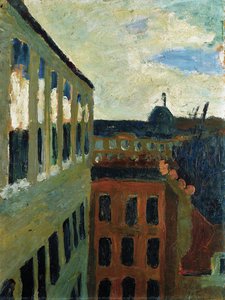 View from the studio window of the artist in Paris1900
 Still life with plant, lemon and orange1906
Essays over Self-portrait
 Polish artworks of the 1900sPolish Symbolism in the 1900s features masterpieces by Jacek Malczewski, Olga Boznańska, and Józef Mehoffer. View the full collection at Or…
 German artworks of the 1900sGerman Expressionism through the works of Franz Marc, Ernst Ludwig Kirchner, and August Macke. Find museum-quality reproductions on Origina…
 Egon Schiele's Top 25 Meesterwerken: Kunstprints voor een Unieke WoonstijlOntdek de 25 meest iconische werken van Egon Schiele! Duik diep in zijn expressionistische wereld vol intense portretten en emotionele krac…