Voorvertoning
 Verstuur
 Delen
Delen
 Details bekijken
 Gids
Gids

 Download
 Vergelijkbare items
 Röntgenonderzoek
 Diavoorstelling
 Statistieken
The Grammar


 Lees meer
Handgemaakte olieverfreproductie
Met de hand geschilderd in olieverf op canvas in uw gewenste maat en lijst, op bestelling gemaakt door onze kunstenaars. ( Schakel over naar print Schakel over naar digitale afbeeldingen)




P118B €10

P118H €10

P118W €10

P438Z €10

P508JH €12

P508YH €12

P805H €10

P805Z €10

P919BZ €10

P919G €10

P919XJ €10

P959ZH €10

P968JZ €12

W106C €8

W218G €10

W218JH €8

W218Y €10

W307PJ €10

W316G €10

W316PJ €8

W316Y €10

W398PJ €8

W4111J €10

W500HY €15

W500JH €15

W692G €12

W849H €8

W940BG €15

W953PJ €8




Kies uit onze vooraf ingestelde maten die overeenkomen met de originele verhoudingen van het kunstwerk.

Voer de breedte en hoogte in die u nodig heeft, passend bij uw lijst of uw muur. Omdat dit handgeschilderd is, kan de kunstenaar bij een afmeting met een andere beeldverhouding iets meer rondom het schilderij schilderen of juist iets meer weglaten — u kiest zelf. Wij sturen u een digitaal mockup ter goedkeuring voordat het schilderwerk begint. De afbeelding die op deze pagina wordt getoond, is niet het uiteindelijke resultaat — alleen de mockup geeft dit weer.
Na de bestelling zal het team van OriginalUniqueArt.com per e-mail contact opnemen met de klant voor instructies en een mockup-voorbeeld sturen.
Wereldwijde levering () binnen 3 tot 4 weken in plaats van de standaard 5 weken. (26 oktober). Zonder concessies aan de kwaliteit.

Gratis wereldwijde expressverzending

Hoogwaardig linnen canvas

Volledige verzendverzekering

Garantie op terugbetaling van invoerrechten

Garantie op exacte kleurweergave

Retourbeleid van 100 dagen (alleen bij defecten)

100% Geld-terug-garantie

Korting bij meerdere afnames
 De optie voor glas is alleen beschikbaar bij een formaat kleiner dan 110 cm.

The Grammar
Druktechniek
Afmetingen reproductie
-


Eindtotaal
€ 263
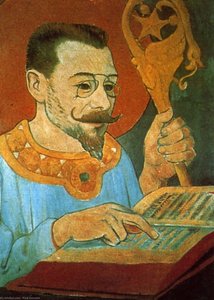
The Grammar: A Pioneering Exploration of Abstraction
Paul Sérusier’s “Grammar,” painted in 1892, stands as a pivotal work not just within the artist's oeuvre but also as a foundational piece in the development of modern art. More than simply a portrait, it’s an intensely personal and experimental exploration of color, form, and the very nature of representation – a bold step towards abstraction that profoundly influenced generations of artists to come. The painting depicts a woman seated on the ground, absorbed in reading a book, a scene rendered with remarkable intimacy and a deliberate departure from traditional academic styles.
Sérusier’s artistic journey was deeply intertwined with the burgeoning Nabis movement, a group of Symbolist painters who sought to move beyond mere imitation of nature towards expressing inner emotions and spiritual truths. He initially studied at the Académie Julian, but it was his summer sojourn in Pont-Aven, Brittany, that proved transformative. There, under the tutelage of Paul Gauguin – a figure whose influence extended far beyond technique – Sérusier encountered the revolutionary approach of Cloisonnism, championed by Gauguin himself. This style, characterized by sharply defined outlines and areas of flat color applied in small, separate strokes, aimed to mimic the appearance of stained glass, creating a sense of luminous clarity and symbolic resonance.
Cloisonnism and the Language of Color
“Grammar” exemplifies this Cloisonnism technique with striking precision. The woman’s figure is not rendered through subtle gradations of tone but rather defined by bold, distinct outlines – a deliberate simplification that prioritizes color and form over meticulous detail. Sérusier employs a vibrant palette, dominated by deep blues, greens, and ochres, creating an atmosphere both serene and slightly melancholic. The colors aren’t blended; instead, they are applied in small, separate strokes, building up layers of hue and texture. This technique, combined with the flattened perspective, creates a sense of immediacy and directness, as if the painting is capturing a fleeting moment of contemplation.
Crucially, Sérusier’s use of color isn't merely descriptive; it carries symbolic weight. The blues evoke a sense of introspection and mystery, while the greens suggest connection to nature – a key theme in Symbolist art. The muted ochres contribute to the painting’s overall feeling of quietude and contemplation. The deliberate choice of colors, rather than realistic representation, is central to the work's expressive power.
A Study in Form and Abstraction
Beyond its technical mastery, “Grammar” represents a significant shift towards abstraction. While not entirely devoid of recognizable forms – the woman’s figure, the book, the surrounding objects – the painting prioritizes the exploration of color and form over strict representation. The simplified shapes, flattened perspective, and emphasis on pure color anticipate later developments in abstract art, foreshadowing the work of artists like Kandinsky and Mondrian. It's a deliberate move away from photographic realism towards a more subjective and expressive approach to visual language.
The painting’s title, “Grammar,” is particularly intriguing. It suggests that Sérusier was not simply depicting a scene but rather exploring the fundamental building blocks of artistic expression – the elements of color, line, and form – in a way that transcends traditional representation. The book itself becomes a symbol of knowledge and contemplation, inviting the viewer to engage with the painting on a deeper level.
Legacy and Inspiration
“Grammar” remains a vital work in the history of modern art, demonstrating Sérusier’s pioneering spirit and his profound influence on subsequent generations. It's a testament to the power of abstraction to convey emotion, ideas, and spiritual truths. Reproductions of this evocative painting continue to inspire artists and collectors alike, offering a glimpse into the heart of artistic innovation and the enduring quest for new forms of visual expression.
Veelgestelde vragen
Wanneer is "The Grammar" door Paul Sérusier gemaakt en bij welke stroming behoort het?
"The Grammar" door Paul Sérusier dateert uit 1892 en behoort tot de Cloisonnism / Nabis.
Bij welke kunststroming behoort "The Grammar" door Paul Sérusier?
De kunststroming die verbonden is aan "The Grammar" door Paul Sérusier is Cloisonnism / Nabis. Deze classificatie plaatst het werk binnen een context van verwante kunstenaars en kunstwerken.
Hoe kan "The Grammar" door Paul Sérusier worden gebruikt in interieurdecoratie?
"The Grammar" wordt aanbevolen voor Reflective; de ideale plek hiervoor is een Living Room.
Biografie kunstenaar
Paul Sérusier: De Pionier van Abstractie en de Nabis
Paul Sérusier, geboren in Parijs op 9 november 1864 en overleden in Morlaix op 7 oktober 1927, was een Franse kunstenaar die een onmiskenbare rol speelde in de ontwikkeling van abstracte kunst. Hij behoort tot de invloedrijke groep de Nabis, maar zijn baanbrekende experimenten met kleur, vorm en compositie legden de basis voor veel latere ontwikkelingen in de moderne kunst.
Sérusier’s jeugd was gekleurd door een comfortabele achtergrond. Zijn vader, een succesvolle parfumeur, kon hem een goede opleiding bieden. Hij begon zijn artistieke reis op de École Fénelon, waar hij snel werd erkend als een uitzonderlijk talent. Een belangrijke invloed kwam echter via het bezoek aan de Académie Julian, waar hij kennismaakte met andere jonge kunstenaars en de werken van Paul Gauguin ontdekte – een ontdekking die zijn artistieke visie voorgoed zou veranderen.
De Invloed van Pont-Aven en Gauguin
In de zomer van 1888 reisde Sérusier naar Pont-Aven, een pittoresk dorp in Brittany. Daar sloot hij zich aan bij een kring van kunstenaars die onder leiding stond van Paul Gauguin. Onder Gauguin’s begeleiding experimenteerde Sérusier met nieuwe technieken en benaderingen. Een cruciaal moment was de schilderij *Le Talisman*, dat hij in 1888 maakte. Dit werk, een extreem voorbeeld van cloisonnism – een stijl gekenmerkt door dichte, afgebakende vormen en heldere kleuren – markeerde een belangrijke verschuiving naar abstractie. Gauguin’s advies om de werkelijkheid te interpreteren in plaats van letterlijk na te bootsen, vormde hierbij de basis.
De omgeving van Pont-Aven, met zijn ruige landschappen en mysterieuze bossen, inspireerde Sérusier enorm. Hij probeerde de essentie van de natuur vast te leggen in zijn schilderijen, waarbij hij zich concentreerde op het overbrengen van emoties en gevoelens in plaats van een exacte weergave van de omgeving.
De Nabis: Een Nieuw Artistiek Idiom
Samen met Gauguin, Maurice Denis, Pierre Bonnard en Édouard Vuillard richtte Sérusier de groep de Nabis op. De naam ‘Nabis’ verwijst naar het Hebreeuwse woord voor ‘profet’, wat duidt op hun streven om een nieuwe artistieke richting te bepalen. De Nabis-kunstenaars zagen zichzelf als volgers van Christ, die door hun kunst de wereld wilden verlichten. Hun werk kenmerkte zich door een expressieve kleurgebruik, het gebruik van platte vormen en een focus op symboliek.
Sérusier’s bijdrage aan de Nabis was cruciaal. Hij experimenteerde met verschillende technieken, waaronder cloisonnism en synthetism – een stijl die gericht was op het combineren van elementen uit verschillende kunststromingen. Zijn werk diende als inspiratie voor andere Nabis-kunstenaars en legde de basis voor de ontwikkeling van abstracte kunst in Frankrijk.
Belangrijke Werken en Erfgoed
Sérusier’s oeuvre omvat een reeks schilderijen die getuigen van zijn innovatieve stijl. Enkele bekende werken zijn *L'Averse* (1893), dat zich afspeelt in het Musée d'Orsay, Parijs; *Portrait of Paul Ranson* (1890), ook te zien in het Musée d’Orsay; en *The Snake Eaters* (1894), een krachtig beeld van de Bretonse landelijke cultuur, nu te vinden in het Nationaal Museum van Warschau. Zijn latere jaren brachten leswerk aan de École Ranson en de publicatie van zijn boek ‘ABC de la peinture’ in 1921.
Paul Sérusier’s nalatenschap is enorm. Hij wordt beschouwd als een pionier van abstracte kunst en een belangrijke invloedrijke figuur binnen de Nabis-beweging. Zijn experimenten met kleur, vorm en compositie hebben generaties kunstenaars geïnspireerd en de weg geëffend voor de ontwikkeling van moderne kunst.

Paul Sérusier
1864 - 1927 , Frankrijk
Belangrijkste feiten
- Artistic Movement Or Style: Post-Impressionisme
- Artists Or Movements Influenced By This Artist: ['Les Nabis']
- Artists Who Influenced This Artist:
- Paul Gauguin
- Maurice Denis
- Date Of Birth: 9 november 1864
- Date Of Death: 7 oktober 1927
- Full Name: Louis-Paul-Henri Sérusier
- Nationality: Frans
- Notable Artworks:
- Le Talisman
- L'Averse
- Melancholy
- Place Of Birth: Parijs, Frankrijk
Gerelateerde artikelen

Top 10 Abstract Expressionisme Meesterwerken: Kunst voor uw Interieur | OriginalUniqueArt.com
Ontdek de 10 meest invloedrijke werken van Abstract Expressionisme! Leer over Jackson Pollock, Mark Rothko & meer. Museumkwaliteit kunst reproducties voor uw interieur. Bekijk de collectie op OriginalUniqueArt.com.

Top 10 Meesterwerken van de Geometrische Abstractie | OriginalUniqueArt.nl
Ontdek de 10 meest invloedrijke meesterwerken van de geometrische abstractie! Van Mondriaan tot Malevich, leer over kunstenaars, technieken & kleuren. Museumkwaliteit reproducties op OriginalUniqueArt.com – voor een unieke interieurstijl.

Paul Cézanne's Top 25 Meesterwerken: Kleur, Vorm & De Basis van Modern Art | OriginalUniqueArt
Ontdek de 25 meest iconische schilderijen van Paul Cézanne! Duik in zijn kleurrijke wereld, leer over impressionisme & post-impressionisme en bewonder meesterwerken als 'De Baders'. Vind museumkwaliteit reproducties & interieurinspiratie op OriginalUniqueArt.com.
Paul Sérusier: Pioneering Synthetism & The Nabis’ Symbolic Revolution
Discover Paul Sérusier's pivotal role in the Nabis movement & the birth of Synthetism. Explore 'The Talisman,' his influence on modern art, and a deeper understanding of this symbolic revolution. Expert analysis & insights.

Paul Klee's Top 25 Meesterwerken: Kleur, Vorm & Emotie voor uw Interieur | OriginalUniqueArt
Ontdek de top 25 meesterwerken van Paul Klee! Duik in zijn kleurrijke wereld vol abstracte kunst, Bauhaus invloeden & expressieve composities. Vind museumkwaliteit reproducties en woondecoratie inspiratie op OriginalUniqueArt.com.