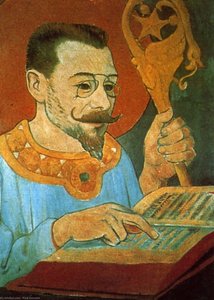
Bekijk op ware grootte
 Verstuur
 Delen
Delen
 Details bekijken
 Gids voor studentenkunstwerken

 Download
 Vergelijkbare items
 Röntgenonderzoek
 Diavoorstelling
 Statistieken
Celtic Tale
 Oil On Canvas
- WallArt
- Synthetist Painting
 1894
1894- 19th Century
 110.0 x 101.0 cm
 Dallas Museum of Art
 Lees meer
Handgemaakte olieverfreproductie
Met de hand geschilderd in olieverf op canvas in uw gewenste maat en lijst, op bestelling gemaakt door onze kunstenaars. ( Schakel over naar print Schakel over naar digitale afbeeldingen)




P118B €10

P118H €10

P118W €10

P438Z €10

P508JH €12

P508YH €12

P805H €10

P805Z €10

P919BZ €10

P919G €10

P919XJ €10

P959ZH €10

P968JZ €12

W106C €8

W218G €10

W218JH €8

W218Y €10

W307PJ €10

W316G €10

W316PJ €8

W316Y €10

W398PJ €8

W4111J €10

W500HY €15

W500JH €15

W692G €12

W849H €8

W940BG €15

W953PJ €8




Kies uit onze vooraf ingestelde maten die overeenkomen met de originele verhoudingen van het kunstwerk.

Voer de breedte en de hoogte in die u nodig heeft, passend bij uw lijst of uw muur. Dit is handgeschilderd, dus bij een afmeting met een andere vormverhouding kan de kunstenaar iets meer rondom het schilderij schilderen of juist iets meer weglaten — u kiest zelf. Wij sturen u een digitaal mockup ter goedkeuring voordat het schilderwerk begint. De afbeelding die op deze pagina wordt getoond, is niet het uiteindelijke resultaat — alleen de mockup geeft dit weer.
Na de bestelling zal het team van OriginalUniqueArt.com per e-mail contact opnemen met de klant voor instructies en een mockup-voorbeeld sturen.
Wereldwijde levering () binnen 3 tot 4 weken in plaats van de standaard 5 weken. (23 oktober). Zonder concessies aan de kwaliteit.

Gratis wereldwijde expressverzending

Hoogwaardig linnen canvas

Volledige verzendverzekering

Garantie op terugbetaling van invoerrechten

Garantie op exacte kleurweergave

Retourbeleid van 100 dagen (alleen bij defecten)

100% Geld-terug-garantie

Korting bij meerdere afnames
 De optie voor glas is alleen beschikbaar bij een formaat kleiner dan 110 cm.

Celtic Tale
Reproductiemethode
Formaat reproductie
-


Totaalprijs
€ 264
Paul Sérusier’s “Celtic Tale”: A Window into Synthetist Vision
Paul Sérusier's "Celtic Tale," painted in 1894, isn’t merely a depiction of a forest scene; it’s a profound exploration of light, color, and the nascent principles of abstract art. This oil on canvas, now residing within the Dallas Museum of Art, offers a captivating glimpse into the artist's innovative approach to capturing the essence of nature – a style he would later define as Synthetism. Born in Paris in 1864, Sérusier’s artistic journey was marked by a restless pursuit of new forms of expression, culminating in his groundbreaking work with the Nabis movement and his pioneering experiments with Cloisonnism.
The painting immediately draws the eye with its vibrant palette. Bold swathes of emerald green, sapphire blue, and ochre yellow dominate the composition, creating a sense of luminous intensity. These colors aren’t applied realistically; instead, Sérusier employs them in a flattened, almost geometric manner – a hallmark of Synthetism. He deliberately rejects traditional perspective, opting for simplified forms and strong contours that delineate shapes rather than mimicking their three-dimensional appearance. This technique, reminiscent of the decorative art of cloisonné enamelwork (hence “Cloisonnism”), creates an arresting visual effect, pulling the viewer into the heart of the scene.
The Spirit of Pont-Aven: Synthetism and its Roots
Sérusier’s artistic evolution was profoundly shaped by his summer sojourn in 1888 to Pont-Aven, a small village in Brittany. There, he encountered Paul Gauguin, who became a mentor and introduced him to the principles of Synthetism. Gauguin encouraged Sérusier to abandon academic realism and instead focus on capturing the *feeling* of a subject – its essence rather than its literal representation. This shift is powerfully evident in "Celtic Tale," where the forest itself becomes a symbolic entity, imbued with an almost mystical quality.
The painting’s composition echoes the work of Seurat and Signac, key figures in Pointillism and Neo-Impressionism, both movements that influenced Sérusier's development. However, unlike their meticulous application of tiny dots of color, Sérusier utilizes broader brushstrokes and bolder blocks of pigment to achieve a similar effect – creating an impression of light and atmosphere through the manipulation of color itself. The figures within the scene are deliberately simplified, almost dissolving into the surrounding landscape, further emphasizing the painting’s abstract qualities.
Symbolism Within the Scene: Nature, Community, and Mystery
Beyond its formal innovations, “Celtic Tale” is rich in symbolic meaning. The gathering of individuals amidst the forest evokes a sense of community and shared experience – a celebration of life and connection with nature. The two dogs present add to this feeling of warmth and conviviality. However, there’s also an underlying current of mystery and perhaps even melancholy. The cloaked figures, their faces obscured, suggest a ritualistic gathering, hinting at ancient Celtic traditions and the enduring power of myth.
The dappled sunlight filtering through the trees creates a sense of ethereal beauty, while the dark, rocky outcrop in the background provides a stark contrast, representing both obstacles and hidden depths. The painting’s overall mood is one of serene contemplation – an invitation to lose oneself in the beauty of the natural world and reflect on its timeless mysteries. It's a testament to Sérusier's ability to translate complex emotions and ideas into a visually arresting and deeply resonant work of art.
A Legacy of Innovation: Paul Sérusier’s Enduring Influence
Paul Sérusier’s “Celtic Tale” stands as a pivotal work in the history of modern art. It represents a crucial step towards abstraction, demonstrating the power of color and form to convey emotion and meaning independently of representational accuracy. His pioneering use of Synthetism paved the way for subsequent movements such as Fauvism and Cubism, solidifying his place as one of the most important figures in the development of 20th-century art. Reproductions of this captivating painting continue to inspire artists and collectors alike, offering a window into the visionary world of Paul Sérusier.
Vragen & Antwoorden
Welke techniek en stijl kenmerken "Celtic Tale" door Paul Sérusier?
"Celtic Tale" is vervaardigd in Oil On Canvas, in de Synthetist Painting-stijl.
Welke techniek is gebruikt voor "Celtic Tale" en wanneer is het gemaakt?
"Celtic Tale" werd in 1894 vervaardigd met de Oil On Canvas-techniek. Materiaal en datum beschrijven hoe en wanneer het origineel is gemaakt.
Welke stemming straalt "Celtic Tale" door Paul Sérusier uit binnen Synthetist Painting?
De Reflective emotie van "Celtic Tale" gaat samen met de Synthetist Painting stijl.
Biografie van de kunstenaar
Paul Sérusier: De Pionier van Abstractie en de Nabis
Paul Sérusier, geboren in Parijs op 9 november 1864 en overleden in Morlaix op 7 oktober 1927, was een Franse kunstenaar die een onmiskenbare rol speelde in de ontwikkeling van abstracte kunst. Hij behoort tot de invloedrijke groep de Nabis, maar zijn baanbrekende experimenten met kleur, vorm en compositie legden de basis voor veel latere ontwikkelingen in de moderne kunst.
Sérusier’s jeugd was gekleurd door een comfortabele achtergrond. Zijn vader, een succesvolle parfumeur, kon hem een goede opleiding bieden. Hij begon zijn artistieke reis op de École Fénelon, waar hij snel werd erkend als een uitzonderlijk talent. Een belangrijke invloed kwam echter via het bezoek aan de Académie Julian, waar hij kennismaakte met andere jonge kunstenaars en de werken van Paul Gauguin ontdekte – een ontdekking die zijn artistieke visie voorgoed zou veranderen.
De Invloed van Pont-Aven en Gauguin
In de zomer van 1888 reisde Sérusier naar Pont-Aven, een pittoresk dorp in Brittany. Daar sloot hij zich aan bij een kring van kunstenaars die onder leiding stond van Paul Gauguin. Onder Gauguin’s begeleiding experimenteerde Sérusier met nieuwe technieken en benaderingen. Een cruciaal moment was de schilderij *Le Talisman*, dat hij in 1888 maakte. Dit werk, een extreem voorbeeld van cloisonnism – een stijl gekenmerkt door dichte, afgebakende vormen en heldere kleuren – markeerde een belangrijke verschuiving naar abstractie. Gauguin’s advies om de werkelijkheid te interpreteren in plaats van letterlijk na te bootsen, vormde hierbij de basis.
De omgeving van Pont-Aven, met zijn ruige landschappen en mysterieuze bossen, inspireerde Sérusier enorm. Hij probeerde de essentie van de natuur vast te leggen in zijn schilderijen, waarbij hij zich concentreerde op het overbrengen van emoties en gevoelens in plaats van een exacte weergave van de omgeving.
De Nabis: Een Nieuw Artistiek Idiom
Samen met Gauguin, Maurice Denis, Pierre Bonnard en Édouard Vuillard richtte Sérusier de groep de Nabis op. De naam ‘Nabis’ verwijst naar het Hebreeuwse woord voor ‘profet’, wat duidt op hun streven om een nieuwe artistieke richting te bepalen. De Nabis-kunstenaars zagen zichzelf als volgers van Christ, die door hun kunst de wereld wilden verlichten. Hun werk kenmerkte zich door een expressieve kleurgebruik, het gebruik van platte vormen en een focus op symboliek.
Sérusier’s bijdrage aan de Nabis was cruciaal. Hij experimenteerde met verschillende technieken, waaronder cloisonnism en synthetism – een stijl die gericht was op het combineren van elementen uit verschillende kunststromingen. Zijn werk diende als inspiratie voor andere Nabis-kunstenaars en legde de basis voor de ontwikkeling van abstracte kunst in Frankrijk.
Belangrijke Werken en Erfgoed
Sérusier’s oeuvre omvat een reeks schilderijen die getuigen van zijn innovatieve stijl. Enkele bekende werken zijn *L'Averse* (1893), dat zich afspeelt in het Musée d'Orsay, Parijs; *Portrait of Paul Ranson* (1890), ook te zien in het Musée d’Orsay; en *The Snake Eaters* (1894), een krachtig beeld van de Bretonse landelijke cultuur, nu te vinden in het Nationaal Museum van Warschau. Zijn latere jaren brachten leswerk aan de École Ranson en de publicatie van zijn boek ‘ABC de la peinture’ in 1921.
Paul Sérusier’s nalatenschap is enorm. Hij wordt beschouwd als een pionier van abstracte kunst en een belangrijke invloedrijke figuur binnen de Nabis-beweging. Zijn experimenten met kleur, vorm en compositie hebben generaties kunstenaars geïnspireerd en de weg geëffend voor de ontwikkeling van moderne kunst.

Paul Sérusier
1864 - 1927 , Frankrijk
Snelle feiten
- Artistic Movement Or Style: Post-Impressionisme
- Artists Or Movements Influenced By This Artist: ['Les Nabis']
- Artists Who Influenced This Artist:
- Paul Gauguin
- Maurice Denis
- Date Of Birth: 9 november 1864
- Date Of Death: 7 oktober 1927
- Full Name: Louis-Paul-Henri Sérusier
- Nationality: Frans
- Notable Artworks:
- Le Talisman
- L'Averse
- Melancholy
- Place Of Birth: Parijs, Frankrijk
Gerelateerde artikelen
Beyond Impressionism: Exploring the Emotional Depth of Post-Impressionist Painting
Explore the profound emotional depth & innovative techniques of Post-Impressionism with OriginalUniqueArt. Discover Cézanne, Van Gogh, Gauguin & more – and their lasting impact on modern art.

Paul Klee's Top 25 Meesterwerken: Kleur, Vorm & Emotie voor uw Interieur | OriginalUniqueArt
Ontdek de top 25 meesterwerken van Paul Klee! Duik in zijn kleurrijke wereld vol abstracte kunst, Bauhaus invloeden & expressieve composities. Vind museumkwaliteit reproducties en woondecoratie inspiratie op OriginalUniqueArt.com.
Paul Sérusier: Pioneering Synthetism & The Nabis’ Symbolic Revolution
Discover Paul Sérusier's pivotal role in the Nabis movement & the birth of Synthetism. Explore 'The Talisman,' his influence on modern art, and a deeper understanding of this symbolic revolution. Expert analysis & insights.

Paul Cézanne's Top 25 Meesterwerken: Kleur, Vorm & De Basis van Modern Art | OriginalUniqueArt
Ontdek de 25 meest iconische schilderijen van Paul Cézanne! Duik in zijn kleurrijke wereld, leer over impressionisme & post-impressionisme en bewonder meesterwerken als 'De Baders'. Vind museumkwaliteit reproducties & interieurinspiratie op OriginalUniqueArt.com.

Top 10 Impressionistische Meesterwerken: Kleur, Licht & Emotie voor uw Interieur
Ontdek de top 10 impressionistische meesterwerken van Monet, Renoir & meer! Duik in kleur, licht en emotie met deze iconische schilderijen. Vind museumkwaliteit kunst reproducties voor uw interieur op OriginalUniqueArt.com.