Olieverfversie
 Alles over Non-Objective Composition (Suprematism)







































 Voor kunstwerken of reproducties die aan één zijde groter zijn dan 105 cm (ongeveer 41 inch), wordt de lijst als een losse set verzonden. Deze methode garandeert een veilige levering en voorkomt schade tijdens het transport.


Identification of Non-Objective Composition (Suprematism)
We are looking at Non-Objective Composition (Suprematism), a significant work by the Russian artist Olga Rozanova. Created in 1916, this piece represents a definitive moment in the artist's career as she moved toward the radical abstractions of the early 20th century. It is a work that belongs firmly to the Suprematism movement, a period defined by the pursuit of pure feeling through the reduction of form.
In this composition, Olga Rozanova moves away from the representational world to explore a new visual language. The work is a product of the intense experimentation occurring within the Russian avant-garde. By stripping away the distractions of recognizable objects, the artist focuses entirely on the relationship between color and geometry. It is a quiet, yet profound, departure from the traditions of the past.
Visual Composition and Geometric Elements
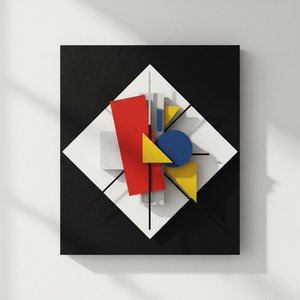
The composition is built upon a variety of geometric forms that interact within a white space. Primarily, the arrangement relies on rectangles and squares, each presented in different sizes and orientations. These shapes do not sit static; instead, they achieve a dynamic balance through their placement. Some forms overlap others, creating a sense of movement across the surface. This layering suggests a rhythmic, shifting energy that avoids a fixed center.
Color is applied in bold, flat applications, stripped of any gradients or shading. The palette is restricted to red, yellow, blue, and black. These saturated hues provide a sharp contrast against the pale, light background. By removing the illusion of depth or three-dimensional modeling, the work emphasizes the relationship between pure color and the flat plane. The interaction of these primary and neutral tones creates a visual tension that defines the entire structure.
Technique and Artistic Medium
In this work, the artist moves away from traditional oil on canvas to experiment with the tactile possibilities of collage on paper. This choice allows for a specific kind of spatial depth that paint alone might not achieve. By layering different materials, the composition gains a physical presence, where the edges of the forms feel deliberate and structural. It is a quiet departure from the heavy textures of earlier periods, favoring instead a more direct, flattened approach to the surface.
The interaction between the various geometric elements relies heavily on the interplay of translucency and opacity. Some shapes appear to possess a certain clarity, allowing the eye to perceive the layers beneath, while others remain dense and solid, anchoring the composition. This creates a sense of weightlessness and movement as the forms overlap. The way these elements intersect suggests a rhythmic, almost musical arrangement of color and light across the paper.
Artistic Context and Movement
This work emerged from the radical atmosphere of the Suprematism movement, a period of intense experimentation in the early 20th century. During this time, artists sought to move beyond the representational constraints of traditional painting, which they believed were obligated to mimic the visible world. Instead, they pursued a language of pure feeling, stripping away the distractions of the material world to reach a state of absolute non-objectivity. This piece is a key example of that shift, focusing on the essential relationship between color and form rather than the depiction of recognizable objects or scenes.
The composition is characterized by non-representational geometric abstraction. It functions as a vital bridge in art history, marking a moment where the boundaries between two-dimensional illusion and a non-representational surface began to blur. By utilizing simple, overlapping forms, the work signals a departure from traditional representation. It captures a transition where the focus moves from the object itself to the pure interaction of shapes within a space.
Reception and Influence on Later Art
This composition functions as a vital bridge within the evolution of modern abstraction. By moving away from the recognizable world, the work helps shift the movement toward the specific aesthetic stance of Suprematism. It moves beyond the structural fragmentation seen in earlier styles, opting instead for a language of pure feeling. This transition marks a moment where the focus shifts from the object itself to the fundamental relationship between color and form.
There is a certain foresight in how these shapes interact. The arrangement anticipates the flat picture plane, moving away from traditional three-dimensional illusion. We see here a precursor to later painterly abstractions that would define much of the coming century. The way color is handled also suggests a connection to the future, anticipating the poetic nuancing of color found in the works of some Abstract Expressionists. It is a quiet, significant departure from the material world.
Related Works by Olga Rozanova
To understand the trajectory of Rozanova's experimentation, one might look toward her earlier explorations of form and color. Around 1911-1912, she produced In a Café, a piece that utilizes thick lines and a specific palette to depict a man and a woman on opposite sides of a table. This work reflects a different stage of her development, moving through the influences of French avant-garde and Russian Neo-Primitivism. By 1913, her focus shifted toward the energy of Futurism, as seen in The Factory and the Bridge. This composition captures a sense of movement through its specific use of color and line.
Her evolution toward pure abstraction is further evidenced by other compositions within the Suprematist movement. A similar Non-Objective Composition (Suprematism) from 1916 is held in the Yekaterinburg Museum of Fine Arts. These works demonstrate her ability to organize space through the relationship of weight and color. Later, in 1917, she moved toward a more reductive approach with Green Stripe, a work that emphasizes the flat picture plane and the poetic nuances of color. These pieces collectively illustrate her movement from the depiction of recognizable subjects toward a language of pure, non-objective sensation.
Veelgestelde vragen
Is Non-Objective Composition (Suprematism) handgeschilderd of een print?
Met de hand geschilderd: een professioneel kunstenaar kopieert Non-Objective Composition (Suprematism) in olieverf op linnen canvas.
Welke maat moet ik kiezen voor Non-Objective Composition (Suprematism)?
De afmetingen variëren van 37.6 x 26.6 cm (€179) tot 240.0 x 169.5 cm (€1358); in de tabel op deze pagina vindt u de verschillende opties en de bijbehorende prijzen.
Hoe lang duurt de bezorging?
De levertijd bedraagt 4 tot 5 weken, inclusief gratis wereldwijde expressverzending; op deze pagina wordt een optie voor spoedproductie aangeboden. U kunt het binnen 100 dagen zonder voorwaarden retourneren voor een volledige terugbetaling.
Waar is het origineel van Non-Objective Composition (Suprematism)?
Het origineel maakt deel uit van de collectie van het Staats Russisch Museum, Sint-Petersburg.
Welk medium heeft Olga Rozanova gebruikt voor Non-Objective Composition (Suprematism)?
Collage
 Voorvertoning

 Verstuur
 Delen
 Details bekijken
 Informatieblad


 Download
 Vergelijkbare items
 Röntgenonderzoek
 Diavoorstelling
 Vraag & antwoord

 Statistieken