Schakel over naar print
 Lees meer







































 Voor kunstwerken of reproducties die aan één zijde groter zijn dan 105 cm (ongeveer 41 inch), wordt de lijst als een losse set verzonden. Deze methode garandeert een veilige levering en voorkomt schade tijdens het transport.


A Testament to Stoicism: Poussin’s Reverie in Corinth
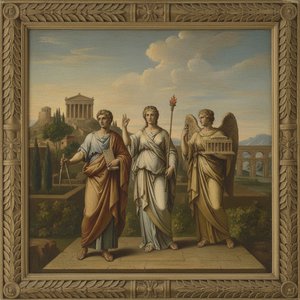
Nicolas Poussin, born in Le Havre in 1594, embodies the paradoxical spirit of his era – a painter deeply influenced by Italian Baroque aesthetics yet fundamentally committed to the austere ideals of classical stoicism. His artistic pilgrimage began in Paris during the early 1610s where he absorbed stylistic cues from contemporaries, but it was Rome in 1624 that truly cemented his legacy as one of France’s foremost Baroque artists and irrevocably shaped his artistic vision. This relocation wasn't merely geographical; it represented a profound engagement with antiquity, mirroring the burgeoning humanist movement that championed reason and virtue.- Subject Matter: The painting depicts a poignant scene centered around Eudamidas, an Athenian philosopher renowned for his unwavering friendship with two citizens who demonstrated extraordinary compassion after his passing. According to Lucian’s tale recounted in Roman literature, Eudamidas bequeathed his estate to these men, highlighting the importance of selfless devotion and moral responsibility – themes central to Stoic philosophy.
- Style: Poussin's distinctive style distinguishes itself from the opulent exuberance of the Baroque. Rather than prioritizing dramatic gesture or vibrant color palettes, he meticulously crafted compositions characterized by serene clarity and balanced perspective. This approach reflects a deliberate rejection of theatricality in favor of intellectual contemplation.
Technique: The Illusionistic Mastery of Trompe-l'œil
Poussin’s technique exemplifies the revolutionary advancements of trompe-l’œil – an illusionistic painting method that convincingly simulates reality. He skillfully employs atmospheric perspective, subtly modulating colors and tonal values to convey depth and distance. Careful attention to detail—the inclusion of a clock, a bowl, and a book—further enhances the scene's realism, immersing the viewer in a meticulously constructed space reminiscent of a hospital or similar institution. The artist’s meticulous brushwork contributes to an overall impression of understated elegance and intellectual precision.Historical Context: Stoicism’s Influence on Artistic Expression
The painting emerged during a period marked by significant philosophical debate concerning the role of reason in human affairs. Stoicism, championed by thinkers like Seneca and Epictetus, advocated for acceptance of fate and moral fortitude—principles that resonated deeply within the artistic circles of Rome. Poussin’s depiction of Eudamidas' friendship serves as a visual embodiment of these ideals: unwavering loyalty, selfless concern for others, and an acknowledgement of mortality – concepts explored extensively in classical literature and subsequently adopted by Renaissance artists.Emotional Impact: Tranquility Amidst Loss
Despite its subject matter—death—the artwork exudes a palpable sense of tranquility. Poussin’s masterful composition conveys not despair but rather dignified remembrance, capturing the essence of Stoic resilience. The muted color palette and harmonious arrangement invite contemplation, prompting viewers to consider themes of compassion, legacy, and the enduring power of human connection. It's a testament to Poussin’s ability to transform profound philosophical concepts into emotionally resonant visual narratives.Veelgestelde vragen
Welke plaatsing past bij het formaat van "The Testament of Eudamidas" door Nicolas Poussin?
Met zijn Landscape-formaat is een reproductie van "The Testament of Eudamidas" een prachtige aanvulling op een Living Room.
Welke ruimte past bij de kleuren van "The Testament of Eudamidas" door Nicolas Poussin?
Met zijn Monochrome palet wordt "The Testament of Eudamidas" door Nicolas Poussin aanbevolen voor een Living Room. De kleuren zijn een van de redenen voor dit advies.
Welke emotie straalt het Baroque Painting-werk "The Testament of Eudamidas" uit?
Binnen de Baroque Painting-stroming is "The Testament of Eudamidas" vastgelegd met een Reflective toon.
 Voorvertoning
 Verstuur
 Delen
Delen
 Details bekijken
 Gids
Gids

 Download
 Vergelijkbare items
 Röntgenonderzoek
 Diavoorstelling
 Q&A
Q&A Statistieken